

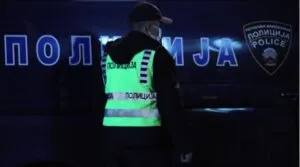
Someone Threw Flammable Liquid at a Shop in Central Skopje - and 17 Hours Passed Before Anyone Reported It
30.08.2026


30.08.2026

30.08.2026
30.08.2026
30.08.2026
30.08.2026

30.08.2026

30.08.2026
29.08.2026

28.08.2026

30.08.2026

30.08.2026

29.08.2026

30.08.2026

30.08.2026

30.08.2026

30.08.2026

29.08.2026

28.08.2026

30.08.2026

30.08.2026

30.08.2026

30.08.2026

30.08.2026

29.08.2026

09.03.2026

27.02.2026

19.02.2026
29.08.2026
28.08.2026
27.08.2026

23.04.2026

23.04.2026

12.04.2026

First the CIA director goes to Moscow. Two days later Lukashenko arrives in Moscow too. That is not a schedule - that is a response.
Belarusian President Alexander Lukashenko travelled to Moscow for talks with Vladimir Putin, and Minsk officially announced that security would be one of the main topics. He arrived on 27 August, two days before his scheduled meeting with Putin on 29 August, having earlier also spoken with Russian Prime Minister Mikhail Mishustin.
The word that matters most in the statement
Minsk announced that Putin and Lukashenko would discuss the key directions of bilateral cooperation, international and regional issues - and security. That last word is the one carrying the weight, given that Russia and Belarus already have a joint Treaty on Security Guarantees of the Union State, and representatives of the two countries specifically reviewed the situation on the borders this year.
"We planned this meeting long ago, before the meeting with the president of Russia. Tomorrow we will discuss many issues with him," Lukashenko said after his talks with Mishustin. He effectively guaranteed that Minsk would deliver everything agreed with Moscow - from fuel and food supplies to more serious systemic projects. "Everything we planned is being implemented and will be implemented," he said. He specifically noted that the two countries had reached full understanding on joint projects in the military-industrial complex as well.
The exercises that have already taken place
That is why today's talks do not start from zero. In May the Belarusian armed forces held exercises with Russian nuclear weapons deployed in the country. The Belarusian defence ministry openly announced at the time that units would practise taking receipt of nuclear munitions, preparing them for use, moving them covertly and deploying them at various locations.
A few days later Putin and Lukashenko observed the first joint Russian-Belarusian exercises on the command of strategic and tactical nuclear forces. Putin said then that nuclear weapons are an "extreme and exceptional measure", but also that Russian-Belarusian nuclear forces should remain the guarantor of the security of the entire Union State.
July brought new weaponry, changes at the top of the military, expanded training in drones and counter-drone warfare, and a further convergence of Russian and Belarusian military structures.
That does not mean a decision has been taken for the Belarusian army to enter the war in Ukraine. In June Lukashenko even said he does not want war with Ukrainians and warned Kyiv not to drag his country into the conflict. But Minsk is clearly preparing the country for a scenario in which the current crisis could widen further.
The first visit by a CIA chief since 2021
It is the timing that draws attention. Only days earlier, CIA director John Ratcliffe was in Moscow. That was the first publicly known visit by a CIA chief to Russia since 2021, when William Burns came to warn Moscow over Ukraine.
According to reports citing informed sources, Ratcliffe carried a different message this time - do not attack NATO. According to new American intelligence assessments, Washington is considering the possibility that Russia might attempt a limited action against a member of the Alliance to check whether the collective defence system really works. The Baltic states are named as the most sensitive space.
Donald Trump rejects such a scenario and says he does not believe Putin will attack NATO, while the Kremlin called the stories of Russian preparations speculation. Nevertheless, sources confirmed that during the talks in Moscow Ratcliffe did in fact raise the question of possible Russian operations against the Alliance.
Why Belarus is the key
In such a scenario the position of Belarus becomes decisive. The country borders Poland, Lithuania, Latvia and Ukraine. Russian tactical nuclear weapons are on its territory. It has a joint system of security guarantees with Moscow.
In other words: every scenario of Russian pressure on NATO's eastern flank runs through Belarusian territory. This is not an ally that merely votes on Moscow's side - this is geography.
An added problem is that NATO is simultaneously reinforcing its eastern flank, while the American Pentagon is asking European allies to take on a larger share of responsibility for their own defence. The Alliance officially designates Russia as a long-term threat to Euro-Atlantic security. Minsk, for its part, claims that it is precisely NATO's military build-up along the Belarusian borders that constitutes a threat to the Union State.
The two presidents will meet again only days later in Bishkek, at the Shanghai Cooperation Organisation summit on 31 August and 1 September. That is exactly why what Putin and Lukashenko have to agree privately in Moscow before that summit matters more - because what gets agreed in front of the cameras has usually already been settled behind them.
The latest 10 news from this category
The largest war in Europe since 1945 has been given a new explanation in front of a student audience. Not...
The army that came to power in a coup is now defending that power from its own soldiers. The same...
Russia does not need an invasion to test NATO. According to a former Ukrainian ambassador, one border town held for...
A Syrian court handed down a death sentence in absentia, and to the question about extradition the Kremlin replied by...
Кралот Харалд им се извинил на саамскиот народ додека бил на функција, а не во мемоари четириесет години подоцна. Неговиот...
The Red Cross admits it has no full picture of the disaster. The government is simultaneously turning down foreign rescue...
It was hit inside the economic zone of a NATO and EU member, not in Ukrainian waters. Three questions remain...

The German manufacturer published the batch number, the date and the right to a refund without a receipt. How often...
Europe's longest-reigning monarch has died, and the succession went through without a single day's gap. We know rather different transfers...
The first visit by a CIA director to Russia since 2021. Intelligence assessments say Moscow does not feel cornered -...
This site uses cookies - is that okay? Learn more
Be the first to know when Metla launches something new
Leave your email and we will write when there is a new guide or something new on Metla.
