Six reports in 24 hours: violence in the Macedonian family runs on a schedule, and the institutions arrive last
29.08.2026


29.08.2026

29.08.2026

29.08.2026

29.08.2026

29.08.2026

29.08.2026
29.08.2026
28.08.2026

27.08.2026

29.08.2026

29.08.2026

28.08.2026

29.08.2026

28.08.2026

27.08.2026
29.08.2026

29.08.2026
29.08.2026

29.08.2026

29.08.2026

28.08.2026

09.03.2026

27.02.2026

19.02.2026

29.08.2026

28.08.2026

27.08.2026

23.04.2026

23.04.2026

12.04.2026
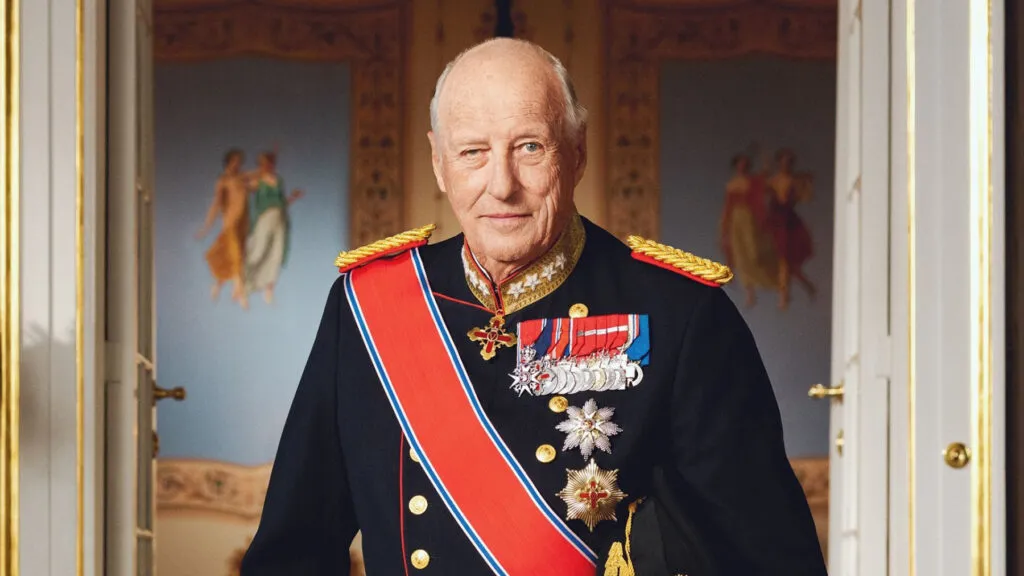
At 6:35 in the morning on 28 August, Norway lost the man who had sat on its throne since before Europe changed its borders, its currency and half its governments. Harald V was the continent's longest-reigning monarch at the moment of his death. The hour is recorded precisely, the way every palace document is written - but what followed that hour is more interesting than the number itself.
On the same day Norway got a new king. Crown Prince Haakon became Haakon VIII, his wife Mette-Marit became queen, and their daughter Ingrid Alexandra became crown princess. The new king kept his father's motto: "All for Norway". No referendum, no vote, not a single day's pause. The institution did not blink.
That is the whole point of a monarchy, and it is exactly what makes it fascinating to a reader from the Balkans. We know transfers of power differently - coalition talks that drag on for months, snap elections, parties that fall apart while the negotiations are still running. In Oslo everything unfolded according to a protocol written more than a century ago.
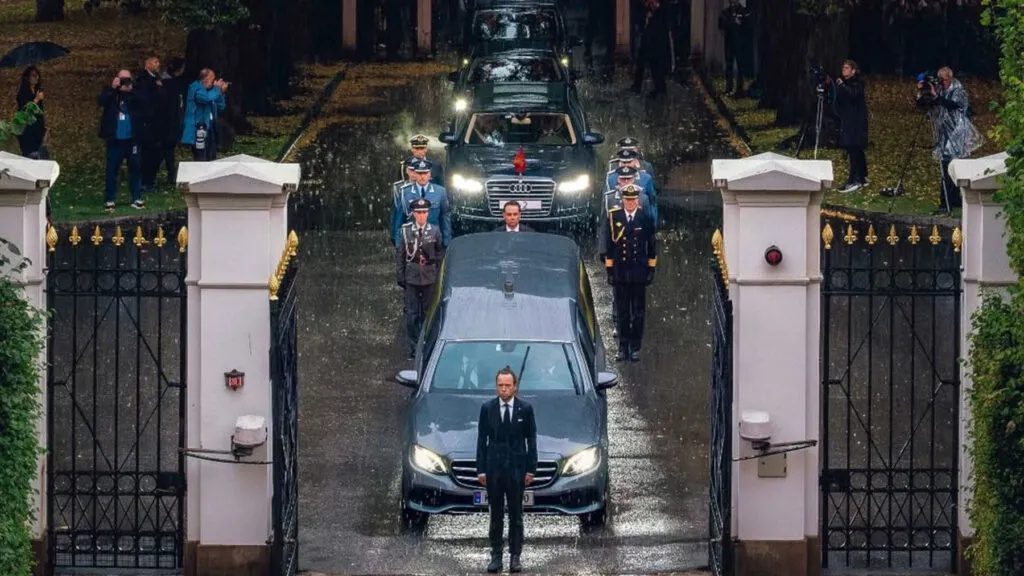
The royal standard with a black mourning band was raised over the palace at exactly 18:35 - twelve hours after the announcement. At 19:10 the funeral procession reached the Royal Palace, having passed through the streets of Oslo. It rained heavily that day. Thousands of people stood along the route anyway, soaked, watching the cars go by.
That flag has its own date - 1905, the year Norway separated from Sweden. On it is a lion holding the axe of King Olav II, a symbol taken from Norwegian medieval coats of arms from the thirteenth century. The country we celebrate as Europe's most modern social democracy still presents itself with a medieval axe. Symbols are stubborn even where the institutions work.
Prime minister Jonas Gahr Store signed the book of condolence and left flowers in front of the palace. Queen Sonja - now a widow - Ingrid Alexandra, Prince Sverre Magnus and Princess Martha Louise were at the hospital when it ended. Spain's King Felipe and Queen Letizia and Charles III sent condolences; for Charles, Harald was a cousin.
Among those who spoke up was Erling Haaland, which is trivia only if you do not think about what it means. The country has a population of five million, and its two best-known faces in the world at that moment were a dying king and a footballer. Norway has a way of holding those two worlds together without it bothering anyone.
What remains open is Mette-Marit. She entered the court as a single mother from an ordinary background, and in 2001 that was a scandal. Now she is queen, after a year in which her health was unclear. What her role will be is a question the palace has not yet answered.
The latest 10 news from this category

The Red Cross admits it has no full picture of the disaster. The government is simultaneously turning down foreign rescue...

It was hit inside the economic zone of a NATO and EU member, not in Ukrainian waters. Three questions remain...

The German manufacturer published the batch number, the date and the right to a refund without a receipt. How often...

The first visit by a CIA director to Russia since 2021. Intelligence assessments say Moscow does not feel cornered -...

The Pentagon is shifting money meant for wages and maintenance into combat operations. When an army has to choose between...
He reigned for 35 years and modernised the monarchy. Support fell from 72 to 54 percent, but the criticism was...

Ratcliffe landed in Moscow unannounced, the content stayed secret, and Trump called the visit semi-routine - then immediately added that...
In 1968 he married a woman without royal blood and changed the equation for the whole of Europe. His death...

Seismographs read it as an earthquake. It was not. One hundred and fifteen kilometres later, 80 bridges are gone, and...

Kyiv was reportedly asked to hold fire for a few hours so the American aircraft could pass. That is not...
This site uses cookies - is that okay? Learn more
Be the first to know when Metla launches something new
Leave your email and we will write when there is a new guide or something new on Metla.