The "Lottery" Trial: 231 Pieces of Evidence, and So Far Not a Single Message Between Grubi and Bajrami
24.09.2026


24.09.2026
24.09.2026
24.09.2026
24.09.2026
24.09.2026
24.09.2026
24.09.2026
23.09.2026
22.09.2026
24.09.2026

24.09.2026

23.09.2026
24.09.2026

24.09.2026

24.09.2026

24.09.2026

23.09.2026
22.09.2026
24.09.2026

24.09.2026
24.09.2026

24.09.2026
23.09.2026
23.09.2026

09.03.2026

27.02.2026

19.02.2026
24.09.2026
23.09.2026
22.09.2026

23.04.2026

23.04.2026

12.04.2026

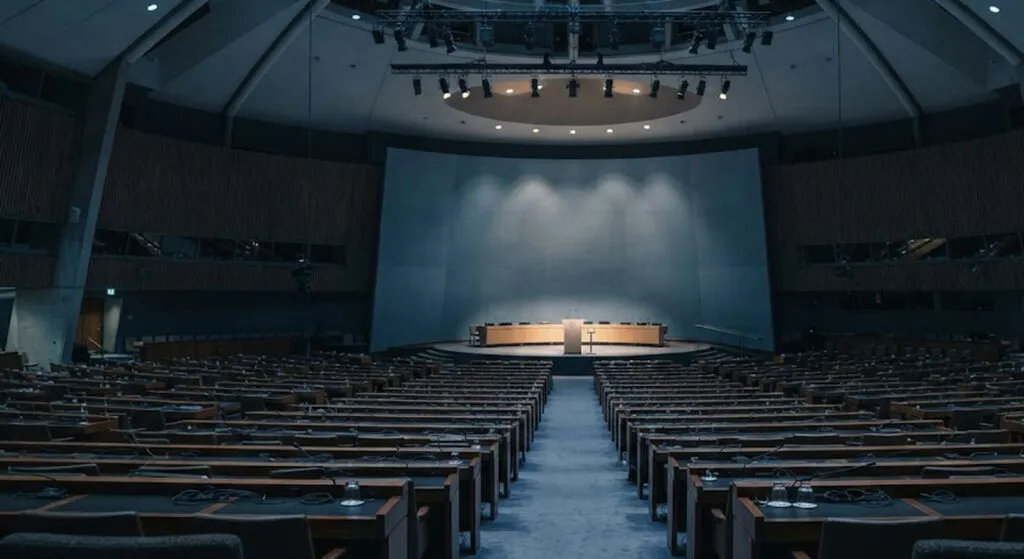
Aleksandar Vučić spoke at the general debate of the 81st session of the UN General Assembly and, right in his opening, challenged this year's theme - "Restoring trust, managing transformation: a United Nations that delivers for all". He agreed on trust. Not on transformation, because in his view it has already happened.
"The international system as we knew it has been destroyed. It doesn't exist," the Serbian president said. In its place, according to Vučić, an order is emerging with two main centres of power and a growing number of strong regional players. Conflicts are increasingly fought through economic pressure, technological restrictions, battles over resources and markets, cyber-attacks and disinformation. "The line between peace and conflict is becoming ever less clear," he added.
Then came the part the speech was written for. Vučić accused the states that, over the previous two days, had used the same podium to call for respect for the UN Charter - especially regarding the war in Ukraine - of shamelessly staying silent about their own role in trampling it. "Here I mean all the countries that recognised the unilaterally declared independence of so-called Kosovo," he said, adding that they had tried to take away 14 percent of Serbia's territory.
Vučić also went back to 1999. The only official reason for the attack by 19 NATO countries on what was then Yugoslavia, he said, was to prevent a possible humanitarian catastrophe. "The humanitarian catastrophe did not happen," he declared, claiming the real goal was to finally bring down the UN order established after the Second World War.
The most honest sentence in the speech wasn't about Kosovo, but about the room left for the small. "For small and medium-sized states like Serbia, such an environment is an enormous challenge. The space for independent decision-making is getting ever narrower, and the pressure on states to pick a side is ever greater." Which small country in the region doesn't recognise the same dilemma?
But a speech about rules that don't apply to everyone is best measured at home. During the same general debate, Croatian Prime Minister Andrej Plenković used that podium to mention the state honours at the funeral of convicted war criminal Ratko Mladić. If standards have to apply to everyone, is Belgrade ready to accept that when the question is its own past?
The latest 10 news from this category
Before the General Assembly, Vučić complained of double standards over Kosovo, attacked Croatia and looked to Trump to save the...
In front of the entire General Assembly, the Croatian prime minister called the military honours for the convicted war criminal...
The question is not emotional but institutional: what does accepting European criteria mean if the verdicts of a court whose...
An economic normalisation signed in 2020 is now filed as a finished war before the General Assembly. A conflict does...
Under the trailer there is not one claim that anything in the film is untrue. There is a ledger: you...
Regimes do not spend tabloid artillery on candidates they are not worried about. Ilija Srdanović got that treatment ahead of...
The president who dissolved parliament himself is now resigning too, promising a cabinet of no more than 12 ministers and...
Eight countries, 120 million people, a motorway to Timisoara and energy connections. And one cancelled visit that says more than...
The call was about damaged furniture on a terrace. Armin Dzutovic died three days later. The internal investigation found first...
Four KLA leaders received 81 years in prison, and Albania's parliament immediately adopted a declaration calling the verdict unjust. The...
This site uses cookies - is that okay? Learn more
Be the first to know when Metla launches something new
Leave your email and we will write when there is a new guide or something new on Metla.