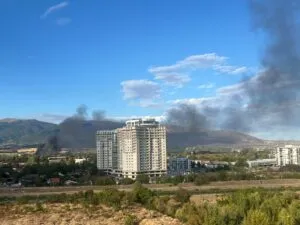
Black Smoke Over Skopje: A Paint and Varnish Warehouse Burned Inside the Old Steelworks
23.09.2026


23.09.2026

23.09.2026
23.09.2026

23.09.2026

23.09.2026
23.09.2026
23.09.2026

22.09.2026

21.09.2026

23.09.2026

23.09.2026

22.09.2026

23.09.2026

23.09.2026

23.09.2026

23.09.2026

22.09.2026

21.09.2026
23.09.2026

23.09.2026
23.09.2026

23.09.2026

23.09.2026

23.09.2026

09.03.2026

27.02.2026

19.02.2026

23.09.2026
22.09.2026

21.09.2026

23.04.2026

23.04.2026

12.04.2026

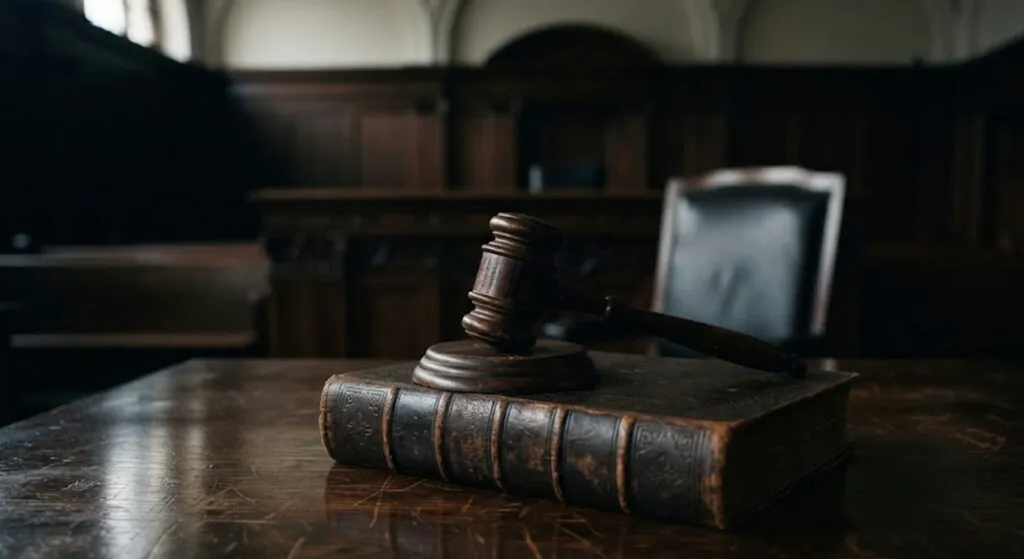
From the podium of the United Nations General Assembly, Croatian Prime Minister Andrej Plenkovic delivered a direct objection to Serbia: the military honours paid to Ratko Mladic after his death were, as he put it, an insult to his victims and to the verdicts of the international court. And he added a sentence that carries more weight than the objection itself - such an act runs against the very European values Serbia claims it wants to adopt.
This is not a dispute over interpreting history. Mladic was convicted by a final judgment of an international court. When a country that is a candidate for EU membership stages a state act around such a figure, the question is not emotional - it is institutional: what exactly does adopting European criteria mean if the verdicts of courts whose jurisdiction that country recognised are treated as a matter of taste?
Small states, and law as the only defence
Plenkovic built his entire speech around one idea: rules-based international law is not naivety, but the only thing standing between smaller states and the right of the stronger. "Not because we are naive," he said, "but because we have seen and lived the alternative." For countries of our size, he added, that law is the boundary between order and tyranny, between sovereign equality and the rule of force.
He offered Croatia's war of the 1990s as evidence for that claim - nearly 20,000 dead and 1,725 people still registered as missing today. Thirty years on, families are still waiting for a grave. That is a figure no country in this region reads as somebody else's statistic.
He carried the same logic over to Ukraine, in a formulation worth remembering: peace must not reward conquest, and reconstruction cannot be separated from justice. That sentence collides head-on with every proposal to "freeze" a conflict along the front line.
And one debt closer to home
Plenkovic also raised electoral reform in Bosnia and Herzegovina, where in his view Croats are left without legitimate representation - a situation he called unjust and destabilising. Here we enter terrain where every side in Bosnia has its own version of the same story, and twenty-five years of international mediation have produced no agreement everyone accepts.
What remains after the speech is a question not addressed to Belgrade alone. If the verdicts of international courts are binding only on those who are weaker, then what guarantee do smaller states have that their own accounts will ever be settled? The call for UN reform, which Plenkovic also mentioned, only starts to make sense once that question is answered.
The latest 10 news from this category
An economic normalisation signed in 2020 is now filed as a finished war before the General Assembly. A conflict does...
Under the trailer there is not one claim that anything in the film is untrue. There is a ledger: you...
Regimes do not spend tabloid artillery on candidates they are not worried about. Ilija Srdanović got that treatment ahead of...

The president who dissolved parliament himself is now resigning too, promising a cabinet of no more than 12 ministers and...
Eight countries, 120 million people, a motorway to Timisoara and energy connections. And one cancelled visit that says more than...
The call was about damaged furniture on a terrace. Armin Dzutovic died three days later. The internal investigation found first...
Four KLA leaders received 81 years in prison, and Albania's parliament immediately adopted a declaration calling the verdict unjust. The...
The court established responsibility for 96 killed, 303 tortured and 385 unlawfully detained. The prosecution asked for 45 years. Serbia...
Thaci and Krasniqi got 25 years each, Veseli 18, Selimi 13. The court established 385 unlawfully detained, 303 tortured and...
"If it is acceptable to the participants" - that is the entire offer. What gets negotiated is the format, not...
This site uses cookies - is that okay? Learn more
Be the first to know when Metla launches something new
Leave your email and we will write when there is a new guide or something new on Metla.