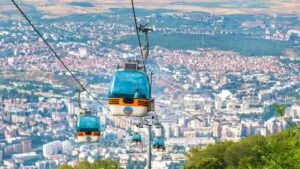
Three of Four Sensors Were Dead: Skopje's Vodno Cable Car Ran Fifteen Years Without a Real Service
17.09.2026


17.09.2026

17.09.2026
17.09.2026

17.09.2026

17.09.2026
17.09.2026

17.09.2026

16.09.2026

15.09.2026

17.09.2026

17.09.2026

16.09.2026
17.09.2026

17.09.2026

17.09.2026

17.09.2026

16.09.2026

15.09.2026

17.09.2026

17.09.2026

17.09.2026

17.09.2026

17.09.2026

17.09.2026

09.03.2026

27.02.2026

19.02.2026

23.04.2026

23.04.2026

12.04.2026

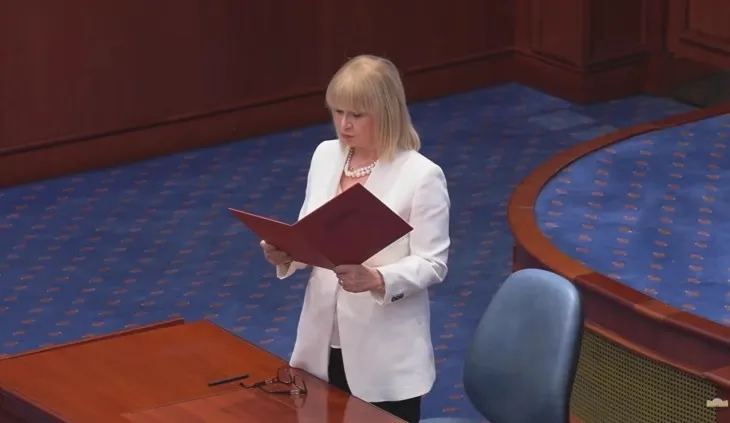
With 64 votes in favour, none against and no abstentions, parliament elected Meri Dika Georgievska to the Constitutional Court. She took the oath immediately afterwards and formally assumed the post.
Zero votes against, for a constitutional court judge. The number suggests a candidate nobody had an objection to. The debate before the vote says otherwise.
A CV that contradicts itself
MP Sali Murati of the European Front asked for the item to be pulled from the agenda. The reason: the candidate's biography contains chronological contradictions.
According to the document submitted to MPs, Dika Georgievska passed the bar exam on 18 February 1987 - and graduated on 16 September 1987. Seven months after she had already passed an exam that, as a rule, is taken after graduation. According to the same document, she worked as a trainee lawyer from 1985, two years before she graduated.
Murati asked that, along with the corrected proposal, MPs also receive her degree, the certificate of the passed bar exam and proof of her service record.
Judicial Council president Aleksandar Kambovski confirmed it was a technical error, already corrected within the Judicial Council. He did not know why the correction had not been forwarded to parliament.
A career that speaks for itself
Set the dates aside and the CV is serious. She graduated from the Faculty of Law at UKIM in 1985 and took a master's degree at American College in 2014. From 1996 to 2005 she was a judge at Skopje II Basic Court, then a judge at the Skopje Court of Appeal. From 2012 to 2018 she was a member of the Judicial Council, after which she returned to the appellate court. In 2023 she was elected president of the Skopje Court of Appeal.
That last post is precisely what triggered the political reaction. Levica issued a sharp comment that VMRO-DPMNE had elected as constitutional judge a person it had previously portrayed as a symbol of a compromised judiciary, which in their view amounts to „political self-cancellation”.
A court that still isn't complete
Despite today's election, the Constitutional Court remains incomplete - judge Goce Naumovski submitted an irrevocable resignation.
So: an appointment made on documentation that the parliamentary debate itself established as wrong, confirmed as a „technical error” already fixed somewhere MPs never saw, for a seat on a court that still isn't full.
The Constitutional Court is the institution that decides whether laws comply with the constitution. If you get there with a CV whose dates don't line up and nobody thinks that is worth pausing over, then the question isn't about this candidate. The question is how carefully the documents are read for everyone else.
The latest 10 news from this category

Of 340 million denars, only 40 million came from private money - the rest came from the State Lottery. Prosecutors...
The State Audit Office already warned that withholding the points makes favouritism possible. The rulebook requiring them to be published...
Two senior officials announced progress, the two largest parties denied it the same day. The amendments sit blocked behind 13,500...

The police acted on their own knowledge, without the PM filing anything at all. The same mechanism exists for every...
The Electoral Code is the one unfulfilled reform obligation, and the working group does not even know when it will...
It was supposed to cost "zero denars". Now the opposition wants an investigation, and the timeline - David Guetta announced...
Five negations in one sentence, pension growth "16 times higher" with not a single figure beside it, and a third...
One side waits for a letter, another waits for a different commission, a third waits for consent. In those same...
The commission's chairman says it only checked whether the documents were complete. The public call says something else entirely -...
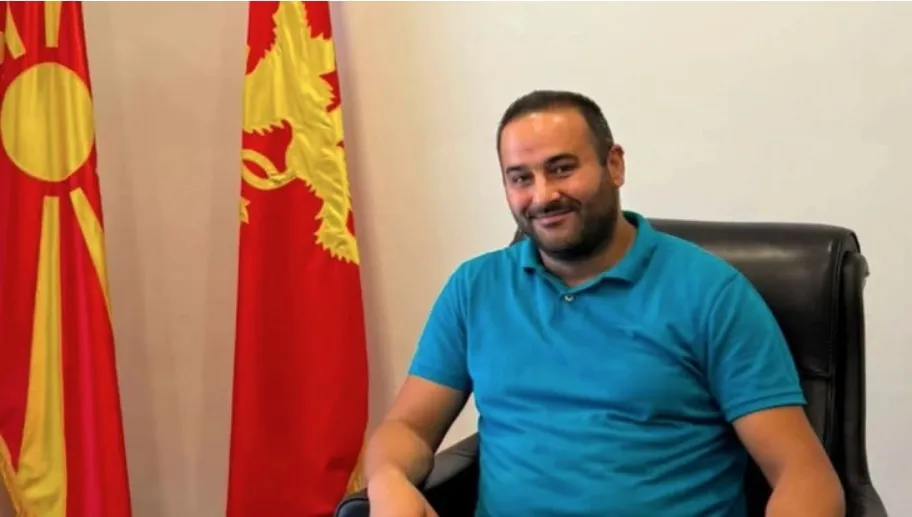
Three candidates, two of them lawyers, one of them employed by the very municipality he is running for. The line...
This site uses cookies - is that okay? Learn more
Be the first to know when Metla launches something new
Leave your email and we will write when there is a new guide or something new on Metla.