
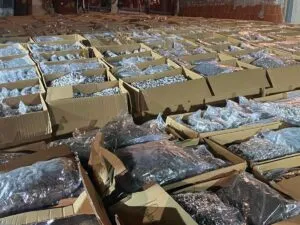
Eight Tonnes of Marijuana Crossed the Border in a Year: the Weight Difference Was Measured, the Chain Ran for Months
19.08.2026


19.08.2026

19.08.2026

19.08.2026

19.08.2026
19.08.2026

19.08.2026

19.08.2026
18.08.2026

18.08.2026

19.08.2026

19.08.2026

18.08.2026

19.08.2026

19.08.2026

19.08.2026

19.08.2026

18.08.2026

17.08.2026

19.08.2026

19.08.2026
19.08.2026

19.08.2026
18.08.2026

17.08.2026

09.03.2026

27.02.2026

19.02.2026

19.08.2026

18.08.2026

18.08.2026

23.04.2026

23.04.2026

12.04.2026
In December it was worth 5 billion dollars. In July it raised 300 million at an estimated valuation of 10.3 billion. This week the American chip manufacturer Etched announced a new round of 700 million dollars (about 640 million euros) at a valuation of 21 billion dollars. That is a doubling in a month and a jump of almost 11 billion within that same month.
The round is led by Jane Street - a quantitative fund that trades its own money and does not habitually invest in hardware startups. That is the part worth attention. Jane Street did not buy a pitch deck; its statement says it tested the chip and already has its own system installed in one of its data centres. „We tested the chip and are pleased with the early results”, the fund's announcement reads. An investor who uses the product first and pays for the company afterwards is a different story from an investor who gets in because everyone is getting in.
What exactly is Etched selling? Not individual chips, but entire systems the company calls „frontier inference clusters”. Nvidia calls the same thing artificial intelligence factories - which tells you who the competitor is.
The technical argument comes in two parts. Co-founder and chief operating officer Robert Wachen explains that inference - the computation that happens after a user sends a question - has two phases. „Inference is built in two phases, prefill and decode”, says Wachen. The first demands raw computing power to understand the question and the context; the second demands memory to push out the answer.
For the first phase Etched built a chip that runs at low voltage, which lets it pack in more transistors without the overheating that plagues other top-end hardware. For the second it developed a new type of memory and interconnect it calls cluster-level memory. „It allows many chips to be connected and use a shared pool of memory, very fast and with low latency”, says Wachen.
The company is still fighting its own past. At the start the idea was literally to etch a single model into the chip - hence the name. That is no longer the case, and Etched claims its systems run any frontier model. When a startup has to explain what it no longer does, it usually means the early story sold better than the product.
The investor list includes Kleiner Perkins, Sequoia Capital, Andreessen Horowitz, Peter Thiel, Tiger Global, Bain Capital Ventures and Blackstone. A doubling in valuation within a month is not explained by an improved product - the product is the same as it was in July. It is explained by how much money is looking for somewhere to sit.
The latest 10 news from this category
Same company, half the valuation in twelve months. Nvidia first took the founder and the team, now it comes in...
The Commission promised investments „in the coming weeks”, and the first deal was announced the next day. Who decides where...

NLB is warning about fake messages carrying the bank's name. The rule is absolute and that is exactly what makes...
200 business enquiries after a single demo on Hacker News. The leap from a small purpose-built model to a genuinely...
A business outlet reported the company was preparing a round - and the article fulfilled itself. The CEO's phone blew...
Europe finally has a tech company it calls its own. The infrastructure underneath it is held by Google, and the...
River AI has no product with a track record, but it has an xAI CV and a full bank account....

When the practice stopped, daily revenue visibly fell - so it was not a side effect. The founders knew from...
Serbian businessman Davor Macura took 100 percent of the shares through a block transaction, then recapitalised. Another financial brand is...

A billion-dollar lawsuit ended in an exclusive supply deal, and the exclusive deal in an acquisition. The civilian idea attracted...
This site uses cookies - is that okay? Learn more
Be the first to know when Metla launches something new
Leave your email and we will write when there is a new guide or something new on Metla.