
The OLVX stolen-password market led to Golema Rečica: the Interior Ministry celebrates the operation but stays silent on whether there are Macedonian victims
16.10.2026


16.10.2026

16.10.2026

16.10.2026

16.10.2026

16.10.2026

16.10.2026

16.10.2026

15.10.2026

15.10.2026

16.10.2026
16.10.2026

15.10.2026

16.10.2026

16.10.2026

16.10.2026

16.10.2026

15.10.2026

14.10.2026

16.10.2026

16.10.2026

16.10.2026

16.10.2026

16.10.2026

16.10.2026

16.10.2026

15.10.2026

14.10.2026
15.10.2026

13.10.2026

12.10.2026

23.04.2026

23.04.2026

12.04.2026

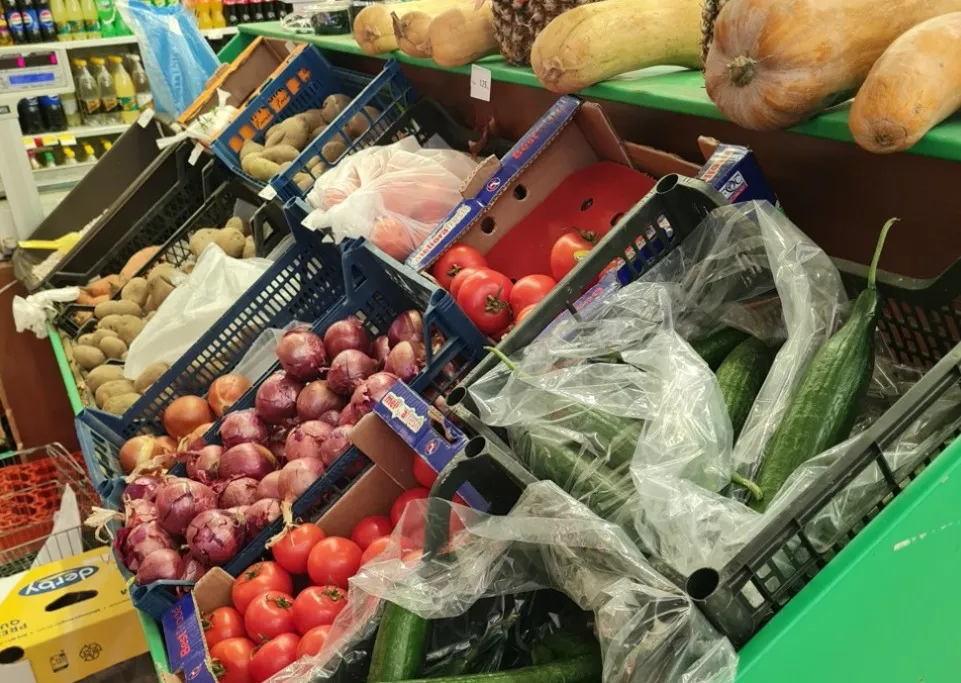
The number that says the most does not come from the commodity markets. It comes from the State Statistical Office: food and drink take 50.1 percent of the total household budget in Macedonia. Half a salary just to eat. Everything else - electricity, rent, medicine, children - comes out of the other half.
That is why a global forecast is not an abstract headline from London. According to an analysis by Oxford Economics, world food prices will rise by 11.8 percent in 2026, and another 4.8 percent in 2027. The heaviest pressure is expected on cereals, fresh vegetables and dairy.
What the indices show
The FAO food price index recorded a monthly rise of 0.6 percent in July - modest. But the cereal index jumped 3.4 percent in a single month, and the world price of wheat rose 5.8 percent. Analysts expect it to be around 36 percent higher in the third quarter compared with the same period last year.
The causes are no mystery. Heatwaves cut yields at the major producers. Fertiliser prices are expected to rise 22 percent this year, and diesel in July was already 36 percent more expensive than a year earlier. The European association Coceral has cut its forecast for the EU and UK grain harvest to 286.6 million tonnes, against roughly 310 million last year. Germany alone expects a 7 percent drop, to 41.9 million tonnes.
Here: one shield and one exposure
Macedonia has a degree of protection on wheat thanks to last year's harvest of over 300,000 tonnes, which according to the Ministry of Agriculture covers domestic needs. That is a real advantage and it is worth saying so.
The exposure is somewhere else. The food industry and the mills are tied to electricity, imported raw materials, packaging and transport. No silo full of wheat pays the mill's electricity bill. Complete insulation from the commodity markets therefore does not exist, however good the harvest was.
Additional pressure comes from inside. In July, input costs for Macedonian farmers were 4.1 percent higher, while purchase prices fell 5.5 percent. The farmer is squeezed from both sides at once, which is exactly why there is no room for him to absorb the coming increases himself.
When it will show
The effect will not arrive all at once. The forecasts split it into two waves: October and November 2026 for fresh fruit and vegetables, then February to May 2027 for processed goods, bread, pasta and dairy.
That is a fairly long stretch of a situation announced in advance. Long enough for somebody in the government to work out what 11.8 percent means for a budget where food already takes half. Has that calculation been done at all, or will it show up as a surprise somewhere in November?
The latest 10 news from this category
The prime minister talks about GDP growth, the minister about an "option". Nobody says what the filters will cost to...

Eurostat says we're the cheapest, the unions say the basket rose by 4,355 denars in a single year. Both are...

The minister says rural women will always have the state's support. The arithmetic says the maternity money will reach 25...

816 billion parameters, open weights and a promise that it runs on a Mac. The small print: you need at...

In four months its valuation jumped by 16 billion dollars. Automating boring expense reports in America is a 60-billion business...

All it takes is an ad appearing on your screen and the device is infected. Al Jazeera is most likely...
Cauliflower at up to 250 denars at the market, young cabbage nearly four times dearer from field to stall. Farmers...

From December 1, shorter loans for a second flat and an easier down payment for a first home. But a...

244,513 tourists in August and 3 percent growth over eight months. But 70.8 percent of overnight stays belong to domestic...

Three labels, from "fully generated" to "no AI", and not a single ban. YouTube is tagging machine-made songs while also...
This site uses cookies - is that okay? Learn more
Be the first to know when Metla launches something new
Leave your email and we will write when there is a new guide or something new on Metla.