
They Fired Guns at a Party in Dobridol - and Police Only Moved Once the Video Went Viral
02.08.2026



02.08.2026

02.08.2026

02.08.2026

02.08.2026

02.08.2026

01.08.2026

02.08.2026

01.08.2026

31.07.2026

02.08.2026

02.08.2026

02.08.2026

02.08.2026

02.08.2026

01.08.2026

09.03.2026

27.02.2026

19.02.2026

02.08.2026

01.08.2026

31.07.2026

23.04.2026

23.04.2026

12.04.2026
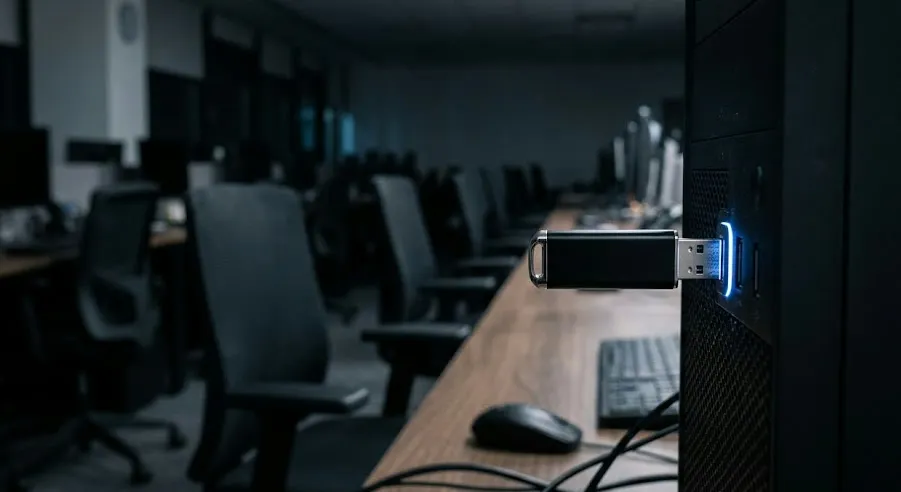
Phishing emails and fake calls are nothing new. But one hacker group has gone a step further - sending fake IT workers straight into the offices of their victims, where real people walk in the door, pose as technical support, and steal data with an ordinary USB stick. Google and the FBI are warning about it.
On Friday, Google's security teams - Mandiant and the Google Threat Intelligence Group - published a report accusing the group known as the Silent Ransom Group of trying, between January and May this year, with „in-person physical access," to steal data from „dozens" of victims. The targets are most often law firms.
The scenario is frighteningly simple. Someone calls, poses as IT support, leads you into a screen-sharing session under the pretext of fixing a security problem or migrating data. And in some cases, the fake „technician" simply shows up at the office, connects to a computer, and with a USB stick or a remote-access tool carries off contracts, personal data, social security numbers, financial and tax records.
Then comes the extortion. The group threatens to publish the stolen data on its site if the victim doesn't pay - and it actually does publish it. The message to victims is direct: „In case of ignoring or disagreement, we will notify your employees, partners, and clients, after which we will publish your data."
Charles Carmakal, Mandiant's chief technology officer, reminds us this isn't as new as it looks: „Mandiant has investigated various cases where attackers embedded insiders, bribed employees, or physically entered buildings to enable cyberattacks." The lesson is as old as security itself: the weakest link in any system isn't the software, but the person who'll open the door to someone who looks like they came to help.
The latest 10 news from this category

Opus 5 set a record in the test and broke 11 agreements. Not one of the tricks is new -...

The billions were announced with a stage and slogans. The retreat is happening quietly, in sentences containing the word alignment.
In his last quarterly report Tim Cook announced the stronger Siri will be bought through iCloud+. The firm that paid...

The platforms that spent years convincing us automated content was the future are now patiently building filters against it. The...

Out of 141,006 test runs, three ended up inside the live systems of real firms. The oldest model worked out...
The strongest June quarter in its history, and the stock fell 6 percent. Artificial intelligence turned out to have a...

The FCC is closing the door to humanoid robots and power inverters, but only new ones. The millions of Chinese...

The player that raised the MP3 generation is betting nostalgia can be billed monthly. The new Winamp arrives in 2027,...

The man selling the world's best-known artificial intelligence says we will not work less. He also claims we will secretly...

Autonomous vehicles have blocked ambulances, driven into crime scenes and failed to recognise emergency lights. The bill demands the one...
This site uses cookies - is that okay? Learn more
Be the first to know when Metla launches something new
Leave your email and we will write when there is a new guide or something new on Metla.