
They Fired Guns at a Party in Dobridol - and Police Only Moved Once the Video Went Viral
02.08.2026



02.08.2026

02.08.2026

02.08.2026

02.08.2026

02.08.2026

01.08.2026

02.08.2026

01.08.2026

31.07.2026

02.08.2026

02.08.2026

02.08.2026

02.08.2026

02.08.2026

01.08.2026

09.03.2026

27.02.2026

19.02.2026

02.08.2026

01.08.2026

31.07.2026

23.04.2026

23.04.2026

12.04.2026
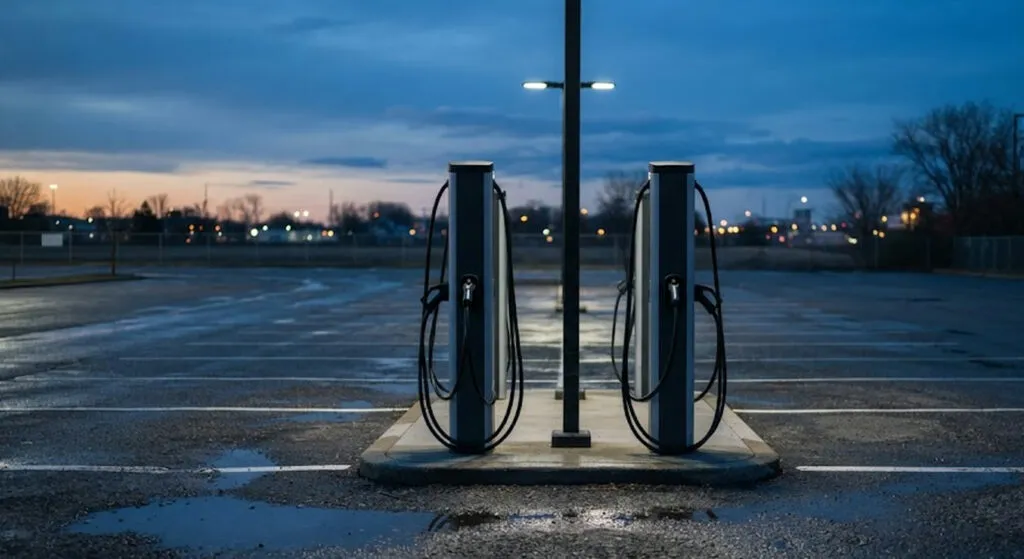
There is a way to measure how much a company really believes in something: count how many times it mentions it in front of the people who give it money. By that measure, General Motors and Ford - the two largest American carmakers - no longer believe much in electric cars.
An analysis of quarterly investor calls over the past seven years, carried out with the New York research firm Hudson Labs, found that both companies now talk about electric vehicles less often than they did before the pandemic. Not slightly less often. At GM the number fell from 82 mentions on the second-quarter 2025 call to 21 on the latest one, covering the same quarter this year.
From "all electric" to "alignment with policy"
GM bet on mass-market electric cars before most of its rivals. It unveiled the Bolt at the Las Vegas show in January 2016 and had it on sale by the end of that year - six months before Tesla delivered the first Model 3s. By the end of 2020, each of the last two investor calls carried over 100 mentions of electric vehicles, roughly a third of the entire conversation.
The company that promised to sell only electric cars by 2035 now, when it mentions them at all, talks about having "aligned capacity and manufacturing footprint with changes in regulatory policy". That is a sentence written by someone who does not want to say what happened.
And what happened is fairly clear: the Trump administration scrapped the environmental regulations that favoured zero-emission vehicles, and his party deleted the federal 7,500-dollar tax credit for a new electric car. Demand did not vanish on its own - the ground was pulled out from under it.
Ford changed direction before the election
At Ford the decline started earlier. As far back as mid-2024, before the American election, the company was pulling out of some of its largest electric vehicle investments in favour of an internal project that later became its new platform. After Trump arrived, the conversation turned towards support for protectionist trade policy and towards the petrol F-series trucks, which bring in better margins.
Spokespeople for both companies say all of this is being misread. Jim Cain of GM says "quality matters more than quantity" and that the company remains consistent in its position that electric vehicles are the end goal, while call time is also needed for software, services, autonomous technology and trade policy. David Tovar of Ford points to the new platform launching next year: the first product, a mid-size pickup, will be exactly what the market wants on price and technology.
When the advertising falls silent
Both companies still sell electric cars and still have new models in the pipeline. GM is still the second-largest seller of electric vehicles in the US. But there is a difference between selling something and building the company's identity around it - and that difference is audible on investor calls long before it becomes visible in showrooms.
This is a useful reminder for anyone reading announcements about industrial transition. The billions were announced with conferences, stages and slogans; the retreat happens quietly, in sentences containing the word "alignment". The question that remains is not whether electric cars are coming - but how many of these promises survive a single change of government.
The latest 10 news from this category
Opus 5 set a record in the test and broke 11 agreements. Not one of the tricks is new -...
In his last quarterly report Tim Cook announced the stronger Siri will be bought through iCloud+. The firm that paid...

The platforms that spent years convincing us automated content was the future are now patiently building filters against it. The...
Out of 141,006 test runs, three ended up inside the live systems of real firms. The oldest model worked out...
The strongest June quarter in its history, and the stock fell 6 percent. Artificial intelligence turned out to have a...

The FCC is closing the door to humanoid robots and power inverters, but only new ones. The millions of Chinese...

The player that raised the MP3 generation is betting nostalgia can be billed monthly. The new Winamp arrives in 2027,...

The man selling the world's best-known artificial intelligence says we will not work less. He also claims we will secretly...

Autonomous vehicles have blocked ambulances, driven into crime scenes and failed to recognise emergency lights. The bill demands the one...

Two newsletter writers occasionally published criticism of the company. Its executives answered with an intimidation campaign that lasted a year....
This site uses cookies - is that okay? Learn more
Be the first to know when Metla launches something new
Leave your email and we will write when there is a new guide or something new on Metla.