
The "Lottery" Trial: 231 Pieces of Evidence, and So Far Not a Single Message Between Grubi and Bajrami
24.09.2026


24.09.2026
24.09.2026
24.09.2026

24.09.2026
24.09.2026
24.09.2026

24.09.2026

23.09.2026

22.09.2026

24.09.2026

24.09.2026

23.09.2026

24.09.2026

24.09.2026

24.09.2026

24.09.2026

23.09.2026

22.09.2026

24.09.2026

24.09.2026

24.09.2026

24.09.2026

23.09.2026

23.09.2026

09.03.2026

27.02.2026

19.02.2026
24.09.2026

23.09.2026
22.09.2026

23.04.2026

23.04.2026

12.04.2026

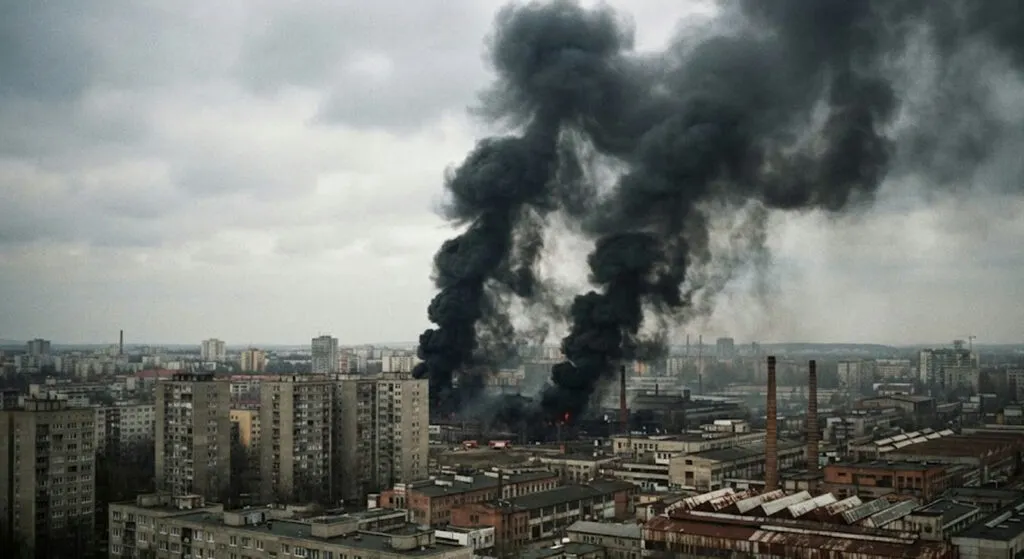
The attack on Kyiv didn't end with the night. The morning brought further strikes on telecommunications and railway infrastructure, warehouses, transport facilities and petrol stations, and afterwards two major internet providers reported outages because of a damaged data centre. One person was killed, eight were injured, and smoke from the fires spread over several parts of the city.
The internet under fire
Providers UTELS and "Pavutina" said one of Kyiv's data centres housing their key equipment had been damaged. Some of the devices lost power, and users began reporting problems with the internet and other services. UTELS said its central network node is located in the very building that was hit. Claims by Russian channels that the whole of Kyiv has been "cut off from the internet" are so far unconfirmed - but what has been confirmed is bad enough.
According to information circulating after the attack, the building of "Giprosvyaz", Ukraine's institute for designing communication networks, was also hit; its complex houses entities linked to "Ukrtelecom", the Ukrainian Research Institute of Communications and the company "Vega". Precision matters here: the fact that the building was hit is not proof that Russia deliberately targeted the communications system itself. There isn't enough public evidence for such a claim so far.
The railway and the drug factory
Almost at the same time, the railway came under attack. Ukrzaliznytsia board chairman Oleksandr Pertsovskyi confirmed that railway facilities in Kyiv had been targeted and that an employee was wounded by shrapnel on his way home after his shift. The central station wasn't directly damaged, but the "Kyiv City Express" urban rail service came to a complete temporary halt. Passengers who miss their train because of security measures, Pertsovskyi promised, will get the full ticket price back.
In the Holosiivskyi district, warehouses and a petrol station were hit, and later a four-storey business centre. In Solomianskyi, drone debris fell between apartment blocks, while another drone struck a nine-storey non-residential building at fourth-floor level. In Darnytskyi, the roof of another petrol station was on fire. The same wave also hit the company "Darnytsia", one of Ukraine's largest drug manufacturers, which according to its own figures has paid more than 2.6 billion hryvnias in taxes since the start of the war.
The numbers in the sky
By 10:24, the air-raid siren had sounded six times. According to the Ukrainian side, a total of 161 drones were launched at the country overnight and in the morning, including 82 jet-powered drones, and by eight o'clock air defences had shot down or electronically disabled 119 of them. Russian sources claim that at least seven jet-powered "Geran" drones took part in the first wave on Kyiv alone and that air defences reacted late - a figure Ukrainian authorities have not confirmed.
The daytime attack was in fact a continuation. As early as the evening of 22 September, hits were reported in the Pecherskyi, Obolonskyi and Dniprovskyi districts; in Obolonskyi, fuel tanks were struck, and the number of injured later rose to nine. During the night a major fire broke out in Vyshneve, the small town right next to Kyiv, where in July a single mass strike damaged 251 buildings.
Ukrainian activist Serhiy Sternenko believes the campaign against Kyiv may have a wider goal than the energy sector - petrol stations, providers' data centres and telecom operators could all be in the firing line, he says. His advice to Kyiv residents sounds like instructions from another era: don't panic, but slowly get ready for winter, build up basic fuel supplies and, just in case, get hold of a Starlink or some other means of communication.
When a single strike hits the internet, trains, public transport, warehouses and petrol stations all at once, the damage doesn't end at the site of the explosion. There are cities in the Balkans that still remember what it's like to live by candlelight, queue for fuel and be cut off from the world. For Kyiv, the question is no longer whether the winter will be hard, but how much of the city will still be working when it arrives.
The latest 10 news from this category
99 MPs voted in favour, and a threat arrived from Moscow right away. Is a small country on the line...
The offer is deliberately narrow - energy only, with a deadline before winter. When a power line goes down in...
On the night Russia was closing its parliamentary elections, Ukrainian drones reached the refinery at Kapotnya and residential blocks in...
Every sentence about last night's offensive has the same author - the Russian Ministry of Defence. There is smoke over...

The Telegram statement reads like a trailer: drones that blind drones, robots dropped from the air behind enemy lines, and...
Black smoke over the main airport, sirens in the middle of the night and a state that will not say...
Western agencies say no decision has been taken - only preparations that would let it all happen overnight. In the...
A Russian commander promised to cut the Kharkiv encirclement "like a pie". Every number comes from the camp running the...
Around 8,500 North Korean soldiers are still in Russia, among them 1,000 engineers and 400 drone operators. Estimates point to...
The unit was running, the operating regime did not change, there was no fire. The difference between a news item...
This site uses cookies - is that okay? Learn more
Be the first to know when Metla launches something new
Leave your email and we will write when there is a new guide or something new on Metla.