They Fired Guns at a Party in Dobridol - and Police Only Moved Once the Video Went Viral
02.08.2026


02.08.2026

02.08.2026

02.08.2026

02.08.2026

02.08.2026

01.08.2026

02.08.2026

01.08.2026

31.07.2026

02.08.2026

02.08.2026

02.08.2026

02.08.2026

02.08.2026

01.08.2026

09.03.2026

27.02.2026

19.02.2026

02.08.2026

01.08.2026

31.07.2026

23.04.2026

23.04.2026

12.04.2026
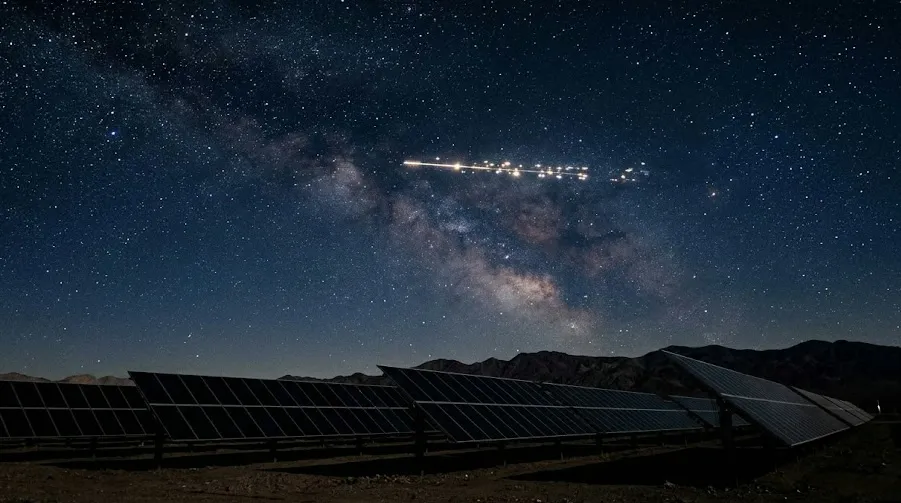
Three years ago Elon Musk wrote "Master Plan Part 3," where the vision was simple - full transition to a solar electric economy. Today his companies are doing something very different. xAI - his AI company - is powering its data centers with 46 unregulated natural-gas turbines, and plans to buy more for $2.8 billion (around 2.6 billion euros) in new fossil-fuel infrastructure.
That doesn't mean Musk has fully abandoned the solar idea - he seems to have simply moved it into space. According to SpaceX's latest filing, orbital solar arrays could generate "more than five times the energy" compared to those on Earth. The argument? AI companies will allegedly demand "terawatt-scale annual growth in compute capacity," and for that there's not enough space and energy on Earth.
The numbers still convince. SpaceX bought Cybertruck vehicles for $131 million (1,279 units). xAI invested $697 million in Tesla's Megapack battery systems over two years. As for solar on Earth? Almost nothing. Tesla, which still officially sells solar panels, is suddenly not the priority for Musk's biggest fan - Musk himself.
There's also one main question. Global data centers today consume around 40 gigawatts. The entire human civilization continuously uses around 4 terawatts. Musk is projecting a jump of hundreds of times more, which is an extrapolation many engineers consider marketing, not real demand. Launching solar panels into orbit requires more energy than trucking them out to a desert, and scaling space-ready products has never been achieved.
The paradox is obvious and visible. Musk, who built a reputation as the leader of the energy transition, is at this moment dressing xAI up in gas turbines and claiming this is a "temporary pause" until the moment space solves the problem. Temporary measures in industrial infrastructure have a tendency to last two decades. And Tesla, which once represented part of the vision for Earth-bound solar, looks more and more like an assistant in building something else.
The latest 10 news from this category
Opus 5 set a record in the test and broke 11 agreements. Not one of the tricks is new -...
The billions were announced with a stage and slogans. The retreat is happening quietly, in sentences containing the word alignment.
In his last quarterly report Tim Cook announced the stronger Siri will be bought through iCloud+. The firm that paid...

The platforms that spent years convincing us automated content was the future are now patiently building filters against it. The...
Out of 141,006 test runs, three ended up inside the live systems of real firms. The oldest model worked out...
The strongest June quarter in its history, and the stock fell 6 percent. Artificial intelligence turned out to have a...
The FCC is closing the door to humanoid robots and power inverters, but only new ones. The millions of Chinese...

The player that raised the MP3 generation is betting nostalgia can be billed monthly. The new Winamp arrives in 2027,...
The man selling the world's best-known artificial intelligence says we will not work less. He also claims we will secretly...
Autonomous vehicles have blocked ambulances, driven into crime scenes and failed to recognise emergency lights. The bill demands the one...
This site uses cookies - is that okay? Learn more
Be the first to know when Metla launches something new
Leave your email and we will write when there is a new guide or something new on Metla.