


Two Schoolyard Assaults Reported in a Single Day: the Police Promised Measures, the Education System Said Nothing
19.09.2026


19.09.2026
19.09.2026
19.09.2026

19.09.2026
19.09.2026
19.09.2026
19.09.2026
18.09.2026

17.09.2026
19.09.2026
19.09.2026
18.09.2026

19.09.2026
19.09.2026
19.09.2026
19.09.2026
18.09.2026
17.09.2026
19.09.2026

19.09.2026
19.09.2026
19.09.2026

19.09.2026
18.09.2026

09.03.2026

27.02.2026

19.02.2026

19.09.2026
18.09.2026
17.09.2026

23.04.2026

23.04.2026

12.04.2026

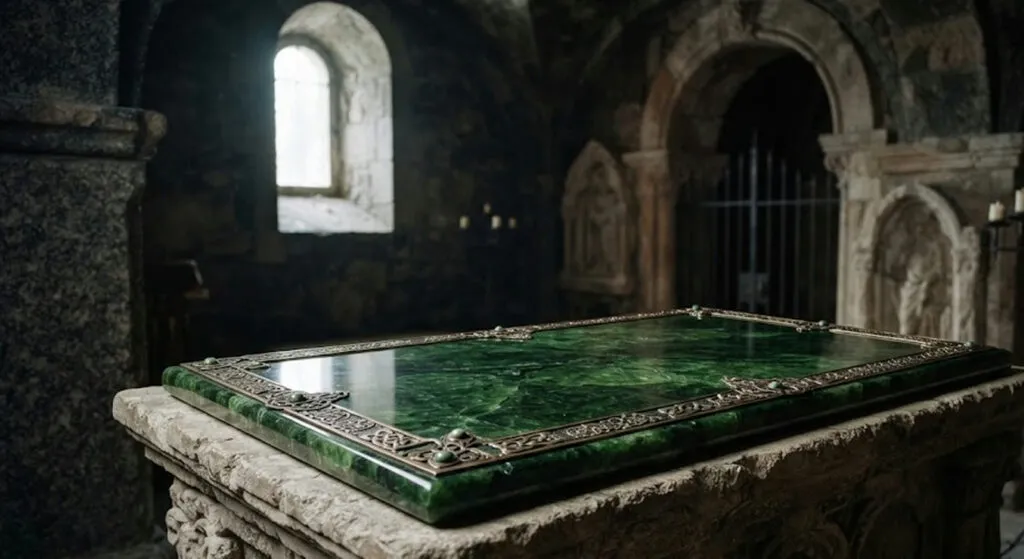
Three weeks after King Harald's death, the Norwegian court showed what usually stays behind a closed door - the place where a monarch rests. The sarcophagus stands in the royal mausoleum at Akershus Fortress, right beside those of his parents, King Olav and Crown Princess Märtha, and his grandparents, King Haakon VII and Queen Maud. The funeral was private. The story of the stone is not.
Harald designed the sarcophagus himself, and that says more than any official obituary. The shape is a ship - with a rounded hull, like a Viking burial boat carrying the dead toward the next world. A man who sailed all his life decided not to lie in a coffin but in a vessel. That is the work of someone who knew exactly how he wanted to be remembered.
The stone is olivine. Not marble, not granite, not an imported slab of Italian luxury - a greenish rock formed deep inside the Earth and pushed to the surface by tectonic forces around 400 million years ago, when Norway was being made. It was quarried in Sunnmøre, a region Queen Sonja has walked through countless times. Olivine absorbs and binds carbon dioxide. A royal couple tying their final resting place to a stone that cleans the air - that is a message, not an ornament.
The lid carries a crown, an orb, a sceptre and a royal sword, set with peridots - the same green gemstone found in the Norwegian crown. All the ornaments were hand-cast in bronze using the ancient lost-wax method. The inscriptions are in Futura, the typeface designed by Paul Renner in the 1920s, with the letters water-jet cut and gilded.
The construction is signed by the Snøhetta studio, led by architect Kjetil Trædal Thorsen. Ten pieces, olivine and peridot quarried and worked by Johansen Monumenthuggeri, reinforced with steel, with bronze symbols cast in two workshops. The cost of both sarcophagi - Harald's and Sonja's - is estimated at around two million euros.
Two million euros for two tombs. That is a figure unlikely to generate a single article in Oslo, while in the Balkans it would mean a week of political storm. The question is not whether it is a lot - the question is why one society takes it as a normal cost for a state symbol and another as a scandal. The answer probably has nothing to do with money.
What remains is the precision. Every element - the stone, the shape, the lettering, the green peridot - was chosen and explained. Nothing is accidental and nothing was left to some protocol department after the fact. The king drew his own ship and then boarded it.
The latest 10 news from this category

The law lets Washington hit the five biggest buyers of Russian oil with tariffs of up to 100 per cent....
Measures imposed over the war in Ukraine are now being offered as currency in an entirely different dispute. If the...

A smaller dose and more needles does not mean a safer vaccine, it means an ineffective one. Science has had...
Von der Leyen proposed a status that does not exist in European law, the Canadians distanced themselves, and Washington announced...
The French candidate called the war in Ukraine a slaughterhouse and pointed out it has already lasted longer than the...
Four decades in politics, but the headline the world wrote was about her brother and his sixteen wives. When the...
The status of "associate member" does not exist in EU law. Macedonia has been queuing for twenty years and hearing...

Sanctions imposed over one war are being offered as currency in an entirely different dispute. Most member states are against...
El Nino in the Pacific shifts the currents that decide where snow falls. An area that usually gets a metre...

The easiest way to dismiss an uncomfortable argument is to point at who is making it. But that does not...
This site uses cookies - is that okay? Learn more
Be the first to know when Metla launches something new
Leave your email and we will write when there is a new guide or something new on Metla.
