


State Lottery: Two Arrests Over an 80-Million-Denar Embezzlement, While the Star Witness in Court Changed His Story
06.10.2026


06.10.2026

06.10.2026

06.10.2026
06.10.2026
06.10.2026
06.10.2026
06.10.2026

06.10.2026

05.10.2026

06.10.2026

06.10.2026

05.10.2026

06.10.2026

06.10.2026

06.10.2026

06.10.2026

05.10.2026
04.10.2026

06.10.2026

06.10.2026

06.10.2026

06.10.2026

06.10.2026

05.10.2026

09.03.2026

27.02.2026

19.02.2026

06.10.2026

05.10.2026
04.10.2026
06.10.2026
05.10.2026
04.10.2026

23.04.2026

23.04.2026

12.04.2026

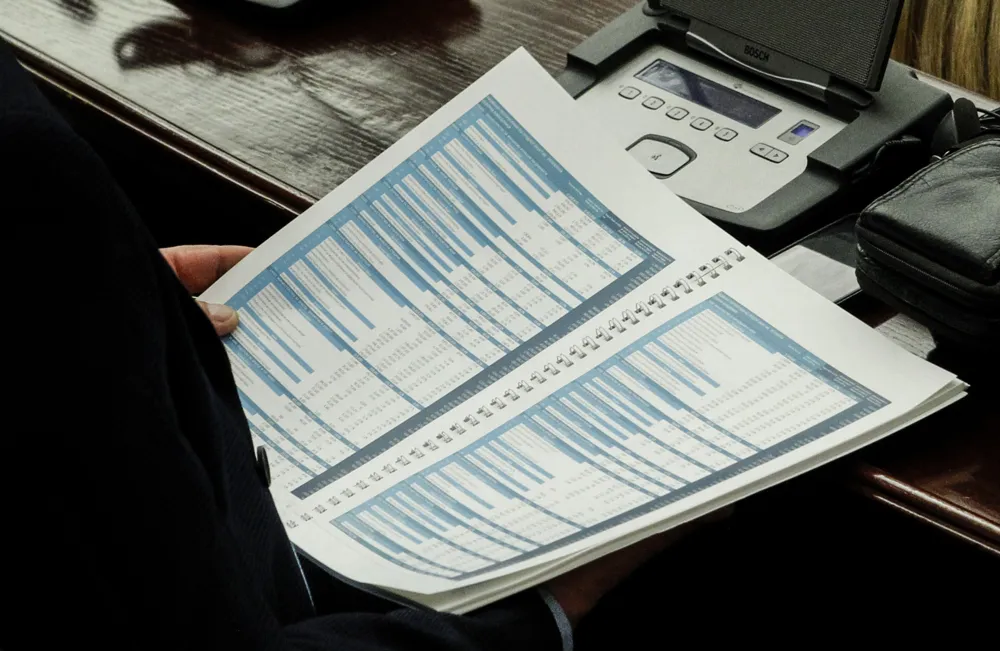
The government is preparing a second budget revision this year, with the procedure due to wrap up by the end of October, Prime Minister Hristijan Mickoski announced. The reason is lower revenue from excise duties and VAT, which the government cut to keep fuel prices low. According to Mickoski, the shortfall is 7 to 8 billion denars, or up to around 130 million euros.
The estimate is growing faster than it is being explained. Last Wednesday, 30 September, the prime minister was talking about 6 to 7 billion denars, or roughly 97 to 113 million euros. In less than a week the figure grew by another billion denars. The first revision was adopted at the end of July.
So where will the cuts fall? Mickoski did not specify which budget users will get less. He said only that citizens' living standards and low inflation are the priorities, and repeated that fuel here is "25 to 50 cents" cheaper than anywhere else in the region. On 5 October the Energy Regulatory Commission cut prices once again: diesel by three denars and petrol by a denar and a half per litre.
The July revision projected revenue at 379.5 billion denars and spending at 425.8 billion, for a deficit of 46.3 billion denars, or 4.1 percent of GDP. By mid-September, according to available data, the actual deficit was already approaching the planned annual figure.
The opposition is not buying the explanation. SDSM leader Venko Filipche argues that if fuel prices rose by more than 50 percent, then even with lower VAT and excise, revenue from pricier fuel should not have fallen as much as the government claims. The LDP, meanwhile, wants a VAT refund for domestic citizens and businesses instead of subsidising fuel for people from neighbouring countries who fill up here.
The cheapest fuel in the region is a policy that sounds great at the pump. But when the estimate of what it costs grows within a single week and nobody says whose budget line will pay for it, it is no longer just a pricing policy. Who will cover the gap - and will we find out before or after the revision?
The latest 10 news from this category
The budget already covers 41 percent of the Pension Fund, and by the mid-2040s there will be fewer contributors than...
The proposal would indirectly cut the number of days off to 13. An analysis of how much companies actually lose...

Brussels forced OpenAI to release a watermark the company had ready back in 2024. Macedonia isn't in the EU, so...
Andreessen Horowitz is leading the round, and the box promises your data stays with you alone and that it will...

54 million Americans say they bought something after seeing a TikTok video. Now the platform wants zero pause for thought...
The prime minister says excise duties alone will leave around five billion denars missing, and with the reduced VAT on...
District heating prices from 1 August were calculated with gas at around 40 euros per megawatt-hour, and today it costs...
The Finance Ministry is celebrating the confirmed rating. The agency's report, however, also spells out what the highways driving that...

By executive order, artificial intelligence became "superintelligence", and the safety pledge tech companies signed at the White House binds no...

A nine-metre catamaran, a motor the company builds itself and off-the-shelf batteries. Hydrofoils have been around for more than a...
This site uses cookies - is that okay? Learn more
Be the first to know when Metla launches something new
Leave your email and we will write when there is a new guide or something new on Metla.