
"That's not my job": the trial of the 13 Puls police officers restarted from scratch, and witnesses describe help being refused
22.09.2026


22.09.2026
22.09.2026

22.09.2026

22.09.2026

22.09.2026

22.09.2026

22.09.2026

21.09.2026

20.09.2026

22.09.2026

22.09.2026

21.09.2026

22.09.2026

22.09.2026

22.09.2026

22.09.2026

21.09.2026

20.09.2026

22.09.2026

22.09.2026

22.09.2026
22.09.2026

22.09.2026

22.09.2026

09.03.2026

27.02.2026

19.02.2026
22.09.2026

21.09.2026

21.09.2026

23.04.2026

23.04.2026

12.04.2026

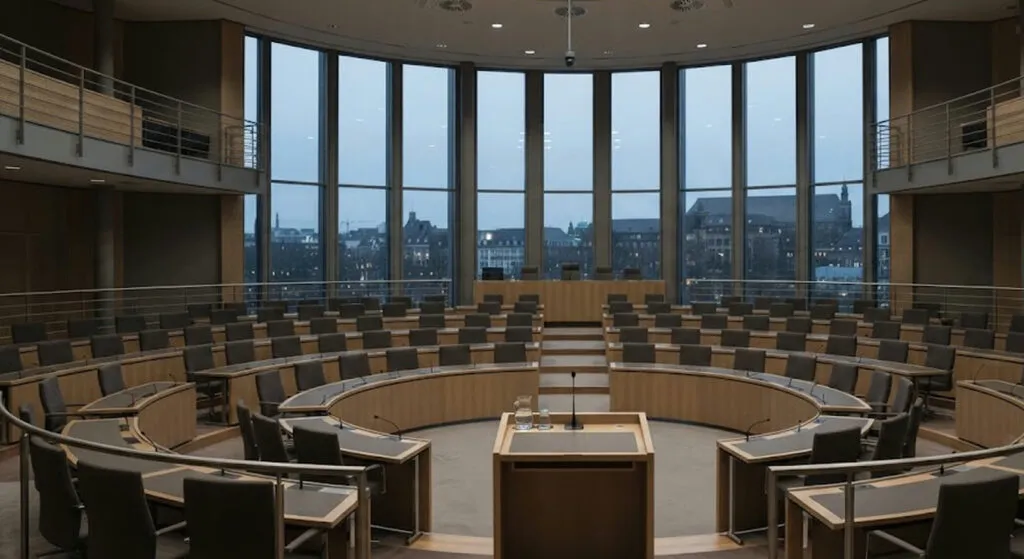
In Germany, one evening brought down a rule that had held since the founding of the Federal Republic. In Mecklenburg-Western Pomerania the CDU, the party of chancellor Friedrich Merz, took 4.9 percent and failed to clear the five percent threshold. According to NDR, this is the first time the CDU has failed to enter a state parliament at all.
The party that governed Germany for decades was left outside the door - by one tenth of a percent.
The AfD first in Mecklenburg
In the same state the AfD took 38.2 percent, finishing ahead of the SPD on 35.5 percent. The Left is on 6.5, the Greens on 5.7, and the BSW stayed under the threshold with 4.8 percent. The outgoing SPD-Left government lost its parliamentary majority, while every other party ruled out a coalition with the AfD during election night. In other words: the party with the most votes has nobody to govern with, and the parties that can govern do not have the most votes.
In Berlin, the left comes first for the first time
In the elections for Berlin's Abgeordnetenhaus, the Left won 25.7 percent and for the first time finished as the strongest party in the city. The CDU got 18.8 percent, the AfD 16.3, the Greens 14.3 and the SPD 12.1 percent. For the social democrats that is the weakest result in the history of Berlin parliamentary elections. The outgoing CDU-SPD coalition lost its majority and cannot continue in the same composition.
The numbers show where the vote went. In 2023 the CDU had 28.2 percent in Berlin. The AfD grew from 9.1 to 16.3 percent. Possible majorities being discussed include an alliance of the Left, the Greens and the SPD, or the mathematically possible CDU-Greens-SPD coalition.
Merz: "a debacle" - and I am staying
German chancellor and CDU leader Friedrich Merz called his party's result in Mecklenburg "a debacle". Even so, he said he takes responsibility and is staying on as chancellor. The message is familiar in every language on this continent: responsibility is taken, the office is kept.
This is not local German news. Germany is the country that has spent years playing the adult in the room for the Balkans - telling us how the rule of law is built, how a budget is run, what political stability means. When, in that country, in a single night, the leading party drops out of one parliament while in another a self-described anti-capitalist left wins for the first time, the definition of a "stable Europe" loosens considerably.
In Skopje this reads another way too. A large share of Macedonian families has someone in Germany, and German state governments decide on work permits, on schooling, on residence. A change in a state parliament in Germany is not distant news for a man whose son works in Schwerin.
What remains to be seen is not who will form a government in Berlin or Schwerin. What remains to be seen is how long a party can lose both the threshold and the election without losing the chancellery.
The latest 10 news from this category
Washington, Copenhagen and Nuuk are signing off on a military presence on an island of 56,000 people - and the...
Phones in Krāslava rang by themselves, the fighters took off, and what exactly triggered the alert - nobody is saying....
Tisza took 16 years of power off Fidesz and won 141 of 199 parliamentary seats. Orbán now says Brussels is...
With 75 percent of protocols counted, the governing party leads in 208 of the 225 single-mandate districts. A parliament of...
He never sat on the throne, and the emirate is lowering its flags for ten days. Sometimes the surname says...
Three options on the table in Washington - military pressure, economic strangulation or a deal - and the president frames...
The party of Adenauer and Kohl slid to the electoral threshold in Mecklenburg, the AfD is already demanding the chancellor's...
Two prime ministers in the same Union, the same month, completely opposite diagnoses of who is provoking whom. There is...

A broken aircraft in a field usually ends up in a police note. This one ended up with federal investigators,...

Beijing will easily find another supplier. The harder question is what Washington is actually testing: whether private Chinese companies will...
This site uses cookies - is that okay? Learn more
Be the first to know when Metla launches something new
Leave your email and we will write when there is a new guide or something new on Metla.