
Six Years of Fake Licence Categories Issued From an Interior Ministry Desk: Six Charged, 21 More Under Investigation
21.09.2026


21.09.2026

21.09.2026
21.09.2026

21.09.2026

21.09.2026
21.09.2026

21.09.2026

20.09.2026
20.09.2026

21.09.2026

21.09.2026

20.09.2026

21.09.2026

21.09.2026

21.09.2026

21.09.2026

20.09.2026

19.09.2026

21.09.2026

21.09.2026
21.09.2026
21.09.2026
21.09.2026

21.09.2026

09.03.2026

27.02.2026

19.02.2026

21.09.2026
21.09.2026

20.09.2026

23.04.2026

23.04.2026

12.04.2026

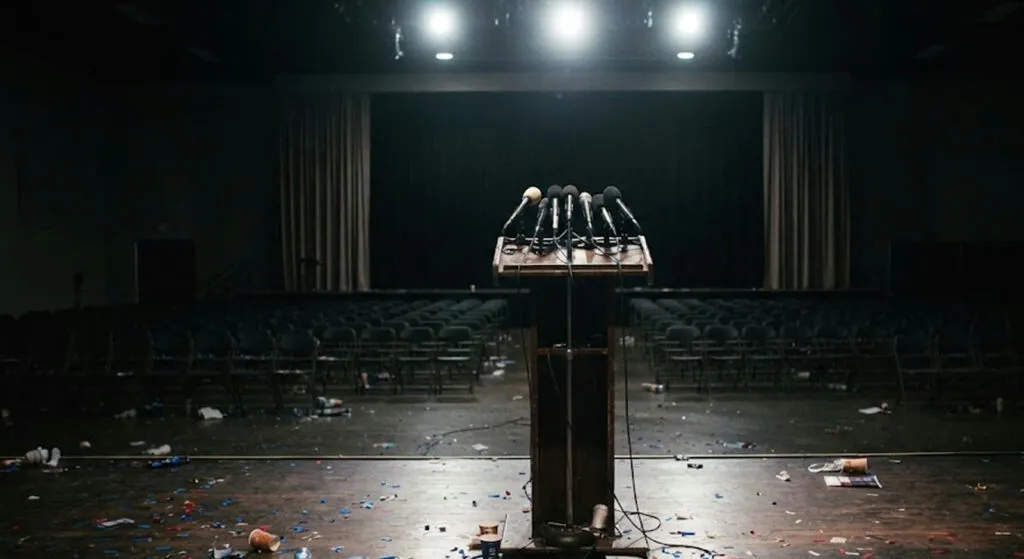
Almost four million voters in Berlin and Mecklenburg-Western Pomerania chose new state parliaments on Sunday, and the evening ended in a political earthquake. According to projections, the Left (Die Linke) is comfortably the strongest party in Berlin, the AfD finished first in Mecklenburg-Western Pomerania, and Chancellor Friedrich Merz's CDU sank in that state to the very edge of the electoral threshold.
Five percent for the party governing Germany
According to the ARD projection at 19:57, the CDU had just five percent of the vote in Mecklenburg-Western Pomerania, against 13.3 percent in 2021. If confirmed, that would be the CDU's worst state election result since the founding of the Federal Republic. Berlin brought no relief either: 19.1 percent, far below the 28.2 percent from the rerun election in 2023.
Merz did not try to dress it up. "We cannot put a gloss on the result in Mecklenburg-Western Pomerania, it is a disaster," the chancellor said, arguing the CDU had been "ground down" in the sharpened fight between the SPD and the AfD. In other words: it is not us, it is the other two. How many times have we heard that from Balkan party headquarters after an election night?
The AfD is already demanding a resignation
At AfD headquarters the result was received as proof that the party is taking the place the CDU once held. "We have displaced the CDU as the leading people's party," said co-leader Alice Weidel. According to Bild, the crowd chanted "Merz must go", and co-leader Tino Chrupalla openly called for the chancellor's resignation. The AfD's candidate for Mecklenburg premier, Leif-Erik Holm, reads the result as a mandate to try to form a government and announced he would invite other parties to talks.
Except that the AfD, despite coming first, has no majority to govern alone, and every other party has so far refused a coalition with it. That does not curb the ambition: one of its leading candidates, Enrico Schult, said that at some future election the AfD could be strong enough not to need a partner at all. State by state, that sentence sounds less and less like fantasy.
Infratest dimap's voter-flow data is particularly uncomfortable for the CDU: in Berlin the AfD gained a net inflow of around 56,000 voters directly from the CDU and another 65,000 from people who had not voted at all before. So this is not just general decline - part of the Christian Democrat base is going straight to the AfD.
The chancellor of announcements
Merz came before the public unusually early for an election night, and that alone says how much pressure he is under. It has been building since the Saxony-Anhalt election two weeks earlier, where the AfD won almost 44 percent and the CDU fell to around 17. Days before this vote, all eight CDU state premiers publicly backed him. And the fact that the party's senior figures had to insist on election night that "the party is united, anything else would be madness", as Karl-Josef Laumann put it, is the best indicator that it is not quite so.
Behind the podium stood the German and European flags, and on the podium itself the CDU logo - which raised the question of whether he was speaking as chancellor or as party leader. He answered it himself: "The reforms must come," and he will implement them "as CDU leader and above all as federal chancellor". He even called the reforms a "remedy against the authoritarian poison" seeping ever deeper into society. The paradox, noted by Tagesschau too, is that the man his own party colleagues called "the chancellor of announcements" during the campaign is now trying to change that image - with new announcements.
Time as the only ally
Merz's strategy now is to buy time, and the calendar helps him: there are no state elections until April 2027. He is counting on the economy - the government expects the effects of large investments financed by borrowing and special funds to be felt gradually, and Merz spoke during the campaign of 1.3 percent growth in 2026. The problem is that a GDP figure does not mean the citizen feels it: energy, healthcare and pension costs remain, and it is precisely the social reforms that have caused the most conflict in recent months. How many Balkan prime ministers have we heard say "the economy is growing" to voters who see nothing of that growth?
And in Berlin an entirely new question has opened: with 25.3 percent the Left became the strongest party in the capital. Veteran Gregor Gysi called it a historic turning point and told his party it must now take responsibility for the whole of Berlin, not only for its own voters. Former mayor Michael Müller of the SPD is already warning that a three-party coalition led by the Left would be extremely difficult - he ran such an alliance himself for five years. In Mecklenburg, meanwhile, Premier Manuela Schwesig's SPD finished on around 36 percent, very close to the AfD, and that after distancing itself during the campaign from parts of the federal government's policies, pensions in particular. When your coalition partner distances itself from you in order to survive, that is a message to the chancellor that needs no ARD projection.
The CDU's federal leadership meets on Monday, the Bundestag parliamentary group on Tuesday. Merz cannot easily be removed - a constructive vote of no confidence requires an absolute majority for a successor - so resigning or calling a confidence vote remain his own decisions. He will probably survive this week. How many such weeks he has left is the question nobody in Berlin says out loud.
The latest 10 news from this category
Three options on the table in Washington - military pressure, economic strangulation or a deal - and the president frames...
Two prime ministers in the same Union, the same month, completely opposite diagnoses of who is provoking whom. There is...

A broken aircraft in a field usually ends up in a police note. This one ended up with federal investigators,...

Beijing will easily find another supplier. The harder question is what Washington is actually testing: whether private Chinese companies will...
The law lets Washington hit the five biggest buyers of Russian oil with tariffs of up to 100 per cent....
Measures imposed over the war in Ukraine are now being offered as currency in an entirely different dispute. If the...

A smaller dose and more needles does not mean a safer vaccine, it means an ineffective one. Science has had...
Harald designed the sarcophagus himself, and it is shaped like a ship. The stone is 400 million years old and...

Von der Leyen proposed a status that does not exist in European law, the Canadians distanced themselves, and Washington announced...
The French candidate called the war in Ukraine a slaughterhouse and pointed out it has already lasted longer than the...
This site uses cookies - is that okay? Learn more
Be the first to know when Metla launches something new
Leave your email and we will write when there is a new guide or something new on Metla.