


They Rode In on Scooters, Torched the Shops and Left: The Fire in Shuto Orizari Burned for Three Hours, Setting It Took Fifty Seconds
13.09.2026


13.09.2026

13.09.2026
13.09.2026

13.09.2026

13.09.2026

13.09.2026

13.09.2026

12.09.2026

11.09.2026

13.09.2026

13.09.2026

12.09.2026

13.09.2026

13.09.2026

13.09.2026

13.09.2026

12.09.2026

11.09.2026

13.09.2026

13.09.2026

13.09.2026

13.09.2026

13.09.2026

12.09.2026

09.03.2026

27.02.2026

19.02.2026

13.09.2026

12.09.2026

11.09.2026

23.04.2026

23.04.2026

12.04.2026

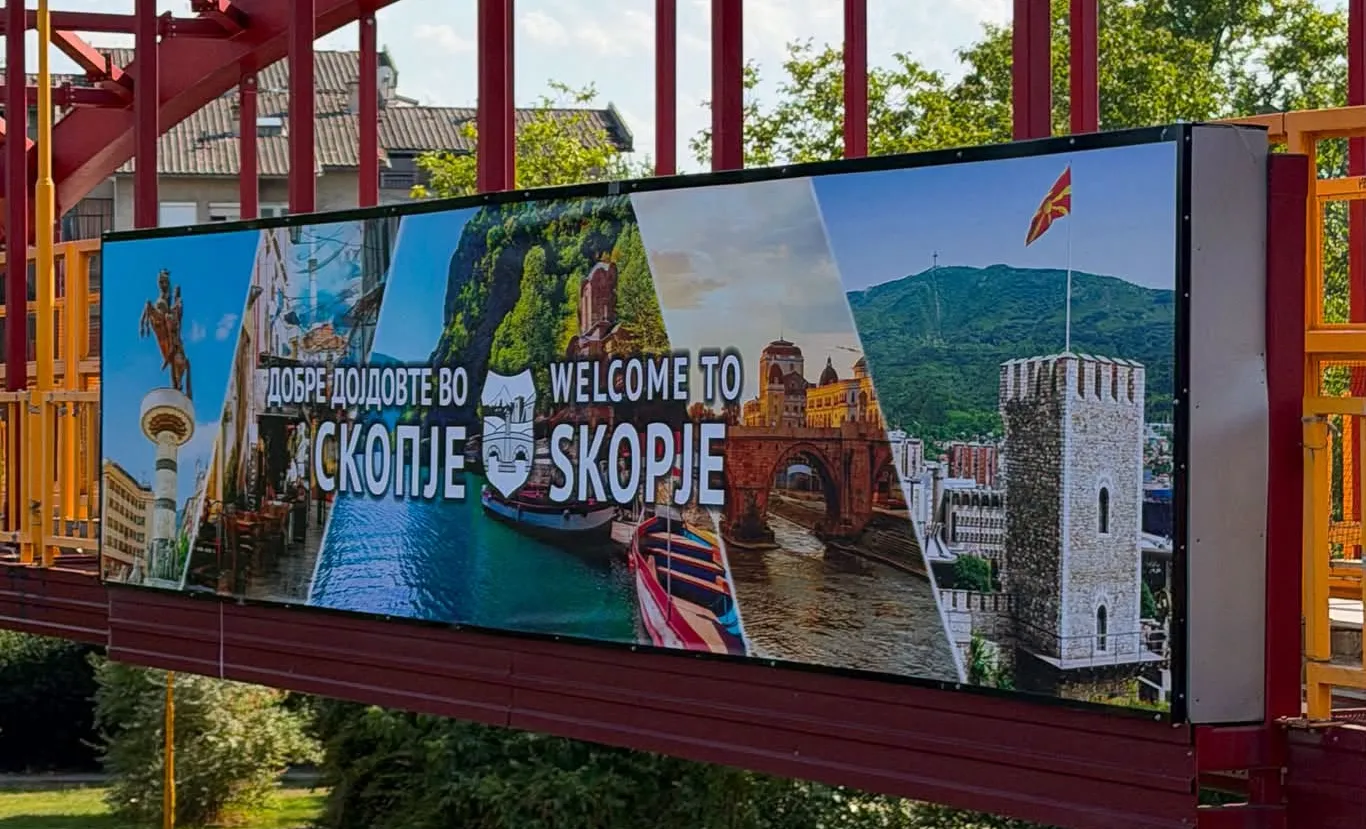
The welcome sign at the entrance to Skopje - the one with the photo collage and the caption „Dobre dojdovte vo Skopje / Welcome to Skopje" - is once again the subject of political dispute. This time not because of the five-legged horse that had earlier made the picture a punchline, but because of something missing: the Albanian language.
DUI accuses the City of Skopje of breaching, twice in a single day, its legal obligation to use the Albanian language. Skopje, they remind, is a bilingual city, and its institutions have a clear legal duty to use Albanian in official communication - yet the sign at the entrance stands only in Macedonian and in English.
But the opposition's main arrow points not at the city, but at one institution that, they say, ought to react and instead stays quiet: the Inspectorate for the Use of Languages. „This institution was formed precisely to establish violations and to impose measures. Years of work, staff and training went into its creation," DUI says - and it demands the immediate resignation of the director, a cadre of the Vlen party.
According to the opposition, the Inspectorate's silence directly emboldens the violators and turns the exclusion of the Albanian language into institutional practice. That's why, alongside the resignation, they also demand legal accountability for everyone who broke the Law on the Use of Languages.
Behind the party sparring sits a question that outlasts the daily statements. The Inspectorate exists, the law exists, the obligation exists - but if the institution set up to enforce the law goes silent when the law is broken most visibly, on the sign at the very entrance to the city, then what is it for? A sign can be changed in a day, the way the billboard with the horse was changed after the criticism. An institution that doesn't act is the heavier problem, and it isn't fixed with a new stamp.
The latest 10 news from this category

Five negations in one sentence, pension growth "16 times higher" with not a single figure beside it, and a third...
One side waits for a letter, another waits for a different commission, a third waits for consent. In those same...

The commission's chairman says it only checked whether the documents were complete. The public call says something else entirely -...

Three candidates, two of them lawyers, one of them employed by the very municipality he is running for. The line...
People are sitting in prison on the basis of verdicts that no longer exist, because the written reasoning has not...

The government says the celebration cost citizens nothing from the budget. But the chairman of the committee that assessed the...
The government tasked the Lottery on 28 April, two days later a call went out with a five-day deadline, and...
The opposition estimates at least a million euros for David Guetta's set alone and up to five million in total....

In court, Grubi said a short "No". The prosecution raised the damage by one and a half million euros -...
The opposition says around 250 children with disabilities started the year without an assistant. The ministry says a record 1,524...
This site uses cookies - is that okay? Learn more
Be the first to know when Metla launches something new
Leave your email and we will write when there is a new guide or something new on Metla.
