


They Rode In on Scooters, Torched the Shops and Left: The Fire in Shuto Orizari Burned for Three Hours, Setting It Took Fifty Seconds
13.09.2026


13.09.2026
13.09.2026
13.09.2026

13.09.2026

13.09.2026
13.09.2026
13.09.2026

12.09.2026

11.09.2026

13.09.2026

13.09.2026

12.09.2026

13.09.2026

13.09.2026

13.09.2026
13.09.2026

12.09.2026

11.09.2026

13.09.2026

13.09.2026
13.09.2026

13.09.2026

13.09.2026

12.09.2026

09.03.2026

27.02.2026

19.02.2026
13.09.2026

12.09.2026

11.09.2026

23.04.2026

23.04.2026

12.04.2026

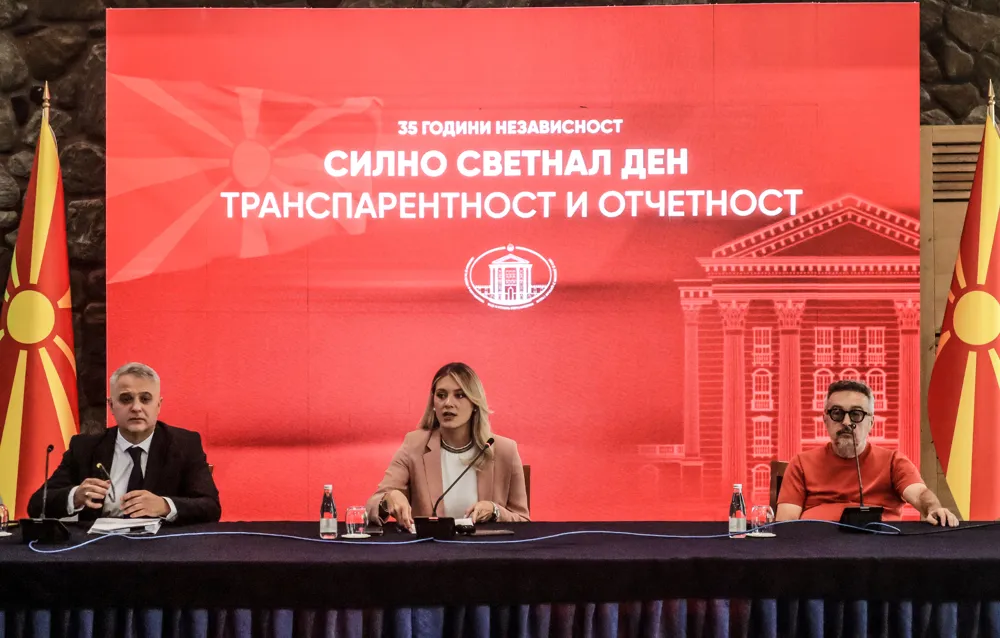
The deadline for submitting bids to organise the celebration of 35 years of independence expired on Friday, 8 May, at noon. A single bid arrived, running to about a hundred pages. On Tuesday, 12 May, the government, together with the production company Avalon, was already presenting the programme in front of the cameras, with David Guetta as the headline name.
Between Friday noon and Tuesday there are four calendar days, two of them a weekend. Within that window, according to the public call, the documentation was supposed to be opened, its completeness verified, a substantive evaluation carried out, production and financial justification assessed, a report prepared, the decisions taken, and the chosen contractor made ready for an official government presentation.
This is a project worth around 5.5 million euros of public money.
A commission that rewrote its own role
The most interesting contradiction is not in the deadlines, but in what the commission says about itself. The public call states in black and white that it conducts the procedure, carries out the evaluation, produces a report proposing the most favourable bidder, and assesses a whole spectrum of criteria: the quality and innovativeness of the concept, production value, expected public interest, technical and logistical readiness, financial justification and transparency.
And its chairman Nikolche Micevski now claims the commission served in practice only to establish whether the documents were complete and submitted on time.
Both claims cannot be true at once. If the call is right, then the body that assessed a five-million-euro project did exactly that - and the report exists. If Micevski is right, then the substantive evaluation the call provided for was carried out by someone else, and that someone has a name.
Chairman of the commission, then a contributor to the programme
Here the story gets heavier. The same Micevski who chaired the commission later appears as the author of the arrangements for the José Carreras concert - part of the same celebration.
Promoter Boban Milosheski stated publicly that he and his "friend and long-standing collaborator Nikolche Micevski" had discussed that project for a full two years. Micevski, for his part, claims that at the time he was running the commission he did not know he would later be engaged in the programme.
Two accounts, two opposing timelines, and one very concrete document that would settle the question - a formal declaration of no conflict of interest, if one was given before he joined the commission.
What exactly is being demanded
Levica is demanding publication of the commission's full report, the minutes of its work, individual scores if they exist, the reasoning for each criterion, the selection decision, the date the chosen contractor was notified, and the entire timeline from the submission of the bid to the official announcement.
The logic is simple: when a single bid arrives in a procedure, the term "most favourable bidder" only means something if the public can see what that favourability was established against. Otherwise the evaluation is merely a bureaucratic path to a pre-prepared outcome.
SDSM is demanding the same - that all documents be published and that it be said who sits on the commission at the State Lottery that selected the companies, and by what criteria more than 5 million euros were handed out.
The scene behind all of this
The backdrop makes the story heavier. The same week these documents are being demanded, winegrowers in the Tikvesh region are digging up their own vines because there is no buyer, and peppers are being bought at 15 denars against a production cost of 26.
Nobody is arguing that the state may not mark 35 years of independence. The question is a different one, and it is entirely concrete: why should a procedure involving five million euros of the people's money stay behind closed doors, if all of it was impeccably clean?
The latest 10 news from this category
Five negations in one sentence, pension growth "16 times higher" with not a single figure beside it, and a third...
One side waits for a letter, another waits for a different commission, a third waits for consent. In those same...
Three candidates, two of them lawyers, one of them employed by the very municipality he is running for. The line...
People are sitting in prison on the basis of verdicts that no longer exist, because the written reasoning has not...

The government says the celebration cost citizens nothing from the budget. But the chairman of the committee that assessed the...
The government tasked the Lottery on 28 April, two days later a call went out with a five-day deadline, and...
The opposition estimates at least a million euros for David Guetta's set alone and up to five million in total....
In court, Grubi said a short "No". The prosecution raised the damage by one and a half million euros -...
The opposition says around 250 children with disabilities started the year without an assistant. The ministry says a record 1,524...

At a panel marking 8 September, the president measured statehood in decades, not in elections. The sharpest message came from...
This site uses cookies - is that okay? Learn more
Be the first to know when Metla launches something new
Leave your email and we will write when there is a new guide or something new on Metla.
