The Entire Interior Ministry Lost Its Health Insurance Overnight: Police Officers Turned Away From Chemotherapy Over One Unposted Entry
11.08.2026


11.08.2026
11.08.2026

11.08.2026
11.08.2026

11.08.2026

11.08.2026
11.08.2026
10.08.2026

10.08.2026

11.08.2026

11.08.2026

10.08.2026
11.08.2026

11.08.2026

11.08.2026

11.08.2026
10.08.2026

09.08.2026
11.08.2026

11.08.2026

11.08.2026
11.08.2026

11.08.2026

11.08.2026

09.03.2026

27.02.2026

19.02.2026

23.04.2026

23.04.2026

12.04.2026
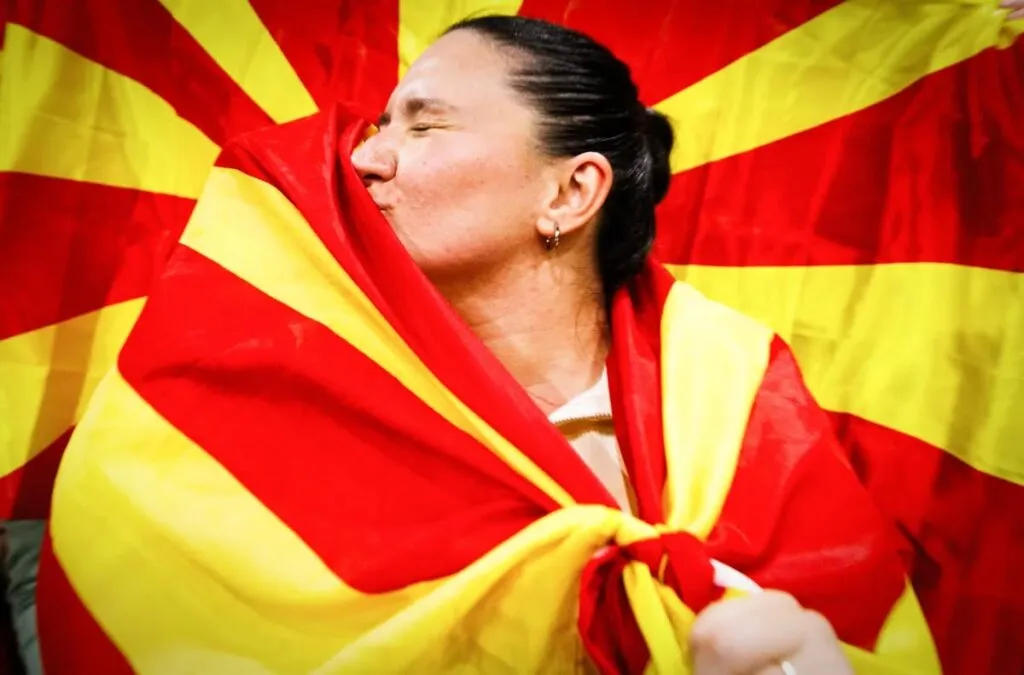
On 11 August 1992 parliament voted through two symbols of a new state. One is still with us. The other lasted three years and triggered an economic blockade.
Thirty-four years on, it's worth reading how exactly that happened - because the story is more interesting than the anniversary.
A competition, 36 submissions, three finalists
The 1991 constitution did not adopt an anthem automatically. It had to be set by law, within six months. On 25 March 1992 the parliamentary commission for constitutional affairs announced a public competition for the coat of arms, the flag and the anthem, requiring the symbols to express statehood, independence and sovereignty, historical tradition, cultural heritage and the country's natural characteristics.
Thirty-six entries arrived for the anthem. The commission picked three finalists: "Himna" by Taki Hrisik, "Denes nad Makedonija" in Todor Skalovski's musical version, and "Da ni bides vecna" by Aleksandar Dzambazov. In the later stages "Denes nad Makedonija" remained the only proposal and was voted through on 11 August.
So there was a real competition, with a real choice. That is a detail that today sounds almost exotic.
A song from 1941, written and played the same evening
What few people know is that the song wasn't new in 1992 at all. It was written in 1941 in Struga - the lyrics by Vlado Maleski, the music by Todor Skalovski. According to accounts, Maleski performed it on guitar the same evening, right after writing it.
After the war it first became the anthem of the Socialist Republic of Macedonia, and after independence in 1992 it acquired fully official status as the anthem of an independent state.
There is a detail rarely mentioned. The lyrics did not stay unchanged. The original 1941 version contained different names: "...Goce Delcev, Pitu Guli, Karev, Vlahov, Sandanski", as against today's "...Goce Delcev, Pitu Guli, Dame Gruev, Sandanski". The line "From the grave rose the glorious builders..." was later replaced with "Once again now the flag flies...". The changes happened by the time of the first publication in the collection "Macedonian National Liberation Songs" in June 1943, with no official explanation of why those particular parts.
The flag that cost a blockade
The same day parliament also adopted the first state flag - the Vergina Sun, a sixteen-rayed sun on a red field. The symbol is named after an archaeological find: a golden larnax excavated in 1977 at Kutlesh in Aegean Macedonia by the Greek archaeologist Manolis Andronikos, in tombs he believed belonged to Philip II of Macedon.
The flag was in use from July 1992 to 1995. The diplomatic dispute with Greece over precisely that ancient symbol led to an economic blockade against the young state. The solution came through diplomacy - on 13 September 1995 in New York, then foreign minister Stevo Crvenkovski and his Greek counterpart Karolos Papoulias signed the Interim Accord.
The current flag was then introduced: a golden-yellow sun with eight main and eight secondary rays extending to the edges. The law is pedantic down to the last detail - the diameter of the solar disc is one seventh of the flag's width, and the ratio between secondary and main ray is precisely specified.
Thirty-four years later
The anthem survived everything - Yugoslavia, independence, the blockade, Prespa. The flag was changed under economic pressure. The two symbols carry the whole story of this state: one thing nobody could take from us, and one we gave up so the border would open.
And the law regulating the use of those symbols, with all those millimetre-prescribed rays, still exists today. Who bothers to read it before ordering a flag for a state celebration - that is already another topic.
The latest 10 news from this category
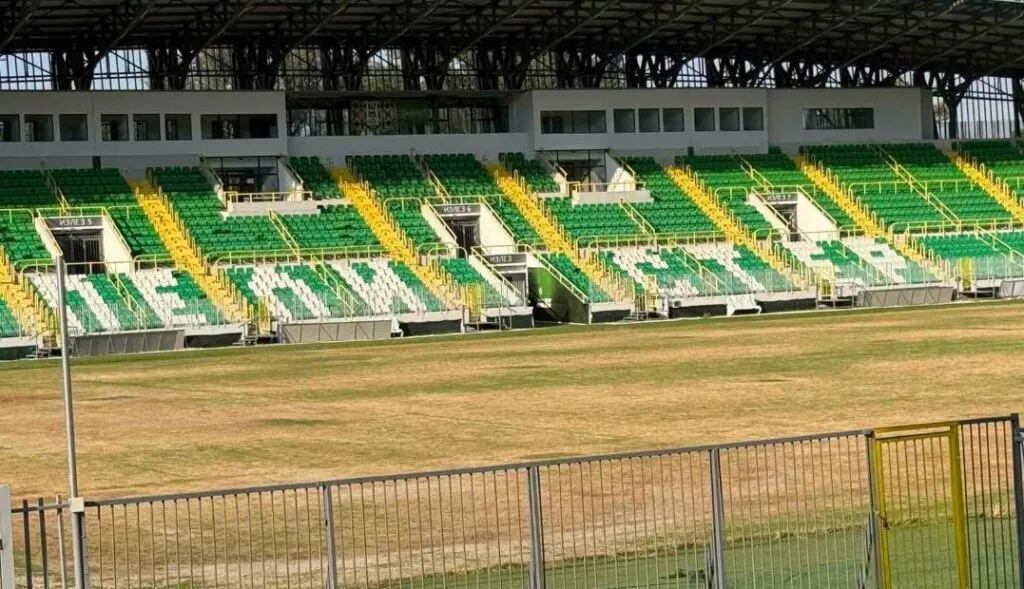
The Petar Milosevski stadium passed a UEFA inspection last year. This week it looks like hay. A councillor published the...
Vasko Tomulevski (44) died on a motorcycle. With a group of villagers he protested for four months and stopped the...
The City of Skopje announces the first layer of asphalt to Dracevo. The chronology shows the section was stuck over...
The appeal was dismissed, the contract follows, and delivery is spread over three instalments up to 18 months. In the...

Neighbours with hoses and shovels waited for the fire engine. Then they asked for something cheaper than any aircraft -...
In Orthodox tradition you do not concelebrate with someone whose status is disputed. Which is why one liturgy at the...
The municipalities publish the treatment boundary down to the last village. What no statement contains is how many mosquitoes are...

A show with over 30 performers and a tour of 11 cities is not made overnight. If nobody in that...
The town already counts over 1,400 parking spaces and knows what every hour costs. What is not published is whether...

Not a single imported headliner in the programme. The budget that would go on one foreign name is spread here...
This site uses cookies - is that okay? Learn more
Be the first to know when Metla launches something new
Leave your email and we will write when there is a new guide or something new on Metla.