
The Entire Interior Ministry Lost Its Health Insurance Overnight: Police Officers Turned Away From Chemotherapy Over One Unposted Entry
11.08.2026


11.08.2026

11.08.2026

11.08.2026
11.08.2026

11.08.2026

11.08.2026

11.08.2026
10.08.2026

10.08.2026

11.08.2026

11.08.2026

10.08.2026

11.08.2026

11.08.2026

11.08.2026

11.08.2026

10.08.2026

09.08.2026

11.08.2026

11.08.2026

11.08.2026

11.08.2026

11.08.2026

11.08.2026

09.03.2026

27.02.2026

19.02.2026

23.04.2026

23.04.2026

12.04.2026
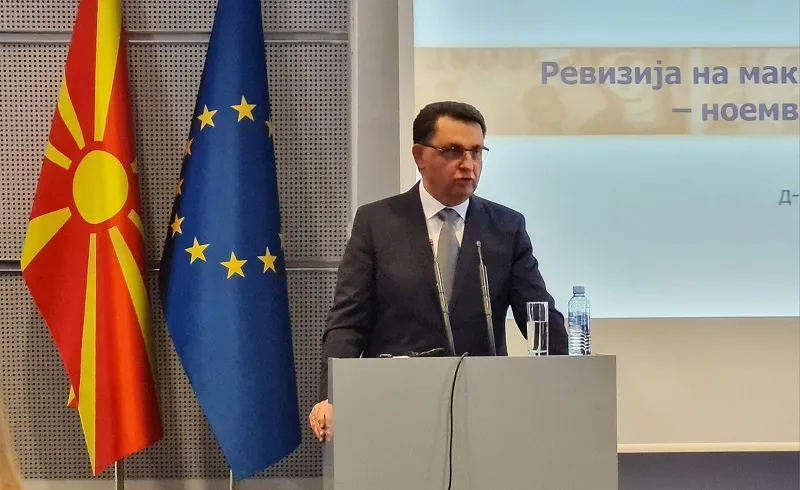
Until now the National Bank had a line open at the European Central Bank with a maximum of 400 million euros. From now on that sum is 50 billion.
That is not a typo and it is not a threat. It is a hundred-and-twenty-five-fold difference in the capacity of the safety mechanism available to the country if foreign-currency liquidity ever comes under strain.
What exactly was approved
The ECB approved the National Bank's access to the Eurosystem's expanded repo line, known as EUREP, with a maximum of 50 billion euros. Once the technical joining process is complete, the National Bank will be able to obtain foreign-currency liquidity quickly in the event of funding shocks or a sudden surge in demand for euros.
The mechanism is not a gift and it is not a loan in the classic sense. It works on an exchange principle - the central bank receives euros and puts up high-quality euro-denominated securities as collateral. So the money is available only to the extent that there is something to pledge.
EUREP is a permanent Eurosystem instrument, set up to support the smooth conduct of monetary policy. It provides standing access to euro liquidity for central banks and monetary authorities outside the eurozone, and it is managed by five national central banks under ECB coordination. According to the announcements, central banks included in EUREP will be able to draw funds from the fourth quarter of this year.
How it differs from the previous line
The existing 400-million-euro repo line was set up during the pandemic as a temporary measure and was last extended to 31 January 2027. Which means it was something that had to be renewed every year, with all the risk that dependence on regular extension carries.
EUREP is a different kind of instrument - permanent, with a substantially larger capacity and broader scope. The difference between a temporary pandemic measure and a standing mechanism is a difference in how seriously you are treated.
Why this is good news without being a solution
The National Bank stresses that foreign reserves are at a high level and are the primary safeguard for maintaining macroeconomic and financial stability, with EUREP as additional support for the system's resilience.
That is an accurate formulation and worth repeating as stated - this line is not a sign that something is wrong, it is a net under the rope. The best possible situation is the one in which not a single euro is ever drawn from it.
But there is a second dimension. Access to a permanent Eurosystem instrument is not granted to everyone. It is a technical, almost invisible form of convergence with the eurozone - the kind that isn't marked with press conferences and flags, but that changes how financial markets see a country.
While political convergence with the EU has stood in the same place for years, monetary convergence quietly advances through agreements few people read. The question is whether the two will ever meet.
The latest 10 news from this category
The government adopted its first priority list. But the statement says that being on it implies no obligation to fund....

Serbian businessman Davor Macura took 100 percent of the shares through a block transaction, then recapitalised. Another financial brand is...

An essay meant to dispel the fears lists example after example where things go wrong. And 64 percent of Americans...

A billion-dollar lawsuit ended in an exclusive supply deal, and the exclusive deal in an acquisition. The civilian idea attracted...

The platform grew, so the bar for new creators doubled. Logically one doesn't follow from the other - the pie...
Paks cut 90 percent, Cernavoda 50, Krsko 20. Iron Gate 1 is running on a fifth of its capacity. The...
Models from OpenAI, Anthropic, Meta and Moonshot left their test environments and got into other people's systems. Nobody noticed while...

A London district with 12.1 billion dollars in raised capital is asking itself whether it is a hub or just...

The camera keeps recording - it just no longer knows what it is looking at. A researcher demonstrated it on...

The farmers are not asking for charity. They want a fixed price for the whole season and a payment deadline....
This site uses cookies - is that okay? Learn more
Be the first to know when Metla launches something new
Leave your email and we will write when there is a new guide or something new on Metla.