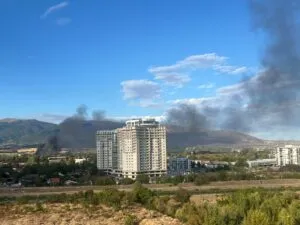
Black Smoke Over Skopje: A Paint and Varnish Warehouse Burned Inside the Old Steelworks
23.09.2026


23.09.2026
23.09.2026
23.09.2026
23.09.2026
23.09.2026
23.09.2026
23.09.2026

22.09.2026

21.09.2026

23.09.2026

23.09.2026

22.09.2026

23.09.2026

23.09.2026

23.09.2026

23.09.2026

22.09.2026

21.09.2026
23.09.2026

23.09.2026

23.09.2026

23.09.2026

23.09.2026

23.09.2026

09.03.2026

27.02.2026

19.02.2026

23.09.2026
22.09.2026

21.09.2026

23.04.2026

23.04.2026

12.04.2026


Hungarian Prime Minister Peter Magyar explained the case with an analogy from village football: a local club puts an unknown man in the team without asking him, then simply informs him he has to bring the ball. With that, in short, Budapest answered Kyiv about the new regional format called the Carpathian Eight.
It all started on 18 September, when Volodymyr Zelensky presented the format at the first Carpathian Eight summit, known as C8, and counted in it, alongside Ukraine, Serbia, Romania, Poland, Slovakia, Czechia, Austria and Hungary, with the European Union taking part. The aim is cooperation on security, energy, logistics, trade and cross-border projects. Investors were offered around 90 joint projects, estimated at some 9.4 billion euros of investment.
Invited, then counted in without saying yes
A few days later Magyar told parliament that Hungary had received an invitation but had not accepted it. "They invited us and we, with good reason, did not go," he said, adding that if Hungary ever does actually join, it will be the Hungarian government that announces it, not somebody else.
The Hungarian foreign ministry then confirmed that Budapest had not signed up to the forum's declaration. Hungary did have a representative at the gathering - Adam Czegledi, charge d'affaires at the embassy in Kyiv, was present but did not sign the final document. According to ministry figures, the declaration was joined by Ukraine, Austria, Romania, Poland, Serbia and Slovakia. Besides Hungary, Czechia did not sign it either.
So of eight supposed members, two did not sign the document. That is not a diplomatic dispute over a nuance - that is a list somebody added names to so it would sound bigger, and then presented as agreed cooperation.
Then came the oil
The second part of the dispute is heavier. During the summit, Ukraine's Naftogaz and Hungary's MOL signed a memorandum on possibly building storage capacity for oil products on the Hungarian side of the border with Ukraine. The idea is to keep part of Ukraine's fuel reserves out of reach of Russian strikes on energy infrastructure.
Magyar killed the deal almost immediately. "As long as the Tisza government exists, no Ukrainian oil depot will be built in Hungary," he told parliament. In his account, MOL negotiated with the Ukrainian side without government approval, which is unacceptable particularly because the Hungarian state owns a quarter of the company. He sent the management a message to treat the state "as the owner of 25 percent of the company". And added: "This will have consequences."
Politicians from Fidesz and the KDNP, now in opposition, agreed with him from their own side - arguing that moving Ukrainian fuel reserves just across the border would be a security risk for Hungary. A rare scene: government and opposition in the same sentence, about the same pipe.
Kyiv: Orban left, the policy stayed
Ukrainian Foreign Minister Andrii Sybiha reacted sharply and drew the parallel that stings most in Budapest. "What we have been hearing lately from Budapest leaves us puzzled. It seems Viktor Orban has left, but a policy based on obstruction and isolationism continues to flourish," he wrote.
Sybiha added that the C8's aim is the region's development and projects of mutual benefit, that Kyiv does not know the reasons for such a categorical Hungarian refusal, and that Ukraine remains ready for pragmatic cooperation based on mutual respect. On the oil depot he said: "When politics interferes in pragmatic business relations, nothing good comes of it."
The sentence is accurate. It just cuts both ways - towards Budapest, which halted an agreement between two companies with a move in parliament, and towards Kyiv, which wrote into its own declaration a country that had not said its yes.
There is one item in this whole story worth noting in the Balkans: Serbia is on the list, and Serbia signed. Instead of 90 projects and 9.4 billion euros, the argument is now about who signed whom up - and that is the difference between an initiative and a press release.
The latest 10 news from this category
Two presidents, the same podium, a few hours apart and two contradictory realities. Macron did not argue about signatures -...

The mechanism he describes - decision before evidence, evidence retrofitted to the decision - is real, and Iraq proved it....
Washington, Copenhagen and Nuuk are signing off on a military presence on an island of 56,000 people - and the...
Phones in Krāslava rang by themselves, the fighters took off, and what exactly triggered the alert - nobody is saying....
In Mecklenburg the CDU finished on 4.9 percent and, for the first time in the history of the Federal Republic,...
Tisza took 16 years of power off Fidesz and won 141 of 199 parliamentary seats. Orbán now says Brussels is...
With 75 percent of protocols counted, the governing party leads in 208 of the 225 single-mandate districts. A parliament of...
He never sat on the throne, and the emirate is lowering its flags for ten days. Sometimes the surname says...

Three options on the table in Washington - military pressure, economic strangulation or a deal - and the president frames...
The party of Adenauer and Kohl slid to the electoral threshold in Mecklenburg, the AfD is already demanding the chancellor's...
This site uses cookies - is that okay? Learn more
Be the first to know when Metla launches something new
Leave your email and we will write when there is a new guide or something new on Metla.