
Black Smoke Over Skopje: A Paint and Varnish Warehouse Burned Inside the Old Steelworks
23.09.2026


23.09.2026
23.09.2026

23.09.2026

23.09.2026
23.09.2026

23.09.2026

23.09.2026

22.09.2026

21.09.2026

23.09.2026

23.09.2026

22.09.2026

23.09.2026

23.09.2026

23.09.2026

23.09.2026

22.09.2026

21.09.2026

23.09.2026

23.09.2026

23.09.2026

23.09.2026

23.09.2026

23.09.2026

09.03.2026

27.02.2026

19.02.2026

23.09.2026

22.09.2026

21.09.2026

23.04.2026

23.04.2026

12.04.2026

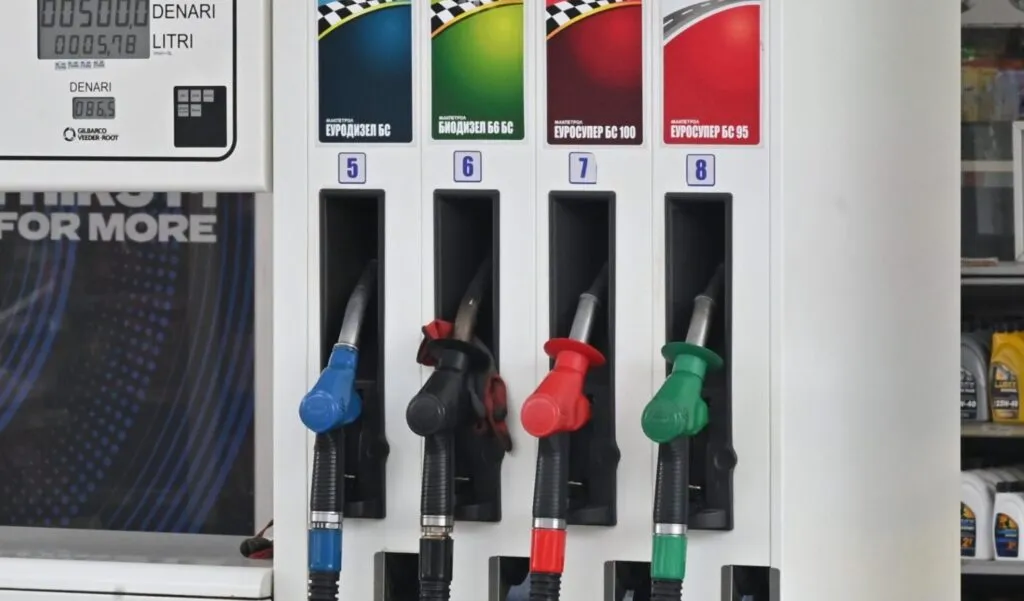
Crude oil on world markets has been getting cheaper for five trading sessions in a row. In the same week, the maximum retail price of eurodiesel in Macedonia jumped to 104.50 denars a litre - an increase of 5.50 denars.
The driver standing at the pump watching this is entitled to ask how that is possible.
A barrel and diesel are not the same thing
The answer is that the price of a barrel of crude and the price of finished diesel do not always move in the same direction, or at the same speed.
Refineries get several products out of one barrel of crude - petrol, diesel, kerosene, heavy fuel oil. Each has its own market, its own supply and its own demand. And diesel is currently under heavy pressure: constraints in refinery output, problems in parts of global supply chains, and increased demand for middle distillates. In those conditions diesel effectively detaches from the movement of the barrel.
Slovenia shows this is not a domestic anomaly - there the regulated diesel price crossed two euros a litre and reached about 2.01 euros, while petrol remains considerably cheaper.
Here, petrol got cheaper the same week: eurosuper BS-95 sells at 99 denars, BS-98 at 101 denars. Diesel is dearer than both.
The second reason: time
The price a driver sees today is not a copy of today's market price. Regulatory calculations are based on movements over a set preceding period. If crude starts falling today, the effect may only be felt in the next calculation - and only if the fall continues.
In the last calculation period the reference price for diesel rose far more than the one for petrol. That is the main reason for the jump.
The bill that adds up fast
For the domestic economy, diesel is not a car owner's expense. It is the operating cost of the trucks bringing food to supermarkets, of distribution vans, of farm machinery, of construction equipment and courier services.
A company burning 10,000 litres of diesel a month faces 55,000 denars in extra monthly cost from this 5.50-denar rise alone. For a haulier burning 100,000 litres, the difference is 550,000 denars a month.
The comparison with the start of summer is sharper still. On 11 August a litre of diesel cost 91.50 denars. In a little over a month the price is 13 denars higher - more than 14 percent.
Why bread gets dearer when diesel does
Not because the bakery oven runs on diesel. Because diesel sits at several points along the road bread travels - in growing the grain, in transport to the silo, in carrying the flour to the bakery, in distributing the finished loaf to the shops.
With fruit and vegetables the effect is even more visible: fuel for the tractors, for preparing the land, for the harvest, for transport to the buyer, then from buyer to distributor. Short shelf-life products add refrigerated transport and storage on top.
Mile Boskov of the Business Confederation warns about exactly this mechanism - higher logistics costs hit transport-dependent companies first, and then part of the load reaches consumers.
Duration decides, not a single price rise
The latest figures from the State Statistical Office show annual inflation at 2.6 percent in August, with the cost of living up 0.4 percent over the month. Food and non-alcoholic drinks rose 0.5 percent compared with July.
But August inflation barely contains the latest hit. The 104.50-denar price applies from 22 September, which means the first direct effect will only show in the September data, and the wider spillover in October and November.
If diesel drops back below 95 denars within two or three weeks, most companies will absorb the shock without changing their price lists. If it stays above 100 for several months, a temporary cost becomes a permanent one - and a permanent cost turns into a new price far more easily.
The least room to absorb it belongs to those on the thinnest margins - the small bakery, the local distributor, the farmer. A large company has long-term contracts and stock. They do not.
The latest 10 news from this category

48,499 denars, or about 789 euros. Croatia is at 1,555, Slovenia at 1,695. Only Kosovo is left below us.

Extra-light heating oil jumped 78.91 percent right before winter. The only remaining instrument is the reduced VAT - and it...

Classic trading fell 27 percent, block transactions jumped 159. The problem is not a shortage of money - it is...

The new GPT-6 models cost half of their predecessors, with accuracy comparable to the top of the series. When a...

Лабораториите ја достигнаа границата на она што се собира бесплатно од интернет, па сега купуваат податоци како што фабрика купува...

Од 13 години нагоре, со сметка врзана за родител и до тројца гости во возилото. Компанијата што ја гради довербата...
From midnight a litre of eurodiesel costs 104.50 denars, while petrol drops 1.50 denars. The explanation is not in Brent,...

The opposition ties Serbia's METER&CONTROL to Rudnap Group and to Sanja Božinovska's past. The statement, however, came with no document...

QR codes, certificates of origin and a public register are promised by the end of October. There is still no...
The German giant called it a productivity offensive. Translated: more hours, same pay. On the same day, 175,000 people were...
This site uses cookies - is that okay? Learn more
Be the first to know when Metla launches something new
Leave your email and we will write when there is a new guide or something new on Metla.