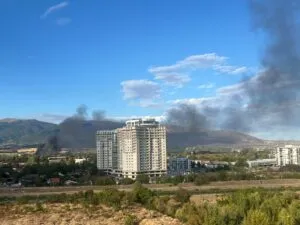
Black Smoke Over Skopje: A Paint and Varnish Warehouse Burned Inside the Old Steelworks
23.09.2026


23.09.2026

23.09.2026

23.09.2026

23.09.2026

23.09.2026

23.09.2026

23.09.2026

22.09.2026

21.09.2026

23.09.2026

23.09.2026

22.09.2026

23.09.2026

23.09.2026

23.09.2026

23.09.2026

22.09.2026

21.09.2026

23.09.2026

23.09.2026

23.09.2026

23.09.2026

23.09.2026

23.09.2026

09.03.2026

27.02.2026

19.02.2026

23.09.2026

22.09.2026

21.09.2026

23.04.2026

23.04.2026

12.04.2026


At a Moscow forum devoted precisely to fake news, Russian Foreign Minister Sergei Lavrov drew the line many in the Balkans have been drawing for decades - only from the other side of the microphone. The information war, he said, did not begin today or yesterday - and he went straight back to 1999.
The "Dialogue on Fake News 4.0" forum gathered over 2,000 participants from around 80 countries. Lavrov claims that before NATO's attack on the FR Yugoslavia, with the help of American associates in the OSCE, an open provocation was organised on Serbian territory in order to start the aggression. He has previously tied this claim directly to the Racak case of 15 January 1999 and to the role of the then head of the OSCE Kosovo Verification Mission, American diplomat William Walker. Racak, in his account, was the "trigger".
NATO began the bombing on 24 March 1999 and said at the time that the operation was launched after diplomatic attempts to resolve the Kosovo crisis had failed. The same date, two opposing explanations that have never met since. The Balkans know this scene by heart.
From Yugoslavia straight to Iraq
The second example Lavrov pulled out is harder to dismiss. On 5 February 2003, then US Secretary of State Colin Powell stood before the UN Security Council and presented intelligence claims that Saddam Hussein's regime held programmes and stockpiles of weapons of mass destruction. As a visual aid he used a small vial of white powder.
The later investigation by the American Iraq Survey Group found no such stockpiles. CIA documents on the group's work state that its then head David Kay concluded as early as late 2003 that they did not exist. The State Department still keeps Powell's entire presentation and the materials used that day in its archive - meaning nobody is hiding anything. It simply sits there, like an exhibit.
"It turned out all of it was a lie," Lavrov said.
The right diagnosis from the wrong doctor
This is where the hard part starts. The mechanism Lavrov describes - a claim is produced quickly, inflated within two or three days to the scale of a global catastrophe, and the decision lands before the public has all the facts - is real. Iraq proved it. Plenty of people in this region lived it earlier too.
But that same mechanism is nobody's exclusive. Moscow runs its own edition of it with equal precision, and the forum where this was said was literally organised in the country doing so. That does not make the diagnosis any less accurate. It makes the doctor interesting.
The point worth holding on to is quieter than the headlines: in 1999 and in 2003 alike, the decision came before the evidence, and the evidence was then fitted to the decision. Who says that in 2026 matters less than the fact that it still needs saying.
So the only question left with any meaning is who gets believed now, when every side already organises its own forum and picks the date from which it starts counting history.
The latest 10 news from this category
Two presidents, the same podium, a few hours apart and two contradictory realities. Macron did not argue about signatures -...

Peter Magyar compared it to a club that puts you in the team without asking, then tells you to bring...

Washington, Copenhagen and Nuuk are signing off on a military presence on an island of 56,000 people - and the...

Phones in Krāslava rang by themselves, the fighters took off, and what exactly triggered the alert - nobody is saying....
In Mecklenburg the CDU finished on 4.9 percent and, for the first time in the history of the Federal Republic,...

Tisza took 16 years of power off Fidesz and won 141 of 199 parliamentary seats. Orbán now says Brussels is...
With 75 percent of protocols counted, the governing party leads in 208 of the 225 single-mandate districts. A parliament of...
He never sat on the throne, and the emirate is lowering its flags for ten days. Sometimes the surname says...

Three options on the table in Washington - military pressure, economic strangulation or a deal - and the president frames...
The party of Adenauer and Kohl slid to the electoral threshold in Mecklenburg, the AfD is already demanding the chancellor's...
This site uses cookies - is that okay? Learn more
Be the first to know when Metla launches something new
Leave your email and we will write when there is a new guide or something new on Metla.