

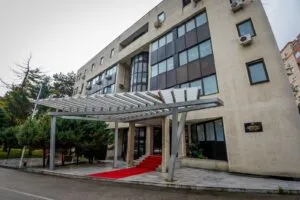
Two young men say police officers beat them while they were tied up: the investigation is being run by the Interior Ministry itself
10.10.2026


10.10.2026

10.10.2026

10.10.2026

10.10.2026
10.10.2026

10.10.2026

10.10.2026
10.10.2026
09.10.2026

10.10.2026

10.10.2026

09.10.2026

10.10.2026

10.10.2026

10.10.2026
10.10.2026

09.10.2026
08.10.2026
10.10.2026

10.10.2026
10.10.2026

10.10.2026

10.10.2026

09.10.2026
09.10.2026

08.10.2026

07.10.2026
10.10.2026

08.10.2026

06.10.2026

23.04.2026

23.04.2026

12.04.2026

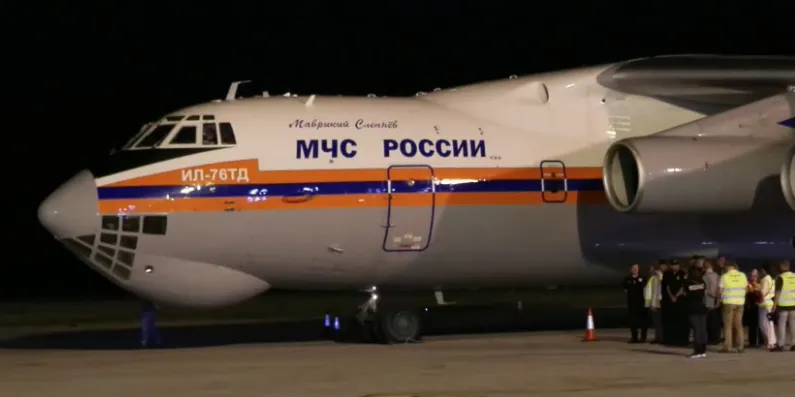
A Russian Il-76 from the Ministry of Emergency Situations landed at „Constantine the Great\" airport in Niš. The aircraft was sent to Serbia on the orders of Vladimir Putin, to help fight the forest fires.
The aircraft will be deployed over the Deliblato Sands, coordinated with the helicopter unit of the Serbian Interior Ministry. The firefighting version of the Il-76 can carry up to 42 tonnes - that is, 42,000 litres of water or extinguishing agent.
The figure is worth holding onto for a second. Forty-two tonnes per flight - that is a quantity no country in the region can deliver on its own.
A fire that will not let up
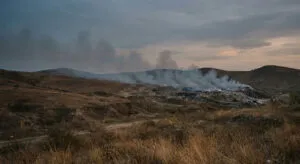
The fire in the Deliblato Sands is still active, and strong winds are hampering attempts to bring it under control. Around 4,000 hectares have burned despite the deployment of multiple units on the ground and in the air. Experts estimate this could be the largest fire ever recorded in this protected area.
The Deliblato Sands is not an ordinary forest. It is a special nature reserve, the largest sand expanse of its kind in Europe, with species that grow nowhere else in the region. What is burning there does not grow back in one season.
When help arrives with a signature
A representative of the Russian Ministry of Emergency Situations thanked those present for the welcome after landing. The welcome, after all, had been organised - cameras, footage, an announcement that the plane was sent „on the personal orders\" of the Russian president.
And here comes the part worth naming out loud: to the person whose house is burning, the plane's origin means nothing. Forty-two tonnes of water are forty-two tonnes of water. But to those staging the welcome, the image of a Russian plane landing in Niš is worth far more than the water it will pour over the sands.
That is not an accusation against the help. It is a remark about how the help is packaged.
A region that burns every summer, and is surprised every summer
We watch this scene in some form every year across the Balkans - a fire slipping out of control, local capacity that is not enough, and then a foreign aircraft as front-page news.
The question rarely anyone asks is a different one: why did no country in the region have its own machine for that job when it was needed? Instead, every July and August we wait for somebody else's plane to show up and we call that solidarity.
The wind over the sands does not ask who is paying. But once it dies down, somebody will have to add up the bill for how long the region has been leaning on other people's wings.
The latest 10 news from this category
His bandmates spent years trying to convince him to get treatment. At the end of September a concert in Makarska...
More than 50 people at the entrance, children and folk dancers inside, shouts of "Kill the Serb" as they left....

Twelve people from the Novi Sad group and eleven who took part in incidents against protesters - pardoned four weeks...
At a dinner in Athens, while Romania was sinking into political crisis, the US ambassador reportedly said America could do...

The European average is 26.3 years, the Finnish one is 21. And they are not students - more than half...
The first police investigation found no irregularities. The second established unlawful and disproportionate force. The difference was made by footage...

The domestic regulator found the irregularities first, and then the story stopped. It took crossing a border for the same...

Two million people stood against twenty-seven states and the text never came out. A reminder that EU membership does not...
A lorry stopped in the hard shoulder with a breakdown, a car with five passengers and one impact in the...

Seven times since 2015, and one trip ended less than two months before the invasion of Ukraine. SOVA says it...
This site uses cookies - is that okay? Learn more
Be the first to know when Metla launches something new
Leave your email and we will write when there is a new guide or something new on Metla.

