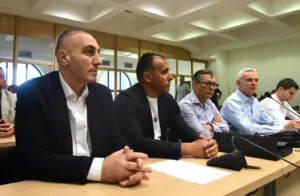
After 19 Months on the Run, Bajrami Handed Himself In at Blace at 5:35 AM: Same Crossing, Same Early Hour as Grubi
10.09.2026


10.09.2026

10.09.2026
10.09.2026
10.09.2026
10.09.2026
10.09.2026

10.09.2026
09.09.2026
08.09.2026

10.09.2026

10.09.2026
09.09.2026

10.09.2026

10.09.2026

10.09.2026

10.09.2026

08.09.2026

07.09.2026
10.09.2026

10.09.2026
10.09.2026
10.09.2026

10.09.2026

09.09.2026

09.03.2026

27.02.2026

19.02.2026

23.04.2026

23.04.2026

12.04.2026

In Sofia, at a joint address, the Bulgarian and Slovak prime ministers said out loud what half of Europe thinks quietly: sanctions policy toward Russia is not delivering results, and yet it keeps being repeated.
Rumen Radev put it most directly. "Logic says that when you keep applying an approach that does not produce results, that approach should be changed." A sentence that sounds banal until you remember it comes from the prime minister of an EU member state, spoken in an EU member state, about EU policy.
Robert Fico went a step further and named the tool that genuinely hurts in Brussels. "If sanctions are proposed that threaten our interests, we will not support them and we are ready to use the veto." And then, without detour: "I do not believe in sanctions policy."
The veto as a red line
The hardest sentence of the whole address was not about Russia at all. Fico said that attempts by some EU countries to limit the right of veto in certain areas are a "red line" for Slovakia.
That is the heart of it. The argument looks like it is about sanctions - it is really about whether small countries in the Union get to keep the mechanism that lets them say no. Any reform that erases unanimity puts precisely them in the position of voting for decisions they do not want.
For a country like Macedonia, which has spent years waiting at the EU's door as if queuing at a municipal counter, this is not somebody else's argument. The mechanism being diluted now is the same mechanism we will inherit tomorrow - if we get in at all. The question is whether we are waiting for a seat at a table where everyone has a vote, or a seat at a table where only a few vote.
Note what exactly was said
Neither of the two said they are leaving the Union. Quite the opposite. Radev was explicit: "Bulgaria is part of the EU's joint decisions, but when we see decisions that threaten our national interests, we do not hesitate to defend our interests in Brussels." And he added: "Our life is in the EU and NATO, but that does not mean we should not communicate and have normal relations with other countries."
That is not an exit. That is positioning - stay inside, but cancel the obedience. The most useful possible position while negotiations over the next package are running.
Fico also recalled that Slovakia took part neither in financing Ukraine's war effort nor in the 90 billion euro credit allocation. Both called for diplomatic solutions, arguing that the military approach only increases the risks.
Is this a matter of principle or a negotiating position for something else? The history of European summits suggests that red lines usually have a price. The only question is whether the price will be paid in money, in sanctions exemptions, or in something else we will never hear about.
The latest 10 news from this category
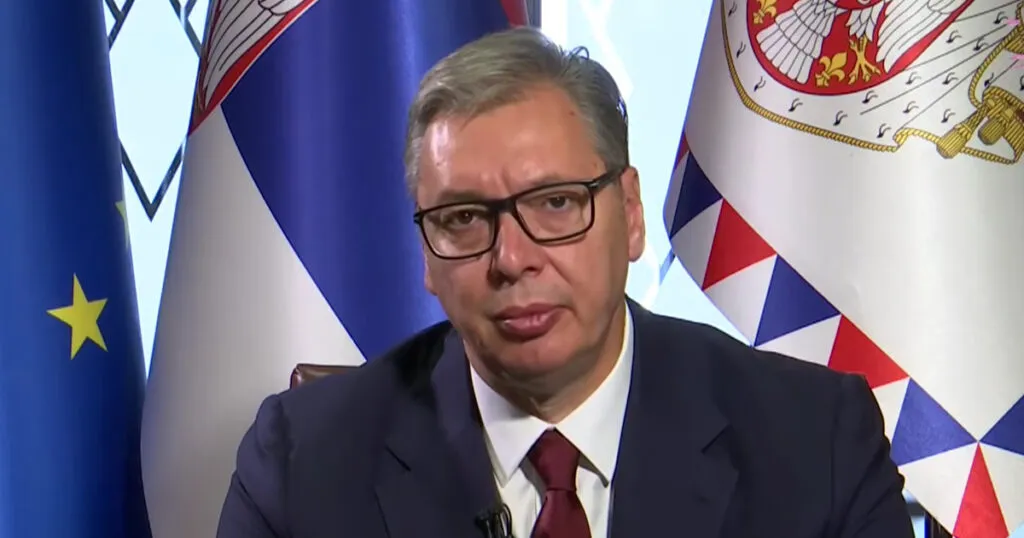
The government asked itself for elections, and packaged the reason as global instability. Serbia votes on 25 October - with...
Almost every German party condemned the Serbian government over the state send-off for Ratko Mladic. The one that did not...
The previous government recognised Palestine. The new one is opening an Israeli embassy. Between the two there is not a...
Serbia sent six ministers but not the leadership of the state - and then claimed these were not state honours....

Belgrade kept the last direct air link between Russia and Europe, and is now opening a route to an enclave...
The opposition is attacked not for what it proposes but for what it would hypothetically do. A mechanism the whole...
A government plane, a coffin draped in the Serbian flag and a minister in the hall - but no state...
Convicted with final effect of the Srebrenica genocide, Ratko Mladić is receiving state and military honours in Belgrade. That is...
The constitution does not allow him a third presidential term, so the post changes - not the holder. Elections are...
Sanctions are written in Brussels but enforced on a quay in Durrës. One ship said no - and the route...
This site uses cookies - is that okay? Learn more
Be the first to know when Metla launches something new
Leave your email and we will write when there is a new guide or something new on Metla.