

Fire by the railway in Prilep: residents watched black smoke over textile waste, "Komunalec" says - a small part, no danger
04.10.2026


04.10.2026

04.10.2026

04.10.2026

04.10.2026

04.10.2026

04.10.2026

04.10.2026

03.10.2026

02.10.2026

04.10.2026

04.10.2026

03.10.2026

04.10.2026

04.10.2026

04.10.2026

04.10.2026
03.10.2026

02.10.2026

04.10.2026

04.10.2026

04.10.2026

04.10.2026

04.10.2026
03.10.2026

09.03.2026

27.02.2026

19.02.2026

04.10.2026

03.10.2026

02.10.2026
02.10.2026
22.08.2026

20.08.2026

23.04.2026

23.04.2026

12.04.2026

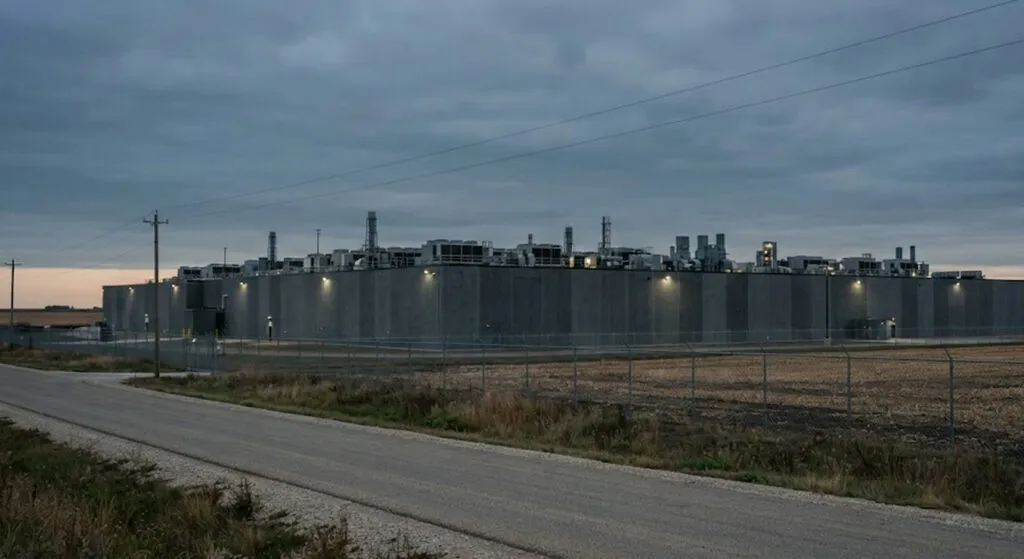
Matt Garman, CEO of Amazon Web Services, wrote a long text with one goal: to convince Americans that data centres are good news for the places where they spring up. The most important thing in the whole text is a single sentence: "We no longer use confidentiality agreements with the government agencies we work with on our projects." Translated from corporate speak: until now they did.
Secrecy is precisely at the heart of the resistance. Environmental activist Erin Brockovich recently said the most common complaint she hears about data centres is the lack of transparency, following a repeating pattern: the project is announced after the permits are already secured, the investors don't return calls, and local officials signed confidentiality agreements before the neighbours even learned something was being planned. New York has already introduced a one-year moratorium on permits for large data centres, and according to Garman himself, more than 100 moratoriums are currently under consideration across the US.
His answer is the classic one: fear. "If these measures are adopted, the US could write its own losing ticket in this race, and the consequences would last for generations," Garman wrote. He then set out to demolish four "myths": that data centres use too much water, that they push up electricity prices, that they pollute and that they bring communities nothing.
On water he cited a report by Amazon itself: data centres' direct consumption was only 0.5% of industrial water use in the US, "several orders of magnitude less than golf courses and almond growing". Except that such figures skip the water used to produce electricity and chips. Scientists are calling for independent measurements, since no federal or state regulation obliges tech companies to report how they consume. When a company measures itself and publishes its own figure, how much does that "0.5%" weigh?
On electricity, Garman claims prices rose only in some states with many data centres, while in others they fell or grew more slowly, and where they are rising, the culprit was an old grid that wasn't invested in on time. An independent watchdog recently said something completely different: data centres are the main culprit behind a price rise of 76% in one year on the largest power grid in the US.
Most telling is the part on pollution, an issue over which the NAACP is already suing Elon Musk's SpaceX/xAI. Garman complains that critics look at the maximum the permits allow. And the maximum is this: a planned Amazon data centre in Texas has a permit to emit 33 million tonnes of carbon dioxide a year, more than any power plant in the US. "The truth is that data centre generators almost never run," he writes, "they are idle 99.9% of the time", meaning they run about ten hours a year, mostly for mandatory testing. If they really almost never run, why do they need a permit bigger than any American power plant's?
The last "myth" is communities: over the past three years Amazon has invested "more than a billion dollars" (around 870 million euros) in the places where it has a significant presence. Will that be enough? Dario Amodei, the CEO of Anthropic, recently said that resistance to artificial intelligence is "essentially a crisis of trust", in which people assume governments and tech companies are constantly coming up with new ways to cheat them. Writer Jasmine Sun noted that opponents of data centres usually answer the companies' arguments briefly: "We don't trust them."
Macedonia already has its own small version of the same story. In Pehchevo, councillors of the ruling VMRO-DPMNE voted against rezoning land for a data centre planned by their own government, because nobody had shown them a project, a study or a calculation of how many megawatts the facility will consume. Pehchevo is not Texas, but the question it raises is the same: why are the neighbours always the last to know?
The latest 10 news from this category

The pope isn't talking about style but about substance: the machine calculates on top of other people's images. The industry...

A setting created for backups now hands AI agents the keys to the whole computer - messages, mail, browsing history....

The cheaper SUV lifted deliveries by around 45 percent. Since June it has had two recalls, the latest over battery...

Some MyChart settings reportedly allowed outsiders to access records without leaving a single trace in the logs. Few companies stop...
OpenAI says the three broke rules on confidential information. It comes two days after it emerged that leadership had ignored...

Meta sold more than 7 million pairs of smart glasses last year alone, and the law meant to ban secret...
Google says it has the most powerful model, and the yardstick comes from a startup on whose index it ranks...

The prediction that electric cars would become cheaper than petrol ones finally has a clean comparison: BMW makes the same...

Content users wrote for free for years is becoming a commodity. RSS shuts down on 13 November, the public API...

It all started when Microsoft cut off the International Criminal Court prosecutor's email. Now France is switching state computers to...
This site uses cookies - is that okay? Learn more
Be the first to know when Metla launches something new
Leave your email and we will write when there is a new guide or something new on Metla.