
Black Smoke Over Skopje: A Paint and Varnish Warehouse Burned Inside the Old Steelworks
23.09.2026


23.09.2026
23.09.2026

23.09.2026
23.09.2026

23.09.2026

23.09.2026
23.09.2026

22.09.2026

21.09.2026

23.09.2026

23.09.2026

22.09.2026

23.09.2026

23.09.2026

23.09.2026

23.09.2026

22.09.2026

21.09.2026

23.09.2026

23.09.2026

23.09.2026

23.09.2026

23.09.2026

23.09.2026

09.03.2026

27.02.2026

19.02.2026

23.09.2026

22.09.2026

21.09.2026

23.04.2026

23.04.2026

12.04.2026

Last year Macedonian investors traded more than 110 million euros in foreign securities through domestic financial intermediaries alone. In the first six months of 2026 - already over 89 million euros.
Over the same period, total turnover on the Macedonian Stock Exchange up to 15 September stands at around 89.8 million euros.
In other words: in six months, Macedonian capital invested abroad almost as much as the entire domestic exchange traded in nine. And that is without counting the transactions citizens make directly through international online platforms.
The domestic market's numbers
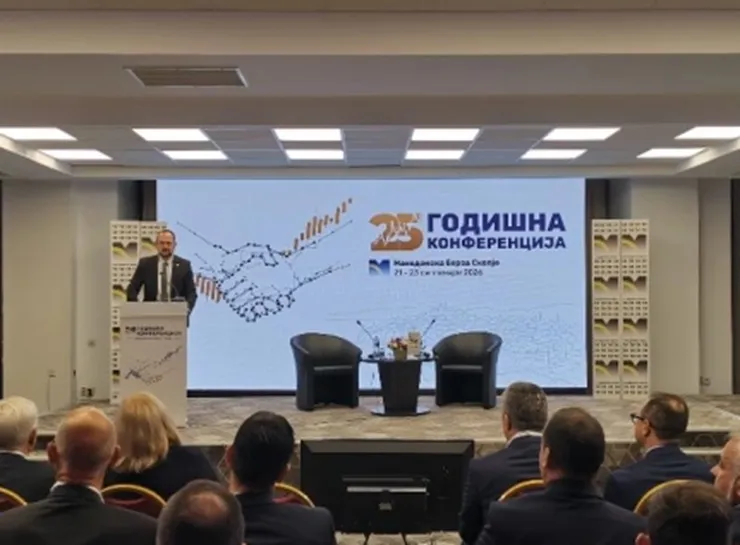
The figures were presented by Macedonian Stock Exchange chief executive Ivan Steriev at the 25th annual conference in Ohrid, marking 30 years since its founding.
Turnover is around eight percent lower than the same period last year. Broken down, though, it shows something more damning: classic trading is down 27 percent, while block transactions are up around 159 percent. On 15 September the MBI10 stood at 9,151 points - 8.9 percent lower than at the end of 2025.
Classic trading is what ordinary investors do on the open market. Block transactions are large agreed packages between known parties. The first falls by a quarter, the second more than doubles.
"On a shallow market like ours, with a small number of active participants, even relatively small shifts in sentiment can be felt significantly," Steriev said.
The problem is not a shortage of money
This is the key to the whole story and precisely what public debate usually misses. Macedonia does not only have a problem with a lack of capital. It has a more complicated problem: there is capital that wants to invest, but not enough variety in the domestic offering to invest it in.
Bujare Abazi, head of the Securities and Exchange Commission, put it directly: "As a regulator we emphasise the need to wake up these passive billions of denars. Citizens and companies hold substantial savings and our task is to create conditions for part of that capital to recognise additional investment opportunities through the capital market."
In her view, the capital market should not be seen as a competitor to bank lending but as its complement - particularly for financing riskier and innovative projects.
The exchange is no longer competing with itself
The Macedonian investor is no longer limited to what the domestic market offers. A few clicks give access to thousands of shares, bonds and exchange-traded funds on developed markets.
Which means the Macedonian Stock Exchange is indirectly competing with the global capital market. So the question is not how to stop investors putting money abroad - that is both normal and healthy as diversification. The question is how the domestic market can build an offering good enough for part of that capital to stay here voluntarily.
What is being offered as a solution
Steriev set out three concrete directions.
The first is a project with the EBRD to prepare domestic companies for market financing. More than 20 companies applied for ten places, with the final selection due soon. "We can only hope that out of this first group of companies one will emerge that says: we are ready to open the door to the capital market as well," he said.
The second is the regional Junctus project, in which the Macedonian exchange participates alongside seven other exchanges from Central and Southeastern Europe. The first expected result is a regional ETF holding several shares from the domestic market, listed on the Macedonian exchange too - planned for the second half of 2027.
The third is the introduction of so-called Macedonian investment accounts, a model Steriev says would encourage long-term investing and greater participation by citizens.
Thirty years, 89.8 million euros
The conference ran under a slogan about a small market with big opportunity. The numbers show the small-market half is already proven.
Thirty years of existence and turnover of around 89.8 million euros over nine months - in a more developed economy that is a sum a mid-sized investment fund turns over without noticing. The domestic savings are here, the appetite for investing is here, and that is exactly why 89 million euros found its way to other people's exchanges in half a year.
The first ETF is scheduled for the second half of 2027. Until then, capital will not wait - it already knows where it is going.
The latest 10 news from this category
48,499 denars, or about 789 euros. Croatia is at 1,555, Slovenia at 1,695. Only Kosovo is left below us.
Eurodiesel hit 104.50 denars while petrol got cheaper. A company burning 100,000 litres a month pays 550,000 denars more from...
Extra-light heating oil jumped 78.91 percent right before winter. The only remaining instrument is the reduced VAT - and it...
The new GPT-6 models cost half of their predecessors, with accuracy comparable to the top of the series. When a...

The labs have hit the limit of what can be scraped off the internet for free, so now they buy...

From 13 upwards, with the account tied to a parent and up to three guests in the vehicle. The company...

From midnight a litre of eurodiesel costs 104.50 denars, while petrol drops 1.50 denars. The explanation is not in Brent,...
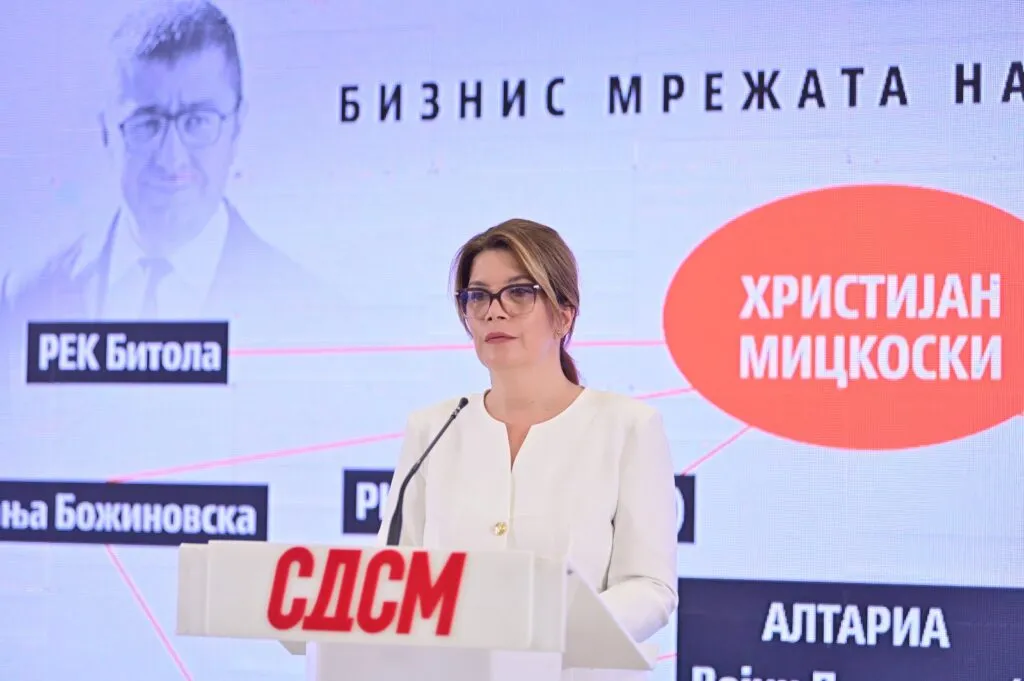
The opposition ties Serbia's METER&CONTROL to Rudnap Group and to Sanja Božinovska's past. The statement, however, came with no document...
QR codes, certificates of origin and a public register are promised by the end of October. There is still no...

The German giant called it a productivity offensive. Translated: more hours, same pay. On the same day, 175,000 people were...
This site uses cookies - is that okay? Learn more
Be the first to know when Metla launches something new
Leave your email and we will write when there is a new guide or something new on Metla.