Six Years of Fake Licence Categories Issued From an Interior Ministry Desk: Six Charged, 21 More Under Investigation
21.09.2026


21.09.2026

21.09.2026

21.09.2026

21.09.2026

21.09.2026
21.09.2026

21.09.2026

20.09.2026

20.09.2026

21.09.2026

21.09.2026

20.09.2026

21.09.2026

21.09.2026

21.09.2026

21.09.2026

20.09.2026

19.09.2026

21.09.2026

21.09.2026

21.09.2026

21.09.2026

21.09.2026

21.09.2026

09.03.2026

27.02.2026

19.02.2026

21.09.2026

21.09.2026

20.09.2026

23.04.2026

23.04.2026

12.04.2026

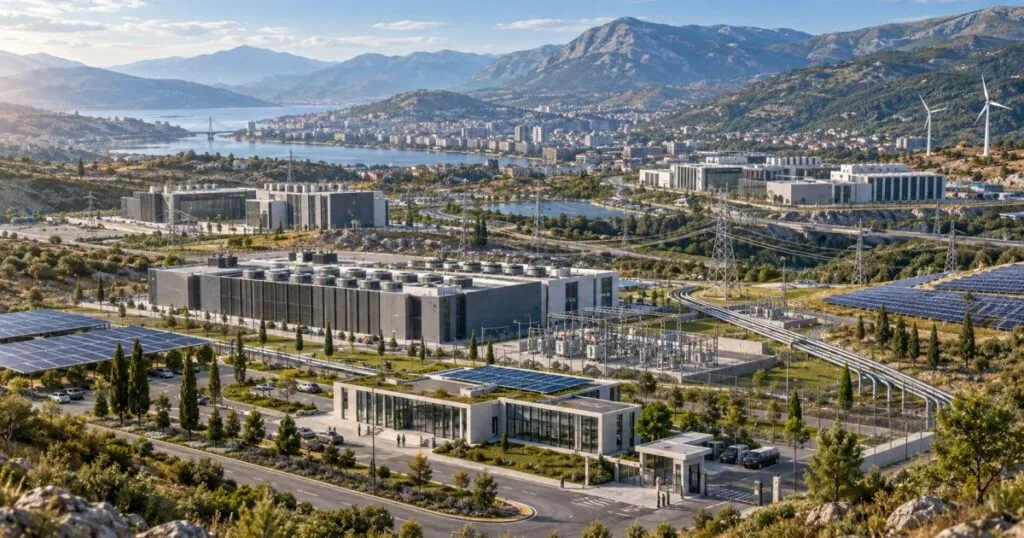
Less than a hundred kilometres from the Macedonian border, at Kozani, Greece's state power company PPC and Amazon Web Services signed a binding memorandum on 17 September for a data centre at Agios Dimitrios. A first phase of 300 megawatts of connected capacity, with an option for the complex to grow to 1,000 megawatts. AWS leases the facility for 15 years; PPC provides the land, the buildings and the energy infrastructure. In a region that lived off lignite for decades, the product is now computing power.
By Macedonian standards the figures are hard to digest. PPC's wider plan to transform the region is valued at around 5.8 billion euros - that is not the data centre alone but the whole programme. For comparison: total Macedonian budget spending for 2026 is around 6.7 billion euros. One Greek regional package equals 86 percent of everything our state spends in a year. Our capital expenditure is around 650 million euros. At peak construction Kozani will employ around 7,500 people, with at least 2,200 long-term jobs projected.
And it is not only Greece. In July the European Union opened a call for seven AI gigafactories with up to 10 billion euros of public money and at least another 20 billion in private capital - centres with more than 100,000 advanced processors. In Sofia, Bulgaria is building the BRAIN++ AI factory at around 90 million euros, tied to the INSAIT institute, and is pitching itself to American companies with the Kozloduy nuclear plant and 80,000 ICT specialists. Romania is developing the Black Sea AI Gigafactory. Serbia already has a state data centre and a National Artificial Intelligence Platform in Kragujevac.
And Macedonia? We have Vezilka - a project inside the European EuroHPC network meant to operate as an AI Factory Antenna, linked to Greece's Pharos AI Factory. That is access to somebody else's infrastructure and know-how, which is a good thing. But an antenna is not a factory. Local computing capacity comparable to what the neighbours are building does not exist. At the end of August Prime Minister Mickoski announced the government was in talks with five or six data-centre investors, one of them a large multinational. "This is the new oil," he said then.
Then came Pehchevo. All nine councillors on the municipal council - five from VMRO-DPMNE and its coalition, three from SDSM and one from ZNAM - voted against launching the planning procedure for a data centre in Pancharevo. Unanimously, across party lines. The reason lies in what councillors and the public never received: the investor's name, the planned capacity, the water and electricity consumption, the cooling system, a concrete benefit for the local community. Those are legitimate questions in the most developed markets too. But the real failure is that somebody asked a council to vote on a black box. Who prepared the initiative that way?
SDSM goes a step further and wants a moratorium on new foreign commercial data centres using water cooling, with Venko Filipche calling for "national mobilisation" and claiming the government is not disclosing investors or terms. That the terms are not public is true. But a moratorium before a single project exists is a decision taken before there is anything to decide.
There is a second half to this story that rarely gets told: a data centre is not an automatic prosperity formula. It is capital- and energy-intensive, and the number of direct jobs after construction need not be proportional to the sum invested. If it ends up as nothing more than a hall of servers consuming electricity and shipping data abroad, the local benefit is limited. So the question for Macedonia is not "yes or no", but on what terms, with what electricity, with what water, and under which publicly published contract.
The Agios Dimitrios thermal plant at Kozani has closed. Of 420 workers at the start of the year, 58 remained. The region is not waiting for the debate to end; it is building. The difference between us and them comes down to one thing: Greece is asking how, and we are still asking whether.
The latest 10 news from this category
Up 757 denars in a single month, and that is before rent. The unions want a 600-euro minimum wage, the...
Tinex, SuperTinex, Konto and Spot move to a Pristina-based group with 235 million euros in turnover. The commission saw no...

Six family members, one agent with its own Gmail and access to everything you forward it. Google says people asked...

The WHO has declared loneliness a global health problem linked to around 870,000 deaths a year. On America's east coast...

A married pair of students woke up unhappy with their late-night scrolling and decided the problem was not the scrolling...
State statistics office data for 2024: 3,280 foreign affiliates, 105 thousand employees, close to three billion euros in value. Four...
In Obrshani and Debreshte the crop is rotting unsold. One question nobody answers - how many tonnes of peppers have...

The DFC is paying for feasibility work and a resource assessment. Mickoski claims the reserves exceed those of the world's...

Nearly a million vehicles will get money without a single application being filed. The previous government froze prices, this one...

A new federal body, an official already being called the AI czar, and one condition for applying - a high...
This site uses cookies - is that okay? Learn more
Be the first to know when Metla launches something new
Leave your email and we will write when there is a new guide or something new on Metla.