Skopje Breathed Smoke From Two Mountains: 21 Fires in One Day, and Vodno Was Clean
25.08.2026


25.08.2026
24.08.2026

23.08.2026

25.08.2026

25.08.2026

24.08.2026

25.08.2026

25.08.2026

25.08.2026
25.08.2026

24.08.2026
23.08.2026

25.08.2026

25.08.2026
25.08.2026

25.08.2026

25.08.2026

25.08.2026

09.03.2026

27.02.2026

19.02.2026

23.04.2026

23.04.2026

12.04.2026
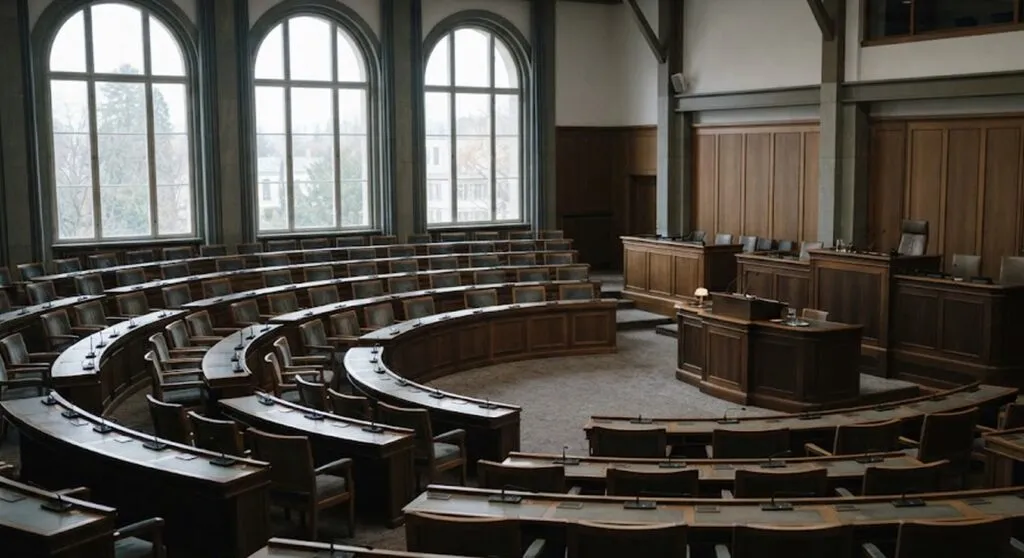
Forty-one percent. That is where the Alternative for Germany stands in Saxony-Anhalt according to the Infratest dimap poll, with Chancellor Friedrich Merz's Christian Democrats trailing on 24 percent. If that holds at the 6 September election, a far-right party will take over a German state for the first time since the Second World War.
The gap is not narrow. It is 17 points, and in politics that is not called an advantage, it is called dominance. And the party's candidate for state premier, Ulrich Siegmund, was recently described by a German outlet as "the most dangerous man in Germany". Epithets like that usually go to people on the fringes. This one is about to win.
The wall that held for twenty years
Since its founding in 2013, the AfD has lived behind the so-called firewall: every other party refused to enter a coalition with it. That is not a law, it is an agreement among politicians not to talk to each other. Agreements like that last as long as the numbers allow. When a party reaches 41 percent, the arithmetic starts eating the principles.
After Saxony-Anhalt come Mecklenburg-Western Pomerania on 20 September, where the AfD polls at 36 percent, and Berlin. Nationally the party leads with around 28 percent, against a little over 20 for the Christian Democrat bloc. This is no longer a protest vote. It is a second political system growing alongside the first.
Why the east, and not the west
The analysis offered by political scientist Bozo Kovacevic is more interesting than the numbers themselves. Anti-migrant sentiment is stronger in the east, even though the east has fewer newcomers. The problem, he says, is not migration - it is that integration between the two Germanys was never finished. Thirty-six years after the wall came down, the eastern states still vote like a separate country.
Kovacevic also describes the German model that is coming apart: cheap Russian energy, American security guarantees that kept defence spending low, and German industrial products going out into the world, especially to China. All three pillars fell almost at once. What is left is a welfare state without the engine that paid for it.
What it promises, and what it can do
Co-leader Alice Weidel has announced that on reaching federal power the party would seek an exit from the eurozone and from Schengen. She claims Germany was significantly better off before the euro. She promises closed borders, more deportations and harder access to citizenship.
This is where the rhetoric hits a wall that is not political but legal. European Union membership is written into the German constitution, and constitutional amendments require a two-thirds majority in both the Bundestag and the Bundesrat. Leaving the eurozone would open a legal and financial knot across the whole Union. Germany already runs border checks on all its land borders - and remains in Schengen regardless. What Weidel proposes is permanently sealing 3,700 kilometres of border with nine countries. The difference between a temporary check and a permanent lock is not technical.
Where the promise is actually deliverable
There is one part of the programme that needs no constitutional majority. Ending military aid to Ukraine, lifting sanctions on Russia and restoring energy ties with Moscow. "We will cut off all aid to Ukraine. No taxpayers' money, no weapons, no German soldiers," Weidel said. That requires no constitutional amendment - only a government.
Kovacevic warns the rhetoric echoes the 1930s uncomfortably closely, and that after Brexit the blow is more serious because Paris and Berlin are the load-bearing pillars of the European project. The Center for Strategic and International Studies assesses that a win in Saxony-Anhalt would be a symbolic shock for Europe - German territory under a party that openly sympathises with Russia. By the same analysis, further AfD gains would paralyse the Union through disagreements over defence and vetoes in the Council.
Why this reads differently from Skopje
The Balkans have been told for years that the road to the European Union runs through reforms, negotiating chapters and patience. But Berlin is also the one holding the keys. If Germany enters an internal reckoning over whether it even stays in the Union as it is, the enlargement question drops several rungs down the list - not because of us, but because nobody will have time for it.
There is a quieter lesson too. A party kept at arm's length for twenty years by an agreement among elites did not disappear - it grew to 41 percent. Isolation is not a policy. It only postpones the moment when someone has to answer why so many people vote that way.
The latest 10 news from this category
The largest financial offensive in history - against an opponent whose biggest customer has no intention of stopping. "You are...
Hungary has fourteen of these aircraft in total. One lost in a single morning - and the story left unwritten...
Leaving the euro, closed borders, the end of Schengen - and 27 percent support nationally. The question is no longer...
Messages scratched into cars, writing on walls. But the revolt is not against foreigners - it is against their own...
A blogger filmed cabbage being dipped in a banned chemical and the authorities confirmed the footage is genuine. China grows...
The biggest sanctions package yet is being billed as historic isolation. The problem is that the ties that need cutting...
The 89-year-old Norwegian king is on antibiotics for a bacterial bloodstream infection. When a palace that says as little as...
A coup, a default, the Kursk, Georgia, the poisoning of Navalny - all in August. This summer: smoke over refineries...
First a threat to attack the interests of anyone joining the American pressure campaign. Then - talks with Oman and...
Not a fault, not a storm - an attack from a distance. For four days the plant stood dead, and...
This site uses cookies - is that okay? Learn more
Be the first to know when Metla launches something new
Leave your email and we will write when there is a new guide or something new on Metla.