
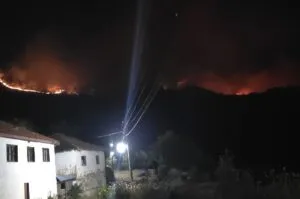
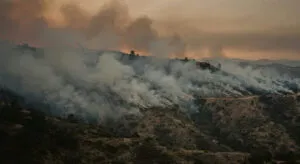
33 fires in 24 hours: a beech forest is burning in Kicevo, and near Kumanovo the flames reached the houses
24.08.2026


24.08.2026

24.08.2026
24.08.2026

24.08.2026
24.08.2026

24.08.2026
24.08.2026

23.08.2026
22.08.2026

24.08.2026

24.08.2026

23.08.2026

24.08.2026

24.08.2026

23.08.2026

24.08.2026
23.08.2026

22.08.2026

24.08.2026

24.08.2026

24.08.2026
24.08.2026

24.08.2026

23.08.2026

09.03.2026

27.02.2026

19.02.2026
24.08.2026
23.08.2026
23.08.2026

23.04.2026

23.04.2026

12.04.2026
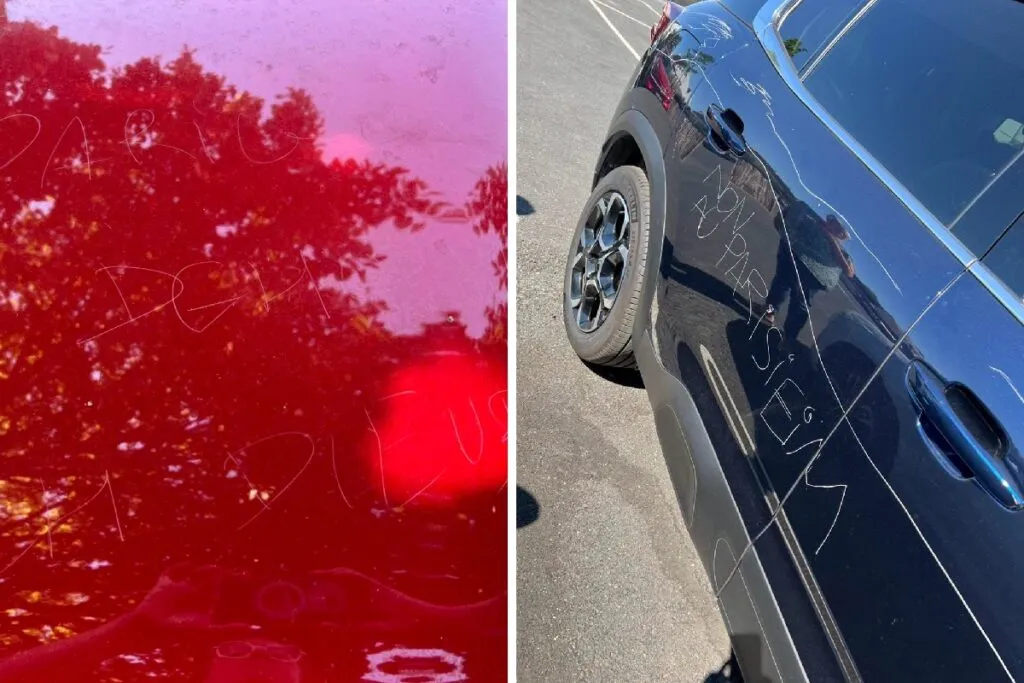
"Parisians, go home" - reads the writing on the walls in Plogoff. Messages have been scratched into cars with Paris plates, and in Plobannalec-Lesconil one car carries the scratched line "safe trip back, Parisians". In Brittany this summer smells of something that is neither salt nor iodine.
It is sharpest in the Finistere department, where the population triples in summer. Last year, between April and September, 7.4 million overnight stays were registered there. And this year the heatwave in the south of France sent another wave of tourists northwards, towards the cooler shores of Brittany and Normandy. A holiday chosen for the temperature, not for the sea.
The mayor of Plobannalec-Lesconil, Loic le Fur, condemned the scratchings: "Our town has always been and must remain an open and hospitable community." His counterpart from Penmarch, David le Ber, said something more urgent than a condemnation - that the population jumps from 5,600 to 17,000 while the roads, the car parks and the housing stay the same. In the same place, a cyclist stopped a woman who was out running to interrogate her about whether she was a local.
When the number overtakes you
French visitors account for 80 percent of overnight stays in Brittany, and 30 percent come from the Paris region. So this is not a revolt against foreigners - it is a revolt against their own compatriots, which makes the picture far more interesting. It is not a question of language or nationality but of arithmetic: infrastructure built for 5,600 people does not hold 17,000, whatever passport they carry.
From there to Ohrid, Struga or Krusevo is not a long distance. There too the number of people in August is many times what the water supply, the parking and the waste collection can handle. The difference is that in Brittany the mayors at least say the infrastructure problem out loud, instead of only counting visitor numbers.
Scratching a car is vandalism and there is no argument about that. But what sits underneath it is a different question: what does a municipality do when its population triples for three months a year, while the budget, the services and the decisions were made for the other nine?
The latest 10 news from this category
Leaving the euro, closed borders, the end of Schengen - and 27 percent support nationally. The question is no longer...
A blogger filmed cabbage being dipped in a banned chemical and the authorities confirmed the footage is genuine. China grows...

The biggest sanctions package yet is being billed as historic isolation. The problem is that the ties that need cutting...
The 89-year-old Norwegian king is on antibiotics for a bacterial bloodstream infection. When a palace that says as little as...
A coup, a default, the Kursk, Georgia, the poisoning of Navalny - all in August. This summer: smoke over refineries...
First a threat to attack the interests of anyone joining the American pressure campaign. Then - talks with Oman and...

Not a fault, not a storm - an attack from a distance. For four days the plant stood dead, and...
A Washington ally duly waited for Russian clearance to sail along the Arctic coast. Brussels is unhappy, but the ship...

The court called the publisher's costs exceptionally high - and then ordered Harry to pay them. Forty million for one...

An eighteen-year-old former pupil with a previous conviction entered a school of 450 children. Exactly one year after Orebro, where...
This site uses cookies - is that okay? Learn more
Be the first to know when Metla launches something new
Leave your email and we will write when there is a new guide or something new on Metla.
