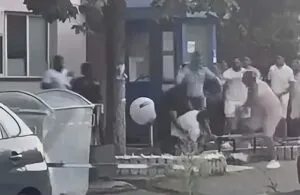
Six Men Brawled Outside the Police Station in Kočani: Now They'll Also Check What the Officers Were Doing
17.08.2026


17.08.2026

17.08.2026

17.08.2026

17.08.2026

17.08.2026
17.08.2026

17.08.2026

16.08.2026

15.08.2026

17.08.2026

17.08.2026

16.08.2026

17.08.2026

17.08.2026

17.08.2026

17.08.2026

16.08.2026

15.08.2026

17.08.2026

17.08.2026

17.08.2026

17.08.2026

17.08.2026

16.08.2026

09.03.2026

27.02.2026

19.02.2026

16.08.2026

15.08.2026

14.08.2026

23.04.2026

23.04.2026

12.04.2026
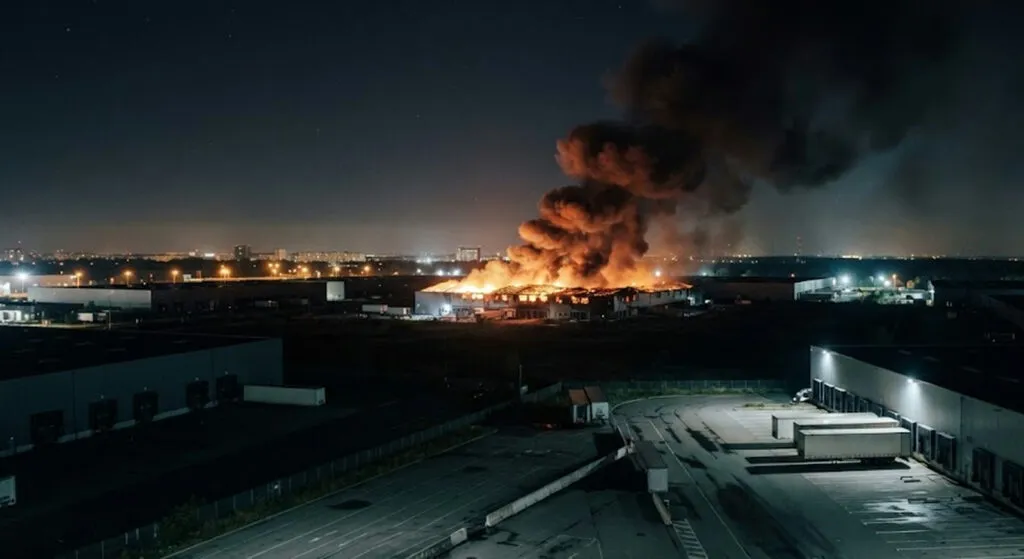
Six hundred drones headed towards the Moscow region during a single night. Two hundred and one were shot down on the approach to the city, according to the mayor of the Russian capital. The Russian defence ministry goes further and says it downed 822 drones in total. If both numbers are accurate, then Ukraine sent an airport's worth into the sky - not as a symbolic gesture, but as systematic work.
„Between last night and 6.30 in the morning, 600 drones flew towards the Moscow region, of which 201 were destroyed in the Moscow region. That was the largest air attack on the Russian capital in the past two years,” the mayor said, with emergency services working at the impact sites.
The outcome did not stop at sirens. A fire broke out at a distribution warehouse near Moscow and at least six people are dead. Among the targets hit, according to social media posts, was one of the largest warehouses of the online retailer Wildberries - a company that, besides parcels for citizens, also supplies the Russian army with equipment. It is logistics, not a barracks. And that is exactly why it is a target.
The British trail now visible
The most interesting part of this story is not the number of drones, but whose signature is on them. The Times reported that Ukraine has spent the last six months using British drones for deep strikes inside Russia. Among them is BAE Systems' jet-powered kamikaze drone Nyan, tested by Britain's Royal Navy, plus another model whose manufacturer has not been disclosed for security reasons.
„The bulk of deep-strike missions are carried out with Ukrainian drones, but the Armed Forces have had significant success with British drones too,” a senior Ukrainian military source told the British paper. The targets hit with British equipment, the report says, included oil refineries near Moscow, in Yaroslavl and in Volgograd. The same drone, according to the report, was also used against Belgorod.
This is where the story stops being only about Ukraine and Russia. When weapons manufactured in a NATO member state strike targets deep inside Russian territory, the question of „who is at war with whom” gets a far less comfortable answer than London would like to admit. The Times itself notes that Russia could respond by increasing hybrid pressure on the United Kingdom. The source adds that Moscow has already targeted Britain with cyber attacks and espionage.
The Balkans know this scene by heart: first the equipment is delivered, then it is explained that this is not participation, and in the end someone pays the difference between the two. The question nobody asks out loud is who draws the line between help and involvement - and what happens when the side on the receiving end of that equipment decides the line does not exist.
The latest 10 news from this category
The front line is not moving, the negotiating table is empty, so what remains is striking deeper into the other...
An officer said the Kursk operation carried risk and immediately lost his post. The risk was not removed - he...
Hundreds of Ukrainian drones hit the Moscow region, and the largest warehouse of Russia's largest online retailer is on fire....

The drone flew in from Moldova, and a Spanish F-18 on a NATO mission shot it down at 5:01am. Romania...

One million three hundred thousand signed contracts, 30,000 killed and wounded a month by Western estimates - and there are...

Over 30,000 killed and wounded a month, a thousand new soldiers a day - and they only plug the holes....

Hamas accepted the 15-point plan, Israel wants genuine disarmament first. When allies agree only on the destination, negotiations come down...
The offer does not ask for an end to the war, or a withdrawal - only that grain ships not...

The door is open for negotiators, while the one thing actually up for negotiation has been declared off limits. A...
Before the war it had almost 60 gigawatts. Today it has twelve. And if the strikes continue at the same...
This site uses cookies - is that okay? Learn more
Be the first to know when Metla launches something new
Leave your email and we will write when there is a new guide or something new on Metla.