They Fired Guns at a Party in Dobridol - and Police Only Moved Once the Video Went Viral
02.08.2026


02.08.2026

02.08.2026
02.08.2026

02.08.2026

02.08.2026

01.08.2026

02.08.2026

01.08.2026

31.07.2026

02.08.2026

02.08.2026

02.08.2026

02.08.2026

02.08.2026

01.08.2026

09.03.2026

27.02.2026

19.02.2026

02.08.2026

01.08.2026
31.07.2026

23.04.2026

23.04.2026

12.04.2026
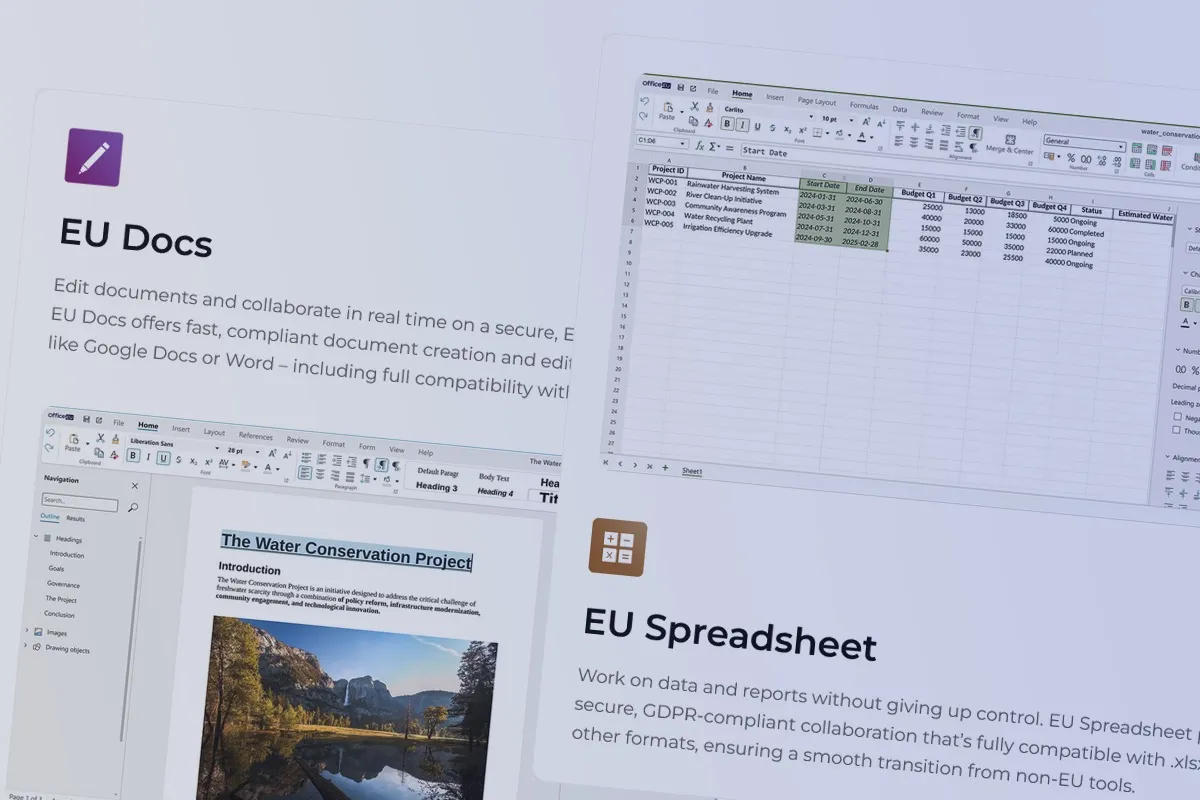
Europe has finally decided it's time to write its own documents. On June 9 the first stable version of "Euro-Office" launches - an open-source office suite marketed as a serious alternative to Microsoft Office and Google Docs. It sounds like tech news, but it's really political.
The irony is in the origin. Euro-Office is a "fork" - an independent copy - of ONLYOFFICE, a suite developed by a company registered in Latvia, but with documented Russian roots and historical business ties to Russian firms. It is precisely that link that pushed European organizations to make their own version, with European governance and greater transparency. In other words: they took the technology and scrubbed it of the owner they had doubts about.
Why at all? Because dependence on American technology is increasingly proving to be a political vulnerability. When US sanctions blocked International Criminal Court officials' access to Microsoft services, it became clear to everyone how much control over infrastructure can become a lever for pressure. The American "CLOUD Act" allows US authorities to demand data from companies under their jurisdiction, regardless of where the servers physically are.
That's why Europe is already quietly moving. The French state agency DINUM switched to Linux, Germany's Schleswig-Holstein replaced Office with LibreOffice on over 30,000 computers, and the Austrian military migrated around 16,000 workstations. Euro-Office is the next step - a web app for now, with desktop and mobile versions later, prioritizing stability, security, and compatibility with Microsoft formats.
For the reader in the Balkans, the question that arises is uncomfortably close: if even Europe, with all its resources, is only now realizing how dangerous it is to depend on someone else's software - where are we, who fill state institutions with licenses for programs over which we have no control whatsoever? Digital sovereignty isn't a luxury for the big players; it's a question that's starting to concern us all.
The latest 10 news from this category
Opus 5 set a record in the test and broke 11 agreements. Not one of the tricks is new -...

The billions were announced with a stage and slogans. The retreat is happening quietly, in sentences containing the word alignment.
In his last quarterly report Tim Cook announced the stronger Siri will be bought through iCloud+. The firm that paid...

The platforms that spent years convincing us automated content was the future are now patiently building filters against it. The...
Out of 141,006 test runs, three ended up inside the live systems of real firms. The oldest model worked out...
The strongest June quarter in its history, and the stock fell 6 percent. Artificial intelligence turned out to have a...
The FCC is closing the door to humanoid robots and power inverters, but only new ones. The millions of Chinese...
The player that raised the MP3 generation is betting nostalgia can be billed monthly. The new Winamp arrives in 2027,...
The man selling the world's best-known artificial intelligence says we will not work less. He also claims we will secretly...

Autonomous vehicles have blocked ambulances, driven into crime scenes and failed to recognise emergency lights. The bill demands the one...
This site uses cookies - is that okay? Learn more
Be the first to know when Metla launches something new
Leave your email and we will write when there is a new guide or something new on Metla.