Six Years of Fake Licence Categories Issued From an Interior Ministry Desk: Six Charged, 21 More Under Investigation
21.09.2026


21.09.2026

21.09.2026

21.09.2026

21.09.2026

21.09.2026

21.09.2026

21.09.2026

20.09.2026

20.09.2026

21.09.2026

21.09.2026

20.09.2026

21.09.2026

21.09.2026

21.09.2026

21.09.2026

20.09.2026

19.09.2026

21.09.2026

21.09.2026

21.09.2026

21.09.2026

21.09.2026

21.09.2026

09.03.2026

27.02.2026

19.02.2026

21.09.2026

21.09.2026

20.09.2026

23.04.2026

23.04.2026

12.04.2026

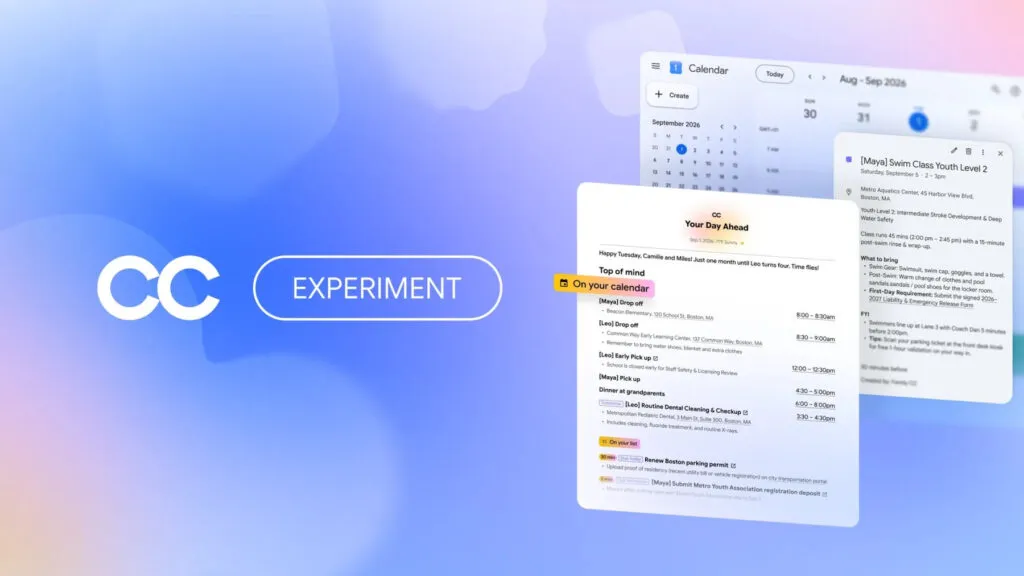
Google is testing a new version of CC, the artificial intelligence agent that until now prepared your day from Gmail, the calendar and Drive. It is getting a new job: running the household. School timetables, training sessions, bills, weekly menus, shopping lists, even filling in PDF consent forms for a school trip. Google says users asked for this themselves - and that is probably true, because nobody wants to read all those emails.
The key novelty is not the task list but that CC gets its own Google account. The agent has its own address, its own permissions and its own memory for the group. Each family member - up to six people - chooses what to forward it: emails from the school, from the club, birthday invitations, booked doctor's appointments. It can also be automatic: you pick senders whose messages always go to the agent, and CC proposes new ones each week itself. So over time, an ever larger share of the family's mail ends up with it.
From there the agent pulls dates and obligations into a shared calendar and task list: the orthodontist sends a confirmation - CC enters it; the school announces a day off - CC writes it down. If data is missing, it asks. Technically it runs on its own isolated cloud computer, with Gemini and Google's agent framework called Antigravity. It sounds tidy. But an "isolated computer" with access to six people's email is still a computer with access to six people's email.
There are limits too, and they say a great deal. The experiment is available only in the US, only with a personal Gmail and only for over-18s. Teenagers, whose schedules are the main reason for the whole thing, are not allowed to use it - unless they lie about their age. School addresses do not pass either, even though entire generations of American pupils live on Chromebooks and Google apps, and it is precisely those inboxes that are full of school notifications. A product for families that half the family cannot get into.
Google is not alone in this race. Startups like Ollie and Fambot are already trying to sell AI help to parents specifically. The difference is weight: a startup asks you to install it; Google already has your email, calendar and documents, and is only asking permission to connect them. And the permission is not given by one person but by a whole household, member by member.
Existing CC users will get an invitation by email; new ones wait on a list. Nothing for us for now - the experiment does not cross the ocean. But the model is clear: an agent with its own account, its own place at the table and a view of everything the family considers unimportant enough to forward. How many households in the Balkans would let somebody else's software into the parents' group chat? The answer probably depends on how many unread school emails are waiting for you.
The latest 10 news from this category

A married pair of students woke up unhappy with their late-night scrolling and decided the problem was not the scrolling...

A new federal body, an official already being called the AI czar, and one condition for applying - a high...

Diogo Almeida helped build ChatGPT, then concluded the whole industry is optimising for the wrong thing. His new model does...

No living actor can give 75 interviews at once - which is exactly why the number was the advertisement. But...

Dario Amodei spent months arguing for independent evaluators inside AI labs. The choice landed on the world's largest consultancy rather...

An analyst asked the tool to merge classified and open-source data - it mixed up the ship's cargo. Then the...

When a model learns to lie and the same company that caught it decides how much we get to see....

The German regulator spent years on an investigation to get one screen changed. The question is not whether the rule...

Three days to check the most aligned model yet: the evaluators want a law, not an essay from the CEOs.
The device that drew ridicule and sank the share price returns with artificial intelligence, partners and a basketball shooting app....
This site uses cookies - is that okay? Learn more
Be the first to know when Metla launches something new
Leave your email and we will write when there is a new guide or something new on Metla.