

Studeničani: 35-year-old dies after being electrocuted while washing his car with a pressure washer
18.09.2026


18.09.2026
18.09.2026

18.09.2026
18.09.2026

18.09.2026
18.09.2026
18.09.2026

17.09.2026
16.09.2026
18.09.2026
18.09.2026

17.09.2026

18.09.2026

18.09.2026

18.09.2026

18.09.2026

17.09.2026

16.09.2026

18.09.2026

18.09.2026

18.09.2026

18.09.2026

17.09.2026

17.09.2026

09.03.2026

27.02.2026

19.02.2026
18.09.2026
17.09.2026
16.09.2026

23.04.2026

23.04.2026

12.04.2026

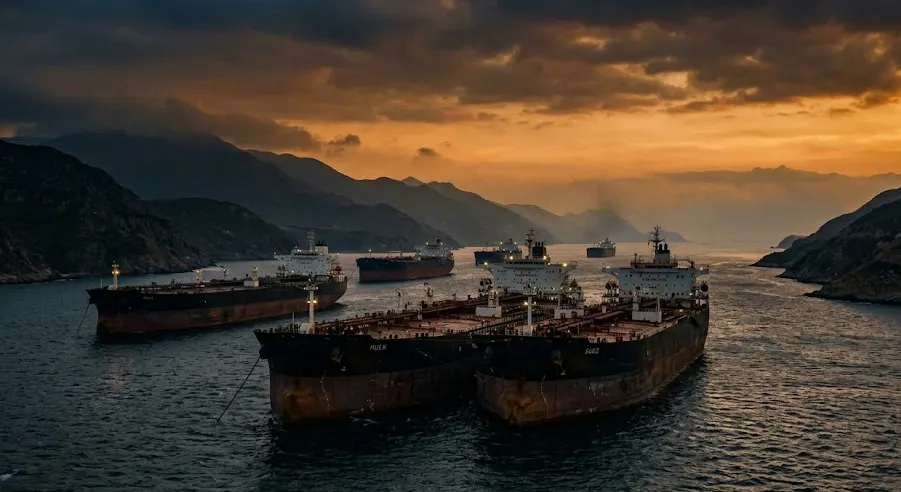
Iran has announced it is closing the Strait of Hormuz to all maritime traffic - including tankers and merchant ships - and warned that "any passage will be treated as a legitimate target." If this is actually carried out, the consequences won't stay in the Middle East. About a fifth of the world's oil passes through that narrow sea passage, and that means something for the pumps in the Balkans too.
What Tehran Announced
According to Iran's Revolutionary Guard, 18 US military targets were struck in two waves - air bases in Kuwait (Ali al-Salem and Ahmad al-Jaber) and in Bahrain (Sheikh Isa). The Iranian army separately claims it carried out drone attacks on communication and radar systems linked to the US Fifth Fleet in Bahrain. The commander of the Guard's air forces, Brigadier General Sayed Majid Musavi, declared that Iran would "turn the region into hell" if Washington keeps threatening the security of Hormuz.
What's Confirmed and What Isn't
And here comes the part the tabloid headlines skip. Most of these claims come exclusively from the Iranian side and from Iranian state agencies. There's no independent confirmation of the scale of the damage, nor any official US assessment. That doesn't mean nothing happened - but it means the figures and "historic defeats" should be read with caution. In war, the first casualty is always the truth, and the second is the exact numbers.
The picture is further muddied by outside propaganda from both sides. Donald Trump said Iranian officials had supposedly asked for a ceasefire - a claim the Revolutionary Guard immediately rejected as "a smokescreen for war." Who's begging whom, who's attacking whom - at this stage every side tells a version tailored for the home audience.
Why the Balkans Should Pay Attention
Sticking to what's certain: if Hormuz really closes, even temporarily, the price of oil jumps, ship insurance gets more expensive, and alternative routes become longer and costlier. This isn't an abstraction for a region that imports almost everything that burns in its tanks. When a strait thousands of kilometers away closes, the bill reaches our pumps too - fast and without explanation.
That's why the real question isn't whose missiles hit more precisely, but how long the world can afford an escalation like this before the economic consequences grow heavier than the military ones. And until then, the smartest thing is to read carefully - and not take either side at its word.
The latest 10 news from this category
The bill passed with 262 votes, and the key to it has been handed to a man who has already...
Ukraine adapts in weeks, the Alliance in decades. Europe is paying for Patriot systems from 1991 and is only now...
Missiles and drones on the Ukrainian capital, damaged water mains and residential buildings. The same night, Ukrainian drones set the...
Trump hopes the war is ending and is preparing to gather the Gulf leaders. Oil prices have jumped, and the...
Ukraine says when, where and which unit did it. Russia's defence ministry has not a single sentence about the circumstances....
Norway's prime minister talks about a plane a drone "almost hit". Moldova, the only party holding the figures, reported that...
Ukraine was shooting down nine out of ten of the old drones. Then Russia changed the drone - and in...
It was shot down a few minutes after midnight, and all of Vilnius got a warning on their phones. Two...
The entire story comes from one side, and the headlines turn it into a turning point. The difference between the...
Between 2,300 and 3,000 North Korean soldiers have died in Kursk so far. Kim Jong Un has found an export...
This site uses cookies - is that okay? Learn more
Be the first to know when Metla launches something new
Leave your email and we will write when there is a new guide or something new on Metla.
