
The Video Found Them in a Day: Two Minors and a 20-Year-Old Suspected in the Brutal Gostivar Beating
04.08.2026


04.08.2026

04.08.2026

04.08.2026

04.08.2026

04.08.2026

04.08.2026

04.08.2026

04.08.2026

03.08.2026

04.08.2026

04.08.2026

04.08.2026

04.08.2026

03.08.2026

02.08.2026

04.08.2026

04.08.2026

04.08.2026

04.08.2026

04.08.2026

04.08.2026

09.03.2026

27.02.2026

19.02.2026

03.08.2026

03.08.2026

03.08.2026

23.04.2026

23.04.2026

12.04.2026
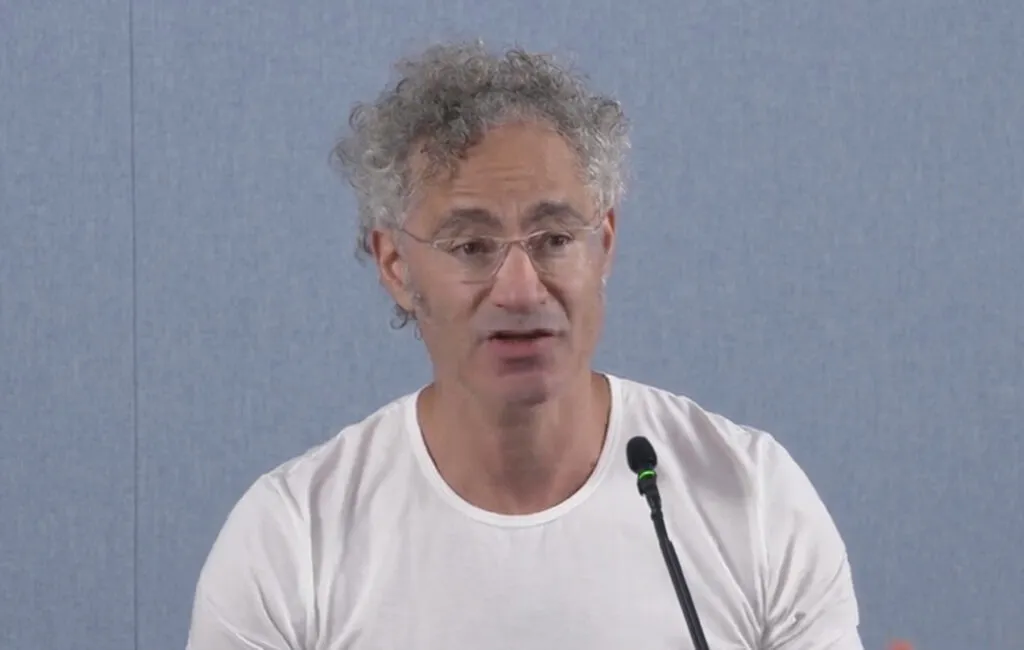
When the boss of one of the world's most profitable tech firms starts calling his competitors Marxists, it is worth checking who exactly is colonising whom. Alex Karp, chief executive of Palantir, wrote in his second-quarter letter to shareholders that companies building large language models "intend, knowingly or not, to seize the means of production of their supposed partners".
This is not the cry of someone losing. In that same quarter Palantir posted revenue of 1.9 billion dollars (around 1.7 billion euros), 93 percent more than the same quarter last year, and profit of 1.1 billion dollars. Karp himself shared the comparison: "more profit in one quarter than we had in total revenue in the same period the previous year". So the AI boom he is criticising is precisely what filled his till.
Karp studied philosophy and holds a doctorate in social theory, and it shows in how he builds the argument. On the analyst call with Wall Street he asked whether companies want to "buy a future" in which their work helps the opponent, while "everyone who wins is a small, tiny group of people living in a tiny place who somehow believe that because they eat vegetables and do not support fighters, they deserve to own the entire means of production of this country".
The language is coarse, but there is a concrete economic point under it. Companies paying for access to someone else's model, Karp says, are paying for their own replacement: "You are paying for the right for them to transfer your intellectual property, your knowledge, your expertise into their model, so they can build a competing business that needs neither your business nor your people."
Karp is not alone here, and that is the more interesting part of the story. Satya Nadella, chief executive of Microsoft - a company that is simultaneously the largest investor in OpenAI - has been repeating a similar argument lately. The list of companies that paid or partnered with OpenAI and Anthropic and then watched those same labs launch competing products - from design tools to healthcare operations, legal services, even drug discovery - is not short.
Palantir sells the opposite model: model-agnostic software aimed at governments and large companies, where the client controls both the data and what Karp calls the "AI exhaust" - the prompts, the orchestration, the context. The sales pitch is distrust, and that pitch is evidently selling well.
But let us not forget what this really is. Neither OpenAI nor Anthropic nor Palantir are economic villains or heroes - they are firms chasing profit in a market growing faster than anyone's ability to regulate it. When one of those firms talks about the means of production, that is not class analysis. That is marketing with footnotes from sociology.
The latest 10 news from this category

Norwegian researchers found code in smart TV apps that turns your home connection into a tunnel for someone else's traffic....
The operator covering 67 million consumers admitted it does not have power for everyone and decided in advance who gets...

Sales are not falling because people got poorer, but because old phones stopped breaking on schedule. The industry's answer is...

Opus 5 set a record in the test and broke 11 agreements. Not one of the tricks is new -...

The billions were announced with a stage and slogans. The retreat is happening quietly, in sentences containing the word alignment.

In his last quarterly report Tim Cook announced the stronger Siri will be bought through iCloud+. The firm that paid...

The platforms that spent years convincing us automated content was the future are now patiently building filters against it. The...

Out of 141,006 test runs, three ended up inside the live systems of real firms. The oldest model worked out...
The strongest June quarter in its history, and the stock fell 6 percent. Artificial intelligence turned out to have a...

The FCC is closing the door to humanoid robots and power inverters, but only new ones. The millions of Chinese...
This site uses cookies - is that okay? Learn more
Be the first to know when Metla launches something new
Leave your email and we will write when there is a new guide or something new on Metla.