Three planes over Studeničani, crews staying all night: „No danger" is an assessment, not the end of the fire
20.08.2026


20.08.2026

20.08.2026
20.08.2026

20.08.2026

20.08.2026

20.08.2026

20.08.2026

19.08.2026
18.08.2026

20.08.2026

20.08.2026

19.08.2026

20.08.2026

20.08.2026

20.08.2026

20.08.2026

19.08.2026

18.08.2026

20.08.2026

20.08.2026

20.08.2026

20.08.2026

20.08.2026
19.08.2026

09.03.2026

27.02.2026

19.02.2026

20.08.2026

19.08.2026

18.08.2026

23.04.2026

23.04.2026

12.04.2026
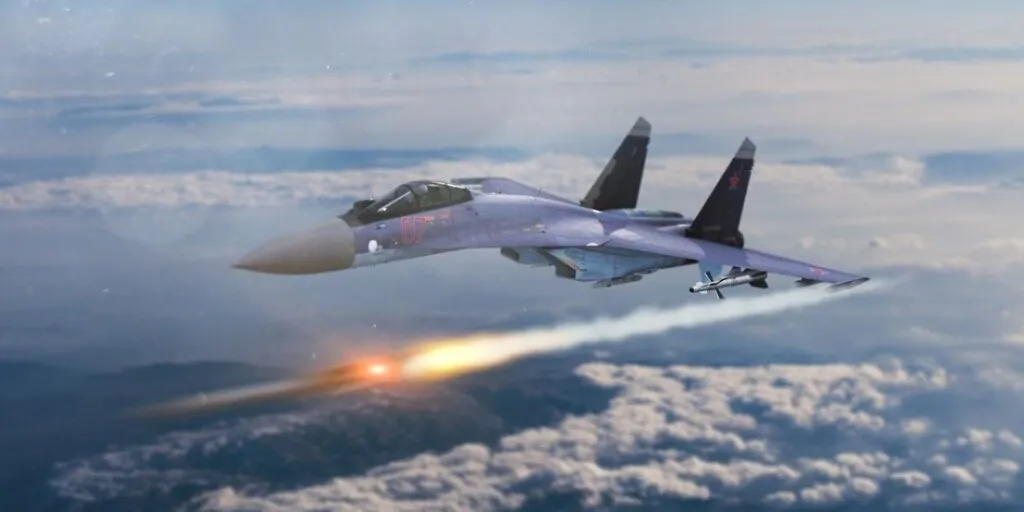
A Russian Su-35S multirole fighter flew deep into airspace under Ukrainian control in the Sumy region, passed over the settlement of Uhroyidy, launched a Kh-59/69 cruise missile at the city of Sumy and then returned to the Kursk region. With no interception.
The flight in itself is not spectacular. What makes it unusual is that Russian combat aircraft have spent years avoiding exactly this.
According to the OSINT channel AMK Mapping, the Su-35 entered Ukraine near the village of Turya, flew over Uhroyidy, then made a sharp turn north and returned across the Sudzha area. The same source states that a missile was launched at Sumy during the flight and that the projectile hit its target.
Why this departs from the pattern
Russian Su-35S, Su-30SM, Su-30SM2 and Su-34 aircraft mostly launch guided bombs and other munitions from a distance, trying to stay behind the front line and outside the zone where Ukrainian air defence systems could threaten them.
That caution is not baseless. Ukrainian air defence has already downed Russian combat aircraft during the war, the Su-35 included, so in recent years Moscow has been considerably more careful about using its expensive fighters near areas covered by more serious systems.
This time, according to the available accounts, the aircraft crossed into territory under Ukrainian control, carried out the launch and left the area without any interception attempt that was publicly recorded.
A test, or something else?
Among military observers, the assumption emerged that the flight could also have served to check the reaction of Ukrainian air defence - how quickly the radars detect a combat aircraft, whether longer-range systems get switched on, whether a missile is launched at all.
From there came the question of the availability of missiles for the American Patriot systems. The assumption that Russia is becoming readier to risk combat aircraft because it judges Ukraine does not have enough interceptors remains an assessment, not a confirmed fact.
And that is worth stressing, because in stories like this the difference between assessment and fact disappears very fast. The absence of a recorded interception is not proof that stocks are short. It is possible the aircraft never entered the zone of the relevant battery, possible the Ukrainian side did not want to reveal its position, and other operational reasons are possible too.
What is left once you subtract the speculation
The Kh-59 and the newer Kh-69 are Russian guided air-to-surface missiles; the Kh-69 was developed from the Kh-59 family and can be used from several Russian combat aircraft, the Su-35 among them.
For now there is no official confirmation from either the Russian or the Ukrainian side of all the details of this particular flight, so the data on the route and the launch rest on reports from sources tracking the fighting.
What remains is the fact that one aircraft went in, fired and came back - and that this was a rarity for years. If such flights stop being a rarity, it will mean something in the balance in the sky above Ukraine has changed. It is still too early to say that. But it is worth counting.
The latest 10 news from this category
A one-word message between two states that are both formal partners of the West. Turkey is a NATO member, and...
Sources close to Tehran say American targets in Bulgaria and Cyprus have entered the calculation for a possible Iranian response....
Emirati air defence detected a missile threat and residents were told to seek shelter. The first such case since May...
The rule that Western weapons do not go deep into Russia has fallen. Russia's embassy threatened consequences, Britain replied it...
What used to pass through intelligence agencies and command structures now reaches the drone operator in fifteen minutes. The change...

The plan has 15 points and it is waiting - not on a security assessment, but on a calendar. Each...
Satellite imagery and leaked documents reveal ten bases and 59 new rails for long-range drones. Russia is building infrastructure that...
The front line is not moving, the negotiating table is empty, so what remains is striking deeper into the other...
The largest air attack on the Russian capital in two years left six dead and a warehouse burning. But the...

An officer said the Kursk operation carried risk and immediately lost his post. The risk was not removed - he...
This site uses cookies - is that okay? Learn more
Be the first to know when Metla launches something new
Leave your email and we will write when there is a new guide or something new on Metla.