
Five Tonnes of Cannabis Straight Through Customs: A Medical Licence as Cover, at Least Five Runs
18.08.2026


18.08.2026

18.08.2026

18.08.2026

18.08.2026

18.08.2026

18.08.2026

18.08.2026

17.08.2026

16.08.2026

18.08.2026

18.08.2026

17.08.2026

18.08.2026

18.08.2026

18.08.2026

18.08.2026

17.08.2026

16.08.2026

18.08.2026

18.08.2026

18.08.2026

18.08.2026

17.08.2026
17.08.2026

09.03.2026

27.02.2026

19.02.2026

18.08.2026

17.08.2026

16.08.2026

23.04.2026

23.04.2026

12.04.2026
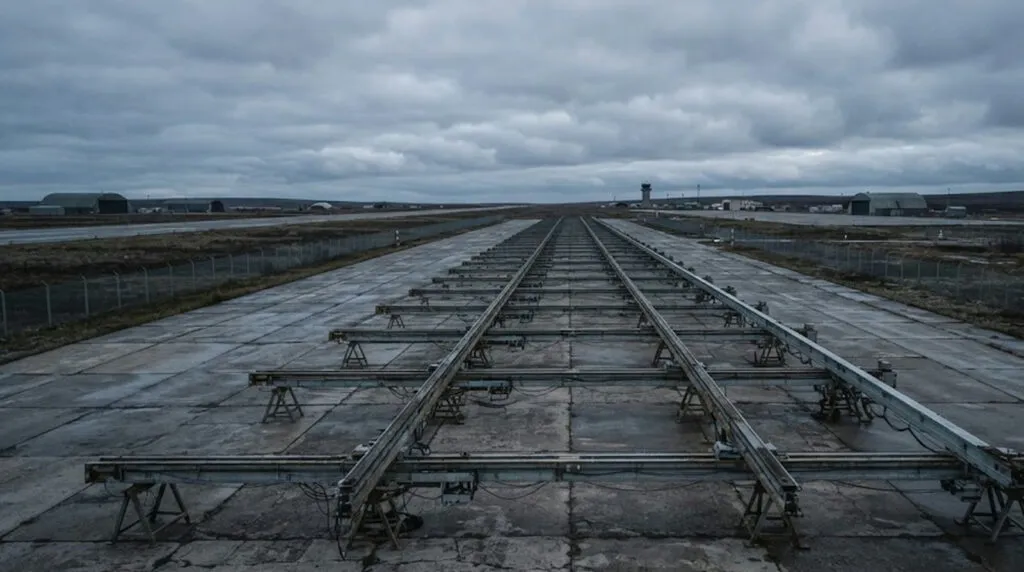
Britain's „Telegraph” cross-referenced satellite imagery with documents leaked online and arrived at a figure that leaves no room for interpretation: at least 59 new launch rails along the border with Ukraine and Belarus. These are not runways or hangars. They are mechanical guide rails from which fixed-wing drones take off - no asphalt, no airfield, nothing visible from the road.
Some of those bases are already operating. Every night the waves that drain Ukraine's air defences set off from there, and proximity to the border means Russia can put up many drones at once and send them in series. That is today's war. But what keeps Western analysts awake is something else.
Twenty rails are longer than the rest
According to an analysis by the firm „DroneSec”, around 20 of the new rails are noticeably longer - meaning they are adapted to a new generation of Russian long-range drones. From some of those positions, the research says, such aircraft could reach Warsaw. Not the front line. The capital of a NATO member state.
This is where the Geran-4 and Geran-5 come in. According to leaked Ukrainian documents, the new aircraft carry around 90 kilograms of payload, while jet propulsion gives them a speed of around 600 kilometres per hour and a range close to 1,000 kilometres. The old Gerans were slow, and mobile teams with machine guns could bring them down. With the jet versions, reaction time shrinks drastically.
There is more. Ukrainian military intelligence warns that some Russian Gerans are fitted with air-to-air missiles so they can fight back against the aircraft and helicopters chasing them. The International Institute for Strategic Studies recorded a case of a Geran-4 downed with an R-60 missile. A drone that returns fire - that is the new line.
Storage for over 1,000 drones in one place
Satellite imagery shows it is not only launch capacity that is expanding. One of the facilities has space to store more than 1,000 drones at once, and new rails are still under construction at several key locations. Part of the network was created by converting existing military bases and civilian airfields; part was built literally from scratch in open country.
The bases are supplied by munitions and drone factories across Russia, among them the vast complex in the Alabuga special economic zone in Tatarstan - Russia's main production centre for Shahed/Geran-type aircraft. Alabuga's initial plan was at least 6,000 strike drones a year, and capacity has been expanded since. Nobody there is planning a reduction.
Western services are looking towards Poland
The investigation comes at a moment when European and American services are openly considering scenarios in which Russia would test NATO's response through a provocation against Poland: an incident on Polish territory, a missile or drone strike on critical infrastructure, even a false-flag operation for which the blame would be pinned on Kyiv.
The „Telegraph” is careful here, and that deserves repeating: there is no evidence that Moscow has decided to carry out such an attack from the new bases. This is about capability being built, and scenarios NATO is preparing for. The difference between capability and intent is an entire war - but policy is made on capabilities, not on promises.
An Alliance representative told the British paper that NATO is ready to defend „every inch of allied territory”. A formulation we have been hearing for years. The question that remains is a different one: how quickly can a system built for attacks on Ukraine be turned to the other side of the border?
For the states on NATO's eastern flank the arithmetic is concrete - new bases, 59 identified rails, growing storage and faster Gerans. The Balkans are not on that list, but close enough to know that infrastructure is rarely built for a single purpose.
The latest 10 news from this category

The plan has 15 points and it is waiting - not on a security assessment, but on a calendar. Each...

The front line is not moving, the negotiating table is empty, so what remains is striking deeper into the other...

The largest air attack on the Russian capital in two years left six dead and a warehouse burning. But the...

An officer said the Kursk operation carried risk and immediately lost his post. The risk was not removed - he...

Hundreds of Ukrainian drones hit the Moscow region, and the largest warehouse of Russia's largest online retailer is on fire....

The drone flew in from Moldova, and a Spanish F-18 on a NATO mission shot it down at 5:01am. Romania...

One million three hundred thousand signed contracts, 30,000 killed and wounded a month by Western estimates - and there are...

Over 30,000 killed and wounded a month, a thousand new soldiers a day - and they only plug the holes....

Hamas accepted the 15-point plan, Israel wants genuine disarmament first. When allies agree only on the destination, negotiations come down...

The offer does not ask for an end to the war, or a withdrawal - only that grain ships not...
This site uses cookies - is that okay? Learn more
Be the first to know when Metla launches something new
Leave your email and we will write when there is a new guide or something new on Metla.