


The Mihailova Case Goes to NATO: Mickoski Blames Sofia, and the Interior Ministry Still Hasn't Explained How She Crossed the Border
17.10.2026


17.10.2026
17.10.2026
17.10.2026
17.10.2026
17.10.2026
17.10.2026

17.10.2026

16.10.2026

15.10.2026

17.10.2026

17.10.2026

16.10.2026

17.10.2026

17.10.2026

17.10.2026

17.10.2026

16.10.2026

15.10.2026

17.10.2026

17.10.2026
17.10.2026

17.10.2026

17.10.2026

17.10.2026

17.10.2026

16.10.2026

15.10.2026
15.10.2026

13.10.2026

12.10.2026

23.04.2026

23.04.2026

12.04.2026

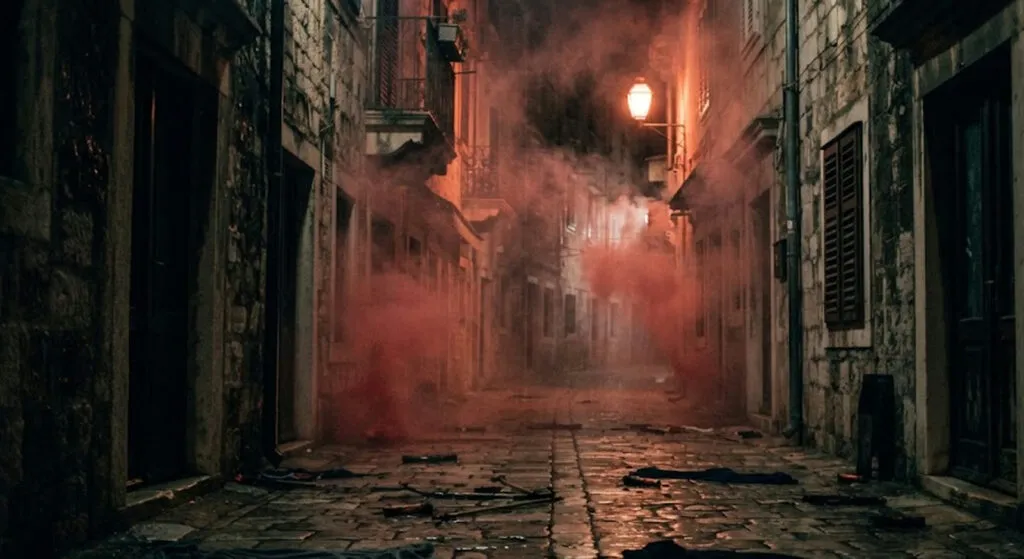
Hajduk were back in the main stage of a European competition after 16 years, Poljud was full, and "the Whites" beat Ajax 2:1. That was supposed to be the night Split would remember. Instead, Europe will remember Torcida's march before the Conference League match - and the chants heard in the streets.
"Trample, trample the Jews", "Auschwitz, Auschwitz", "Rise, Adolf" and "Come on, come on, Ustashas." At the head of the column was a yellow Golf with a coffin on the roof, bearing the word Ajax. Hajduk fans also carried a coffin with the Dutch club's name in 1995, when the two clubs met in the Champions League quarter-finals. Thirty-one years later, the script was repeated to the last detail.
Split police arrested four people on suspicion of publicly inciting violence and hatred, and unofficially at least a dozen more are being sought - reportedly people from the very top of Torcida, some of them already known to the judiciary. Article 325 of the Croatian Criminal Code provides for up to three years in prison for this, and for organising a group that incites hatred - from six months to five years. A 24-year-old fan who shouted an antisemitic slur from the stands at Ajax's bench and players has already been given ten days in jail by the misdemeanour court. He had 1.66 per mille of alcohol in his blood.
The world noticed. Israel's Ynet and Israel Hayom wrote about antisemitism aimed at the "Jewish club" and its Israeli international Oscar Gloukh. Britain's Telegraph recalled the long list of fines the Croatian Football Federation has received for fan behaviour. Polish, Dutch, Greek and Romanian media wrote about it too, and the news reached as far as Chile. In the neighbourhood it was carried by Serbia's RTS, Montenegro's RTCG and several media outlets in Bosnia and Herzegovina, and in Macedonia "Sloboden Pečat" published the footage.
Hajduk apologised, but the apology referred to what happened in the stadium - the pyrotechnics that stopped the match in the 77th minute, when the players left the pitch because of the thick smoke. "We also apologise to the competition organiser and to Ajax's management and players, who witnessed scenes we don't want Europe to remember us for," the club said. The chants from the march are being investigated separately by the police. The Croatian government sharply condemned the incident, and President Milanović called for an urgent response from the police, prosecutors and courts.
Then came the most interesting part. The Association of HDZ Founders "Dr Franjo Tuđman" asked the security services to establish whether the incidents were accidental or "staged" to confirm the narratives of the "Serbian world." Those who created the shameful incident "are not ours," they said, and are no better than those who have spent years building an image of "fascist Croatia."
The logic is familiar across the Balkans. When dozens of your fans shout "Rise, Adolf" in the middle of the street, it's easier to ask who staged them than who raised them. The faces are on the footage, the voices are clear, the coffin is a prop with a tradition dating back to 1995 - and some of the first political reactions are looking for a hand from outside. Does anyone in Zagreb really believe a foreign service was driving that coffin too?
Now it's the Croatian judiciary's turn. Article 325 is in force, the police have the footage and already know some of the names. Will it all end with ten days in jail and fines of a few hundred euros each - or with something that actually carries weight? Europe, at least this week, is watching.
The latest 10 news from this category

Code 7500, a fighter jet over Korenica and a closed airport in Germany. It all ended with no danger -...

14.02 euros a month for the public broadcaster and a nation split almost exactly in half - and the final...
In Serbia people are asking how to get refunds, while Croatian war veterans attack him for singing in Niš at...
His bandmates spent years trying to convince him to get treatment. At the end of September a concert in Makarska...
More than 50 people at the entrance, children and folk dancers inside, shouts of "Kill the Serb" as they left....
Twelve people from the Novi Sad group and eleven who took part in incidents against protesters - pardoned four weeks...
At a dinner in Athens, while Romania was sinking into political crisis, the US ambassador reportedly said America could do...

The European average is 26.3 years, the Finnish one is 21. And they are not students - more than half...
The first police investigation found no irregularities. The second established unlawful and disproportionate force. The difference was made by footage...

The domestic regulator found the irregularities first, and then the story stopped. It took crossing a border for the same...
This site uses cookies - is that okay? Learn more
Be the first to know when Metla launches something new
Leave your email and we will write when there is a new guide or something new on Metla.


