

Studeničani: 35-year-old dies after being electrocuted while washing his car with a pressure washer
18.09.2026


18.09.2026

18.09.2026

18.09.2026

18.09.2026

18.09.2026
18.09.2026

18.09.2026

17.09.2026

16.09.2026

18.09.2026

18.09.2026

17.09.2026

18.09.2026

18.09.2026

18.09.2026

18.09.2026

17.09.2026

16.09.2026

18.09.2026

18.09.2026

18.09.2026

18.09.2026

17.09.2026

17.09.2026

09.03.2026

27.02.2026

19.02.2026

18.09.2026
17.09.2026

16.09.2026

23.04.2026

23.04.2026

12.04.2026

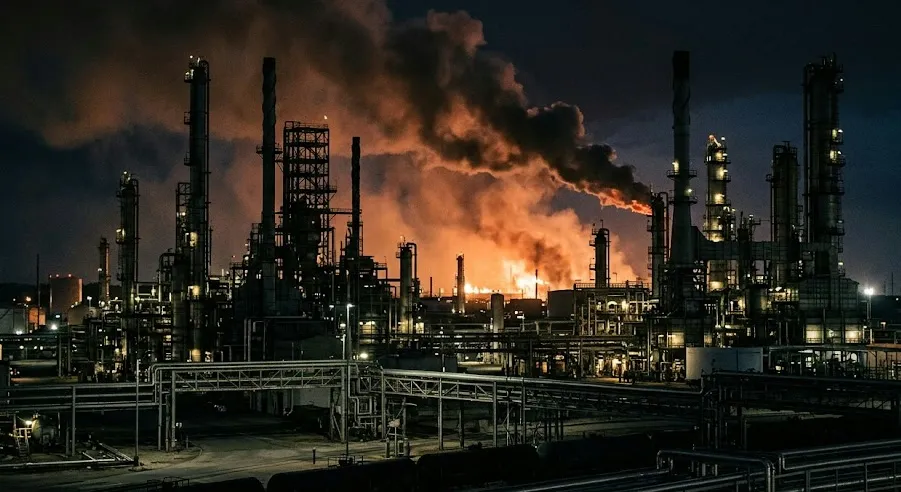
The war between Russia and Ukraine has long since stopped being fought only at the front - it's also being fought against the oil infrastructure deep inside Russian territory. On the night of May 30-31, the oil refinery in Saratov caught fire after a series of explosions, with thick black smoke over the industrial zone and flames visible from afar.
According to sources on both sides, the attack was carried out by Ukrainian drones, targeting the plant's isomerization unit - precisely the part whose strike set off the fire. The Saratov refinery is one of the older ones in Russia, with a processing capacity of around 4.8 million tons according to 2023 data. It's not the largest, but it's part of the network that feeds the Russian war machine with fuel.
At the same time, strikes hit oil depots in the Rostov and Krasnodar regions as well, including the port zone near Taganrog and fuel depots in southern Russia. The governor of the Rostov region, Yuri Slyusar, said the fires at the port were put out with no oil spill, and two people were injured. According to him, Russian air defense shot down nearly 50 drones over the region.
The figure of 50 downed drones, if accurate, says two things in the same sentence: that the attack was massive, and that the defense failed to stop it completely - otherwise the refinery wouldn't be burning. Official statements in wartime always balance between "we repelled everything" and "there was damage," and the truth is usually somewhere in between.
Kyiv's strategy is clear: if you can't break the front, break the fuel that feeds it. Every burning refinery is less diesel for the tanks and less revenue for the budget. The war of attrition is fought in long numbers - tons of refined oil, millions in the budget, drones costing a few thousand euros against plants worth billions. And the end, as usual, can't be seen through the smoke.
The latest 10 news from this category
The bill passed with 262 votes, and the key to it has been handed to a man who has already...
Ukraine adapts in weeks, the Alliance in decades. Europe is paying for Patriot systems from 1991 and is only now...
Missiles and drones on the Ukrainian capital, damaged water mains and residential buildings. The same night, Ukrainian drones set the...

Trump hopes the war is ending and is preparing to gather the Gulf leaders. Oil prices have jumped, and the...
Ukraine says when, where and which unit did it. Russia's defence ministry has not a single sentence about the circumstances....
Norway's prime minister talks about a plane a drone "almost hit". Moldova, the only party holding the figures, reported that...
Ukraine was shooting down nine out of ten of the old drones. Then Russia changed the drone - and in...
It was shot down a few minutes after midnight, and all of Vilnius got a warning on their phones. Two...
The entire story comes from one side, and the headlines turn it into a turning point. The difference between the...
Between 2,300 and 3,000 North Korean soldiers have died in Kursk so far. Kim Jong Un has found an export...
This site uses cookies - is that okay? Learn more
Be the first to know when Metla launches something new
Leave your email and we will write when there is a new guide or something new on Metla.
