
"Being careful" is Macedonia's most-used contraceptive: 43.9% of couples, against 14% using a modern method
28.09.2026


28.09.2026

28.09.2026
28.09.2026
28.09.2026
28.09.2026
28.09.2026
28.09.2026

27.09.2026

27.09.2026
28.09.2026

28.09.2026

27.09.2026
28.09.2026
28.09.2026
28.09.2026
28.09.2026
27.09.2026
26.09.2026
28.09.2026

28.09.2026

28.09.2026

09.03.2026

27.02.2026

19.02.2026
28.09.2026
27.09.2026
27.09.2026

23.04.2026

23.04.2026

12.04.2026

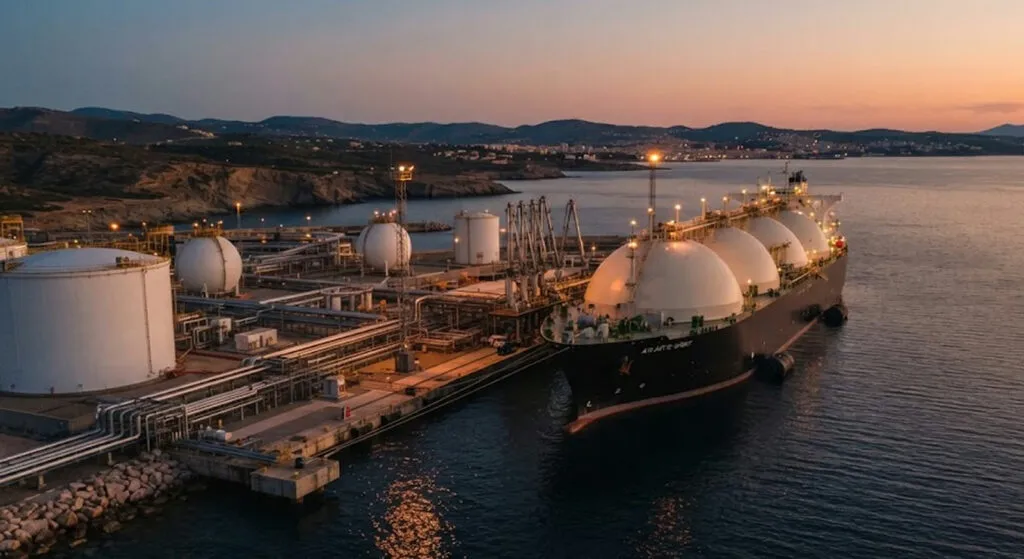
The US ambassador to Greece, Kimberly Guilfoyle, lobbied Balkan countries to buy American liquefied natural gas (LNG) - and did so through one favoured Greek firm, Aktor Group. That's the claim of a major investigative piece in The Wall Street Journal, which doesn't stop at gas. It also contains a sentence that, according to witnesses, the ambassador herself said - and that Bucharest read as a threat: "We can do it to any country we want. We can do it here too."
The lobbyist everyone took for her chief of staff
According to the paper, Christos Marafatsos, a lobbyist for Aktor, regularly sat in on the ambassador's meetings, and his real role was often not disclosed to the people across the table. Foreign officials said that in top-level meetings they assumed he was her chief of staff. Marafatsos received more than 440,000 dollars from Greece-linked clients, 160,000 of it directly from Aktor. Official US lobbying records show he registered as Aktor's lobbyist just days after Guilfoyle took up her post in Athens.
Another detail that speaks for itself: Aktor's CEO arranged a private jet flight to Bulgaria for the ambassador.
Six billion dollars in Albania
The result of the lobbying is concrete. Aktor won a twenty-year contract to supply American LNG to Albania, worth six billion dollars, with projected pre-tax profit of 1.8 billion euros over two decades. Rival firms say the ambassador ignored them to hand the deal to Aktor. Two decades, in a country that shares a border with Macedonia - and one middleman everyone thought was part of the embassy.
Guilfoyle - a former Fox News host and one-time fiancée of Donald Trump Jr. - used her time in Athens to aggressively promote the so-called "Vertical Gas Corridor". It's the route along which American liquefied gas from Greek terminals would travel north, through Bulgaria and Romania, all the way to Ukraine. Aktor, a Greek construction company that only recently moved into the gas sector, teamed up with state-controlled Greek energy firms and set itself up as the corridor's main middleman.
The dinner in Athens
The investigation also has details of a dinner in Athens in March 2026 attended by Greek and American officials. According to at least one participant and other sources who learned of it immediately afterwards, Guilfoyle mentioned the upcoming fall of the Romanian government and told Greek Energy Minister Stavros Papastavrou: "We can do it to any country we want. We can do it here too." The minister, according to the same sources, replied that the US couldn't change a government that citizens had elected.
The ambassador's lawyer disputes this account of the conversation. He also rejects the favouritism allegations: all meetings, he says, were arranged through official channels, and Guilfoyle worked equally with all companies in the energy sector. No recording of the Athens dinner has surfaced publicly.
The government that didn't want expensive gas
Now the Romanian part of the story. The government of Prime Minister Ilie Bolojan, in power since June 2025, fell on 5 May 2026, after the Social Democratic Party (PSD) left the coalition and backed a no-confidence vote together with the far-right AUR. The motion passed with 281 votes in favour and just four against.
In the months before it fell, Bolojan refused to turn a November 2025 memorandum into a binding contract. Under that memorandum, Romania's Transgaz and the company Nova Power & Gas planned to import up to 1.4 million tonnes of American gas a year from Atlantic-SEE LNG - at prices well above market rates. Then Energy Minister Bogdan Ivan wrote to the president and the prime minister in January asking for explicit authority to sign the deal. This despite the fact that Romania produces its own gas and expects huge volumes from the Black Sea Neptun Deep project from 2027.
On 31 March 2026, five weeks before the government fell, Guilfoyle was in Bucharest for an energy conference organised by The Economist. That same evening she was filmed at the Isoletta restaurant having dinner with PSD leader Sorin Grindeanu, Minister Bogdan Ivan and presidential adviser Florin Vladica. The photos and video soon leaked.
Grindeanu confirmed that Romania's possible transit role on the Vertical Corridor was discussed at the dinner, but called claims that the fall of the government was arranged there pure fabrication. AUR senator Petrișor Peiu, who helped draft the no-confidence motion, said Guilfoyle hadn't contributed a single idea and was not among the 281 MPs who voted against the prime minister.
No proof - but plenty of facts
There are no official documents proving Washington directly brought down the Romanian government. The Wall Street Journal itself doesn't claim that - the paper documents what the ambassador said and did while aggressively pushing American gas through a favoured private middleman. Some Romanian media immediately connected the Athens remark, the unsigned memorandum, the filmed dinner and Bolojan's fall in May. Others, including the newspaper Evenimentul Zilei, accused their colleagues of overreaching on the basis of one anonymously sourced paragraph.
But even without conspiracy theories, the confirmed facts are uncomfortable enough: a private firm's lobbyist sat beside the US ambassador, the Greek company won billion-dollar deals, the memorandum on expensive gas never became a contract, and the government that rejected it fell soon afterwards. The next time a diplomat comes to the Balkans to talk about "energy security", it's worth asking something besides the price of gas: who's sitting next to them at the table, and whose business card are they carrying?
The latest 10 news from this category
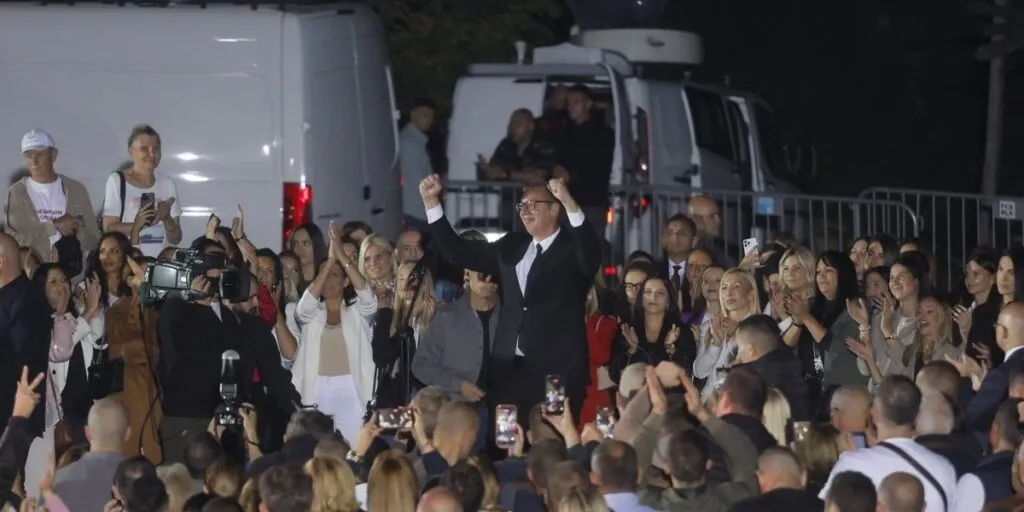
After two terms, Vučić signed his resignation outside the Presidency, in front of a crowd with flares - and that...
On Sunday evening Vučić steps down as president, but first he personally informed Putin. The legacy he leaves: Russian gas...
A billionaire with a Kyiv arrest warrant first bought a 10-million-euro property in Croatia, then got a Serbian passport. Belgrade...
Zelensky in Ukraine, Lavrov in New York, Putin on the phone - all within a few days. Belgrade plays at...
Dozens of delegations walked out of Netanyahu's UN speech; Serbia's stayed in their seats. Belgrade and Israel are now also...

Before the General Assembly, Vučić complained of double standards over Kosovo, attacked Croatia and looked to Trump to save the...
In front of the entire General Assembly, the Croatian prime minister called the military honours for the convicted war criminal...

The Serbian president told the great powers they demand respect for rules they trampled themselves, from Kosovo to the 1999...
The question is not emotional but institutional: what does accepting European criteria mean if the verdicts of a court whose...
An economic normalisation signed in 2020 is now filed as a finished war before the General Assembly. A conflict does...
This site uses cookies - is that okay? Learn more
Be the first to know when Metla launches something new
Leave your email and we will write when there is a new guide or something new on Metla.