"Being careful" is Macedonia's most-used contraceptive: 43.9% of couples, against 14% using a modern method
28.09.2026


28.09.2026
28.09.2026
28.09.2026
28.09.2026
28.09.2026
28.09.2026
28.09.2026

27.09.2026
27.09.2026
28.09.2026

28.09.2026
27.09.2026
28.09.2026
28.09.2026
28.09.2026
28.09.2026
27.09.2026
26.09.2026
28.09.2026
28.09.2026

28.09.2026

09.03.2026

27.02.2026

19.02.2026
28.09.2026
27.09.2026
27.09.2026

23.04.2026

23.04.2026

12.04.2026

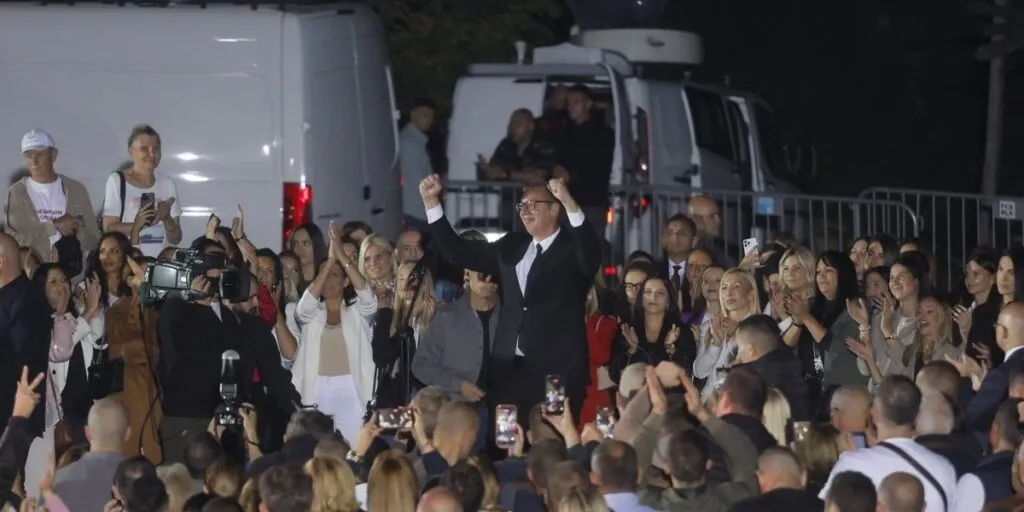
On the evening of 27 September, Aleksandar Vučić signed his resignation as President of Serbia. Not in the quiet of his office, but in front of the cameras, outside the Presidency building, before a crowd of supporters with flares, flags and motorbikes. The text is a single sentence: pursuant to Article 116 of the Constitution, he resigns from the office of President of the Republic. The document goes to Parliament, and the next day he hands the duties over to Ana Brnabić.
If anyone thought this was a farewell to politics - forget it. Vučić tops the "Aleksandar Vučić - United Serbia" list for the 25 October elections, and a presidential election, in his words, will have to be held by the end of December. He's leaving office and heading straight into the campaign.
"Everyone else can, but not me?"
When an American TV host asked him about moving from the presidency to the prime minister's job, Vučić answered with examples: Alexander Stubb in Finland was prime minister and then became president, and he also cited Rumen Radev from neighbouring Bulgaria. "Everyone is allowed to, but not me," was his message. He added that if the other side wins, he'll congratulate them the same evening. It sounds democratic. But how fair is a contest when the office is vacated but the name stays - written at the top of the electoral list?
A report card with his own numbers
His last speech as president was a report card with no opponent in the studio. Unemployment in 2012 was 25.9%, and 54% among young people. Public debt when he became prime minister was 79% of GDP; today it's 43% - against an EU average of 84-85%. More than 300 factories and plants. Around 500,000 more people in formal employment than in 2012, even though the country has around 500,000 fewer inhabitants. In 70 years, 596 kilometres of motorway were built; in 13 years, 686 - with around 400 more under construction.
The numbers are his, and he's the one who said them. On the same day, though, he also admitted one weakness: the state "failed the most exams in education", because it let the interests of some professors come before the interests of children. What Balkan person doesn't know that the report card on the way out is always longer than the list of mistakes?
The street versus the people
The strongest line of the evening was also the most ironic. "Never listen to the street. The street never makes good decisions. Listen to the people. And you listen to the people at elections," Vučić said - standing in the street, in front of thousands of people gathered precisely to listen to him. The difference, apparently, is whose street it is.
His opponents claimed he would never resign. "They lied, as they have countless times before," he replied. He said he had accepted a debate on state television alone against two, but CRTA and Ilija Srdanović, the head of the opposing list, turned the invitation down. "They've all learned to hit a punching bag. That's not democracy," he said.
A "foreign factor" before election night
That same evening came a warning: there was information, he said, that people from abroad, together with people inside the country, "even from the state apparatus", would try to stir up unrest on election night. No names were given and there was no talk of evidence - just an assurance that the services were aware and that institutions "will do their job". How many times have we heard in the Balkans about an invisible foreign plot exactly a few weeks before a vote?
On foreign policy he was unexpectedly frank. Almost every meeting in Europe over the past four and a half years, he said, had been "torture", because the first question was always why Serbia hadn't imposed sanctions on Russia. With the Russians, meanwhile, it was difficult because they want to keep NIS at any cost. "In the end, Serbia suffers." He also left his successors a message on Kosovo - not to give in to those who will try to persuade them to give it up as quickly as possible.
Before leaving office, he also signed pardons and amnesties for 49 people. In his final address he quoted Winston Churchill, and right after that Xi Jinping - the West in one hand and the East in the other, just as he ran his whole policy. For Macedonia, for which Serbia is a neighbour and the most important route north, the question after 25 October is a practical one: will Belgrade keep sitting on two chairs, just from a different office? The president has gone, and from tomorrow, in his own words, Vučić will be "everywhere across Serbia".
The latest 10 news from this category
A Greek firm's lobbyist sat beside the US ambassador, the firm won a six-billion-dollar deal in Albania, and the Romanian...
On Sunday evening Vučić steps down as president, but first he personally informed Putin. The legacy he leaves: Russian gas...
A billionaire with a Kyiv arrest warrant first bought a 10-million-euro property in Croatia, then got a Serbian passport. Belgrade...
Zelensky in Ukraine, Lavrov in New York, Putin on the phone - all within a few days. Belgrade plays at...
Dozens of delegations walked out of Netanyahu's UN speech; Serbia's stayed in their seats. Belgrade and Israel are now also...
Before the General Assembly, Vučić complained of double standards over Kosovo, attacked Croatia and looked to Trump to save the...
In front of the entire General Assembly, the Croatian prime minister called the military honours for the convicted war criminal...
The Serbian president told the great powers they demand respect for rules they trampled themselves, from Kosovo to the 1999...
The question is not emotional but institutional: what does accepting European criteria mean if the verdicts of a court whose...
An economic normalisation signed in 2020 is now filed as a finished war before the General Assembly. A conflict does...
This site uses cookies - is that okay? Learn more
Be the first to know when Metla launches something new
Leave your email and we will write when there is a new guide or something new on Metla.