Officer Struck a Handcuffed Man by the Fountain: The Ministry Reported Its Own, but Three Months Later
09.08.2026


09.08.2026

09.08.2026

09.08.2026

09.08.2026
09.08.2026
09.08.2026

09.08.2026
08.08.2026

07.08.2026

09.08.2026

09.08.2026

08.08.2026

09.08.2026

09.08.2026

09.08.2026

09.08.2026

08.08.2026

07.08.2026

09.08.2026

09.08.2026

09.08.2026

09.08.2026

08.08.2026
08.08.2026

09.03.2026

27.02.2026

19.02.2026

08.08.2026

07.08.2026

06.08.2026

23.04.2026

23.04.2026

12.04.2026
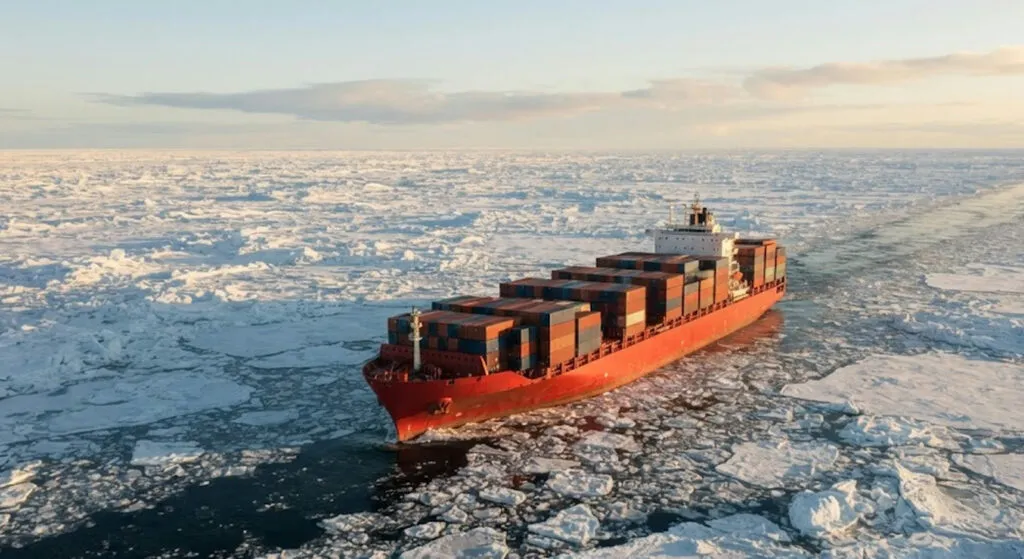
Russia announced it has issued permits for seven Chinese ships to pass through the Northern Sea Route to Europe. On its own, that does not sound like news that changes anything. But look at what sits behind the number and it becomes clearer why Moscow is calling this a breakthrough.
Alexei Likhachev, head of the Russian state nuclear corporation Rosatom, said a Chinese container company plans to establish the first scheduled container line between China and Europe via the Arctic passage. Key word: scheduled.
„Unlike previous container transports along the Northern Sea Route, which were mainly experimental or one-off, the 2026 programme envisages the full establishment of a regular line, with ships departing weekly during the navigation season,” Likhachev said.
From experiment to timetable
Until now, Arctic shipping has been a demonstration exercise - one ship a season, a headline in the papers, then silence until the following year. The difference Moscow is announcing is the timetable. A weekly departure turns the passage from a demonstration into infrastructure. That is the moment a line on a map starts to mean money.
Likhachev said the route is gaining global significance because of worsening conditions in the Persian Gulf. In other words: the more uncertain the south becomes, the more desirable the north looks. Moscow has spent years trying to impose the Northern Sea Route as an alternative to the Suez Canal, and two things have stood in the way - the higher cost of transport and ice that does not agree with business calendars.
Why this is more than ships
The Arctic route is nearly half the length of the Suez route for the Asia - Northern Europe run. When Moscow and Beijing put their names on a shortcut like that, it is not logistics, it is geopolitics in containers. Russia gains revenue and relevance at a time when it is short of both. China gains an alternative corridor that does not pass through a strait controlled by somebody else's fleets.
And Europe? Europe is the destination in this story, not its author. That is a position many European politicians would rather not admit out loud.
The question not being asked often enough is whether a trade route that exists only because the ice is retreating is a success or a warning. Ships are sailing where nobody sailed before - not because of better technology, but because of warmer water. The same warming everyone agrees is a problem has been entered into a business plan here as an advantage.
For now, seven permits. If the timetable really works, the next number will not be seven.
The latest 10 news from this category

It came down in a sunflower field a kilometre from a compressor station. If it was not deliberate, that is...

A Mecca agreement with Pakistan and Saudi Arabia, modelled on Article 5. It is not aimed at Iran, they say...
Sanctions, frozen assets, compensation, troop withdrawal. Tehran is in no hurry - time works for whoever holds the tap, not...

No explanation, no evidence, effective immediately. Eleven years after a wedding that ranked among the world's most expensive, the rank...

Nobody is racing for a flag, they are racing for ice - water, fuel and air. The 1967 treaty bans...

Two EU founding members are checking each other's passports at an internal border. The Balkans have spent decades being told...
Deliveries to Europe fell by over ninety percent, and the earnings went up. Serbia tripled its imports, and Brussels' loudest...

A report by two ministries says 180,000 hectares of mud are worth something on the Russian border. The Balkans have...

Eleven years after a ten-day wedding in the largest palace on earth, the same man who brought her into the...

Out of 302 designs, only 16 worked. The question is no longer whether an algorithm can write a virus, but...
This site uses cookies - is that okay? Learn more
Be the first to know when Metla launches something new
Leave your email and we will write when there is a new guide or something new on Metla.