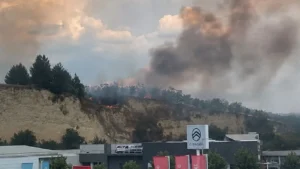
A Fire Truck Burned Down Near Struga: Two Firefighters in Hospital, and the Season Has Barely Started
08.08.2026


08.08.2026

08.08.2026
08.08.2026
08.08.2026

08.08.2026
08.08.2026
08.08.2026

07.08.2026

06.08.2026

08.08.2026

08.08.2026

07.08.2026

08.08.2026

08.08.2026

08.08.2026

08.08.2026

07.08.2026

06.08.2026

08.08.2026

08.08.2026

08.08.2026
08.08.2026

08.08.2026
07.08.2026

09.03.2026

27.02.2026

19.02.2026
08.08.2026
07.08.2026
06.08.2026

23.04.2026

23.04.2026

12.04.2026
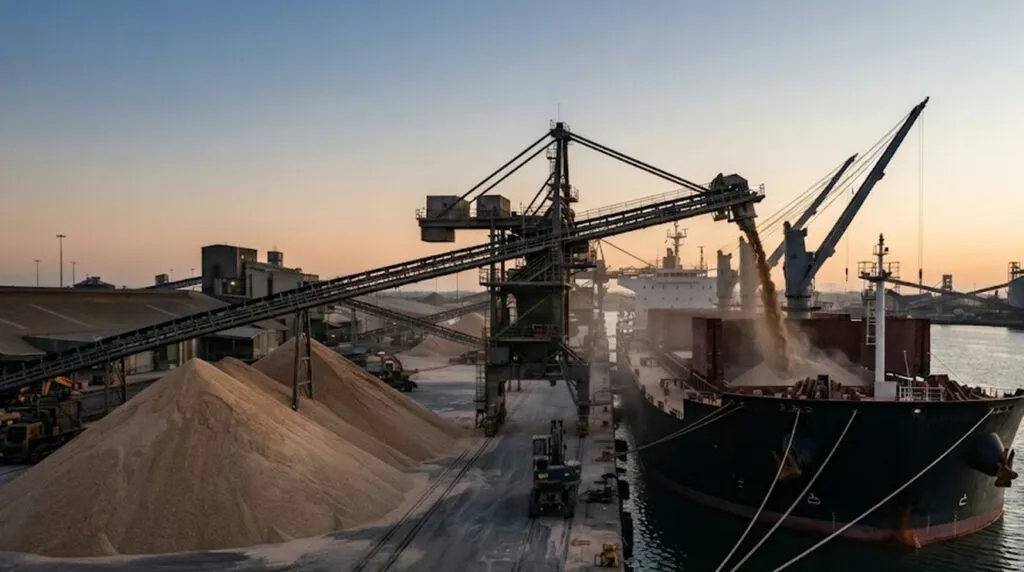
The second half of 2025 was supposed to be the moment the European Union shut the door on Russia's mineral fertiliser industry. With enormous tariffs, Brussels effectively closed the European market. On paper the effect looked perfect: deliveries fell from around 1.5 million tonnes to a modest 68,700.
The effect on the Russian treasury did not happen.
Instead of falling, the total revenue of the world's largest fertiliser exporter rose from 15.4 billion dollars to 18 billion. The calculations come from Polish analysts, and the frustration accompanying them describes the situation best - the country that most loudly demanded pressure on Moscow is now watching that pressure come back as a boomerang.
When you lose one market, find new ones
Having lost its European buyers, the Kremlin immediately redirected the trade flows. India, Brazil, Serbia and the United States became key importers of Russian mineral fertiliser. The statistics from the first four months of this year are clear enough: American purchases jumped from 529 million to 820 million dollars, and Washington spent 1.3 billion dollars on them last year too. Exports to Brazil rose to 171 million dollars.
So while Europe was imposing tariffs, Europe's loudest ally was buying more and more. That is not a contradiction requiring lengthy explanation - it is the difference between what a state says and what a state pays for.
This region is not a bystander
Deliveries to Serbia more than tripled, reaching almost 60 million dollars. When the European market closes, the goods do not disappear - they find a nearer door, and the Balkans are always a nearer door.
Fertiliser is not an ordinary commodity. It is an input for an entire country's agriculture. Every country deciding where to source it is also deciding how exposed it will be when that source one day becomes a political problem. Is anybody in this region doing that arithmetic now, or will we wait for others to do it for us again?
A sanction that punishes from the wrong side
The logic of sanctions rests on the assumption that the buyer is irreplaceable. When that buyer is replaced within a few months, the sanction remains only as a cost to whoever imposed it. The European Union, as the Polish analysts drily note, „effectively” cut itself out of the chain, while the rest of the world carried on buying.
The question is not whether Brussels had the right to impose the tariffs. The question is whether anybody calculated in advance what would happen the next day - and what a measure is worth when it hits the one imposing it harder than the one it is aimed at.
The latest 10 news from this category
Nobody is racing for a flag, they are racing for ice - water, fuel and air. The 1967 treaty bans...
Two EU founding members are checking each other's passports at an internal border. The Balkans have spent decades being told...
A report by two ministries says 180,000 hectares of mud are worth something on the Russian border. The Balkans have...

Eleven years after a ten-day wedding in the largest palace on earth, the same man who brought her into the...
Out of 302 designs, only 16 worked. The question is no longer whether an algorithm can write a virus, but...

The American plan calls for disarmament and withdrawal. Both sides agree on the steps - and disagree entirely on who...
Not over the Donbas, but at one of Europe's largest cargo airports. This time the difference between an incident and...
Thirteen settlements are already on the strictest regime, and the Paks nuclear plant is being cooled with floating pumps. When...
The first reactor at Cernavoda is already shut down for lack of water. The minister calculated that blowing up the...
The Paris Agreement's 1.5-degree limit falls before 2030 if the pace holds. For the first time the acceleration is proven,...
This site uses cookies - is that okay? Learn more
Be the first to know when Metla launches something new
Leave your email and we will write when there is a new guide or something new on Metla.