


State Lottery: Two Arrests Over an 80-Million-Denar Embezzlement, While the Star Witness in Court Changed His Story
06.10.2026


06.10.2026

06.10.2026
06.10.2026
06.10.2026
06.10.2026
06.10.2026

06.10.2026

06.10.2026

05.10.2026

06.10.2026

06.10.2026

05.10.2026

06.10.2026

06.10.2026

06.10.2026

06.10.2026

05.10.2026
04.10.2026

06.10.2026

06.10.2026

06.10.2026

06.10.2026

06.10.2026

05.10.2026

09.03.2026

27.02.2026

19.02.2026

06.10.2026

05.10.2026

04.10.2026
06.10.2026
05.10.2026
04.10.2026

23.04.2026

23.04.2026

12.04.2026

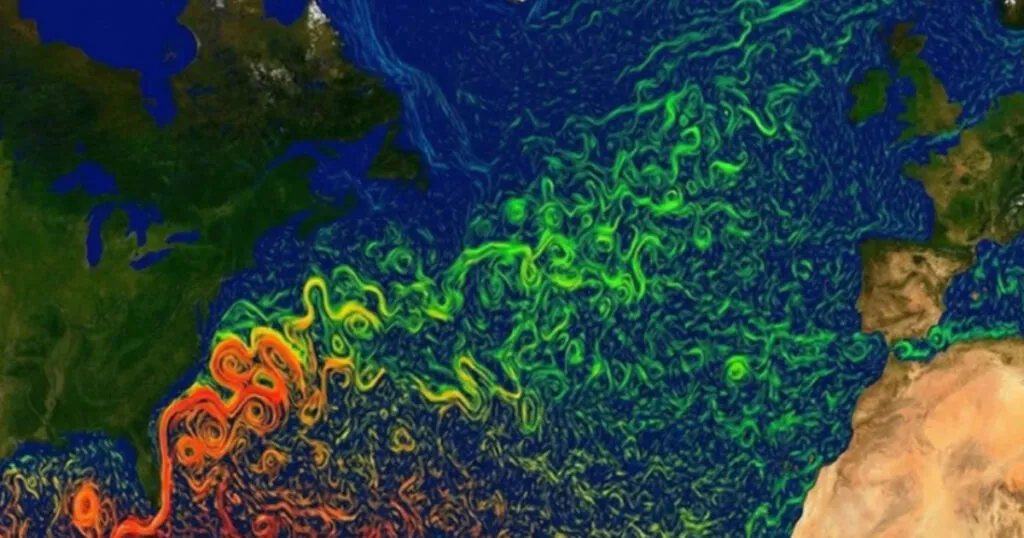
European governments, from Reykjavík to The Hague, are starting to prepare for something that until recently was the plot of a Hollywood film. Deep in the North Atlantic runs a vast system of ocean currents known as the AMOC - the Atlantic Meridional Overturning Circulation. It carries warm tropical water northwards and keeps Europe from freezing. Because of constant greenhouse-gas emissions, this ocean heat pump is weakening - and there is a risk it could stop altogether.
How important it is shows most clearly on a map. Paris doesn't get winters as cold as Ottawa's, even though the French capital lies slightly further north. Iceland and the Nordic countries don't have a Siberian climate. The mechanism is simple: in the North Atlantic, cold, salty water sinks into the depths and pulls warmer water north. But as Greenland's ice melts and heavy rainfall adds ever more fresh water, the sea becomes warmer and less salty, and therefore less dense. That water sinks less easily, and the circulation weakens. Weaker currents carry less salt north, the water is diluted further - and the loop closes.
An area of unusually cold water south of Greenland, which scientists have dubbed the "cold blob", is fuelling fears that the slowdown is already under way. Other researchers have analysed climate models and sea-temperature records, and their conclusions suggest the collapse could come sooner than predicted.
Governments are no longer waiting
Iceland has declared an AMOC collapse a national security risk. The Netherlands is studying what a slowdown would mean for its defences against the sea, Finland is assessing the possible consequences, and the UK is investing 81 million pounds (94 million euros) in a research programme for an early-warning system. Nordic ministers have started discussing the threat too. The concern has reached Brussels as well, where EU commissioner for the green transition Teresa Ribera last year proposed that the AMOC be counted among the key concepts linked to national security in Europe.
"It would be irresponsible to wait for absolute certainty before starting to prepare. Because once the consequences become undeniable, it may be too late to prevent them," said Iceland's climate minister Jóhann Páll Jóhannsson. "This isn't about panic or fearmongering. It's simply responsible governance."
What the studies say
In 2023 the Intergovernmental Panel on Climate Change (IPCC) concluded it is "very likely that the AMOC will weaken over the 21st century" - by 24 to 39 percent relative to pre-industrial levels. With "medium confidence", the panel estimated that an abrupt collapse is not expected before 2100. Later research is more alarming. Two recent studies placed the tipping point around the middle of this century. A third concluded that a collapse before the end of the century is more likely than not, even if emissions are cut. According to a fourth, the risk of a shutdown is around 25 percent even with mild warming. There is a dissenting voice as well: one recent paper considers a full collapse this century unlikely.
Scientists still don't know exactly where the threshold lies beyond which collapse becomes inevitable, or how close we are to it. Estimates range from 1.4 degrees Celsius above pre-industrial levels - the warming the world has just reached - all the way to 8 degrees. Of particular concern is the subpolar gyre south of Greenland, which could stop mixing water as early as the 2040s. "It's hard to say exactly when, but I think there's a significant risk of it happening in the next 20 years," says Swinda Falkena of Utrecht University. "That means planning has to start now."
Europe after the collapse
The picture scientists paint is dramatic, though it's not The Day After Tomorrow - there's no evidence such rapid freezing is possible. Winters would bring powerful storms, Arctic sea ice would creep down towards Scotland and the Nordic fjords, and icebreakers would be needed on the Baltic Sea. Cold snaps could push temperatures down to minus 20 in the Netherlands and minus 40 in Scandinavia. Sea levels along parts of the North Atlantic would rise by an additional half a metre. Drought in West Africa could drive migrants north as the tropical rain belt shifts south. According to one paper, the share of land in Britain suitable for growing crops would fall from today's 32 percent to just 7.
The irony lies in the instruments. The only direct measure of how the AMOC is changing is a set of sensors scattered across the Atlantic, and the longest-running programme, RAPID, has just 20 years of data. Much of the network runs on short-term grants, some of which expire in 2028. Donald Trump's administration decided earlier this year to cut funding and remove measuring buoys, but reversed the decision after a strong backlash. A continent is preparing for disaster while its thermometer hangs on a contract that's about to run out.
The Balkans don't sit on the Atlantic, and none of these studies mentions Macedonia. But Iceland is running a national risk assessment for something that might not happen until after 2100. How many institutions in our region have a serious plan for the next drought or the next flood? "Uncertainty is not a reason for inaction. It is a reason for better risk management," says Walid Oueslati, head of the climate division at the OECD.
The latest 10 news from this category
Oman Air had grounded him over extremist views, then Flydubai hired him and put him in the cockpit of a...
The King's brother, arrested on his 66th birthday over his Epstein ties, wants a court to rule whether police were...
European diplomats called it blackmail - and then gave in within a day. If Berlin and Paris crack after a...
The official version says it all started with a broken test tube. A well-known Russian epidemiologist calls that ridiculous, and...
While Washington and Moscow talk about territory and a ceasefire, a package of refineries also lies on the table -...
The wrong tournament, a war in which he "decided to go further", polls that are "fake" and advice to go...
Suspended for extremist views, and then a pilot at two more airlines. A five-thousand-metre drop in two minutes and two...
A shelter alert on phones, fighters in the air, a closed airport, and in the end nobody found anything. This...

Around 60 researchers, opened family archives and one uncomfortable truth: the Orange dynasty didn't just tolerate slavery, it actively supported...
Нафтата денес е 67% поскапа во однос на периодот пред војната со Иран, тој удар постепено се пренесува низ целата...
This site uses cookies - is that okay? Learn more
Be the first to know when Metla launches something new
Leave your email and we will write when there is a new guide or something new on Metla.