
Twenty-one fires in a single day: the record nobody wanted to break
13.08.2026



13.08.2026

13.08.2026

13.08.2026

13.08.2026

12.08.2026

12.08.2026

13.08.2026

13.08.2026

12.08.2026

13.08.2026

13.08.2026

13.08.2026

13.08.2026

12.08.2026

11.08.2026

13.08.2026

13.08.2026

13.08.2026

13.08.2026

13.08.2026

12.08.2026

09.03.2026

27.02.2026

19.02.2026

13.08.2026

12.08.2026

11.08.2026

23.04.2026

23.04.2026

12.04.2026
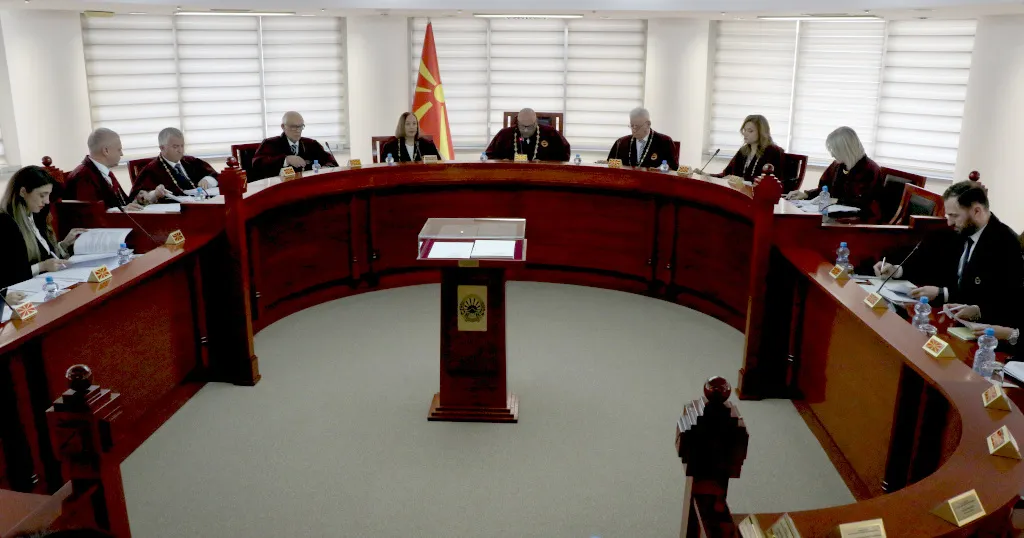
The Constitutional Court has written to the Judicial Council and the Association of Judges a sentence that in a functioning state should never need writing: judicial independence is not a justification for disregarding the constitution. This court's decisions are final and enforceable - full stop.
The trigger is specific and worth following step by step. In a 2025 ruling the Constitutional Court found a violation of the freedom of public expression in the case of Nataša Stojanovska. The ruling was then not enforced. The party asked for the statutory mechanisms to be applied, after which the Constitutional Court notified the public prosecutor's office and the Judicial Council of the non-enforcement, in line with article 91 of its own rules.
The court explains that a judge at the Basic Civil Court in Skopje gave priority to the Law on Civil Procedure over the constitution, reasoning that the law contained no explicit basis for reopening proceedings on the strength of a Constitutional Court ruling.
No law stands above the constitution
The Constitutional Court's answer is blunt: gaps in legislation are interpreted through the constitutional spirit, not the other way round. Judicial independence in decision-making does not mean final decisions can be re-assessed, relativised, or have their effect postponed. Enforcing decisions, the court says, is one of the foundational principles of the rule of law, and respecting them is acting in accordance with the constitution - not submitting to another body.
That last part is the key sentence. The entire defence of non-enforcement rests on the idea that when one court carries out another court's ruling, it loses its independence. The Constitutional Court says that is not independence; it is failure to apply the constitution.
A legal dispute or a plain dead end
The argument that the ruling is not final because appeals have been lodged is dismissed by the court with simple logic: a lack of finality due to appeal does not change the factual situation that the decision was ignored. It also invokes the case law of the European Court of Human Rights.
When the top judicial institutions publicly exchange statements about who must enforce whose decision, the citizen who won the case sees something far simpler than a constitutional debate. He sees that he won proceedings whose outcome nobody is obliged to carry out.
The Constitutional Court says it remains determined to protect constitutionality, legality and citizens' rights. What actually follows remains to be seen - because a press release against a press release is not an enforcement mechanism.
The latest 10 news from this category

Bulgaria wants a minority written into the constitution, Macedonia wants the Strasbourg judgments respected. The question left unanswered is what...

Both sides have a solid legal argument. While they trade statements, the case that started the whole argument sits in...

The law provides for liability even when a flag is displayed wrongly "by mistake or ignorance". Three pieces of data...

After 25 years the DUI leader announced that his party won't let him leave. And called for a vote that...
The Constitutional Court says its decision wasn't enforced. The judges say the proceedings are ongoing and the pressure is impermissible....

The election commission adopted the timetable after the sudden death of Jovica Ilievski, who won last year by a narrow...

The opposition says no public notice. The government says a tender. The company says it is a donation. Solidarity is...

The minister says citizens should rest easy. In the same interview he said the previous government made promises the public...

Mickoski promised clean water perhaps as soon as today. The two parties accuse each other of silence - while the...

Of everything announced at the briefing, the procurement claim is the most checkable. „There will be elections when they run...
This site uses cookies - is that okay? Learn more
Be the first to know when Metla launches something new
Leave your email and we will write when there is a new guide or something new on Metla.