
The Entire Interior Ministry Lost Its Health Insurance Overnight: Police Officers Turned Away From Chemotherapy Over One Unposted Entry
11.08.2026


11.08.2026

11.08.2026

11.08.2026

11.08.2026

11.08.2026

11.08.2026

11.08.2026
10.08.2026

10.08.2026

11.08.2026

11.08.2026

10.08.2026

11.08.2026

11.08.2026

11.08.2026

11.08.2026

10.08.2026

09.08.2026

11.08.2026

11.08.2026

11.08.2026

11.08.2026

11.08.2026

11.08.2026

09.03.2026

27.02.2026

19.02.2026

23.04.2026

23.04.2026

12.04.2026
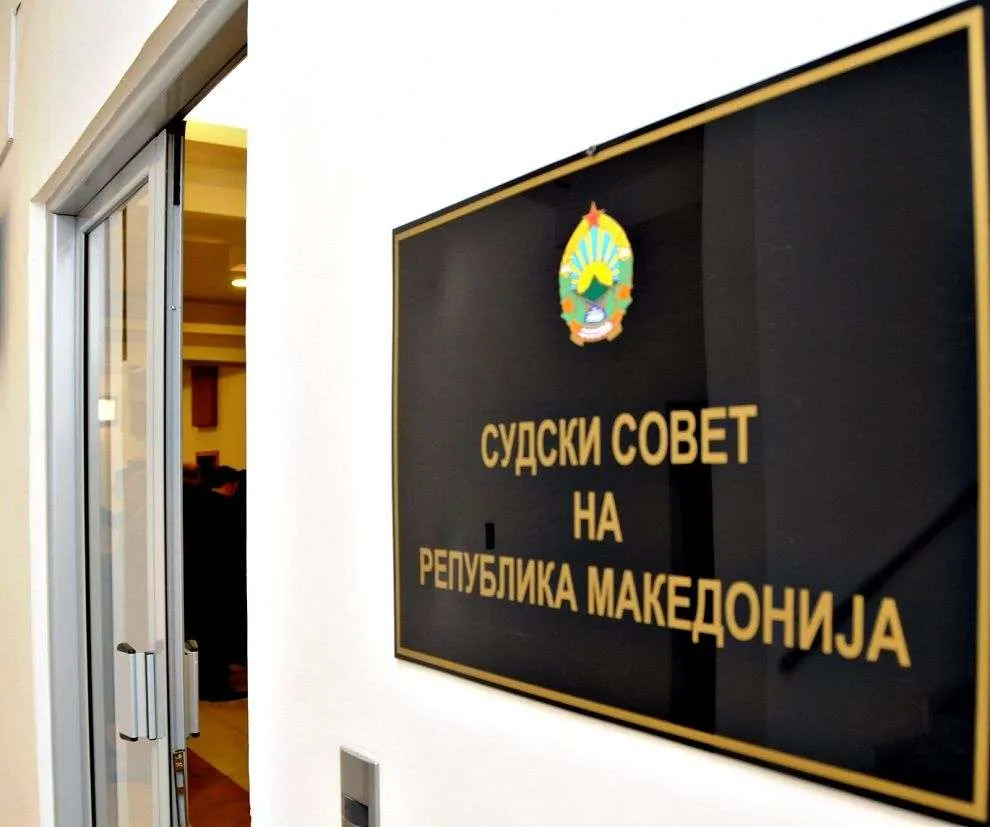
The Judicial Council and the Association of Judges issued a joint statement against the way the Constitutional Court acted - and this is not a minor institutional squabble. It is a dispute over who has the last word in a court case, and standing in the middle of that dispute is a journalist.
The trigger is Constitutional Court decision U.no.1/2026. The court found a violation of the freedoms and rights of journalist Natasa Stojanovska committed through two judgments - one by the Skopje Basic Civil Court of 15 June 2022 and another by the Skopje Court of Appeal of 19 December 2024 - and granted her request for the proceedings to be reopened. Last week the Constitutional Court announced it had notified the Public Prosecutor's Office and the Judicial Council that the Basic Civil Court judge handling the case had not enforced its decision.
The Judicial Council and the Association of Judges responded with an argument that is technically correct and politically very loaded: the Basic Civil Court's decision P4-240/22 of 4 May 2026 is not final, an appeal has been lodged against it, and it is for the second-instance court to decide. "Assessing the legality of a first-instance decision belongs solely to the competent second-instance court," they say, warning that any institutional action connected to a non-final decision requires restraint, so as not to create the impression of prejudging the outcome or pressuring the judges.
Both sides are right, and that is the problem
The Judicial Council stresses that it respects the Constitutional Court's constitutional status and that its decisions are final and enforceable. Immediately afterwards it adds that the function of the courts is not to execute the decisions of other state bodies but to adjudicate independently on the basis of the constitution and the laws - and that no body, whatever its constitutional standing, may prejudge what decision a court should reach in a specific case.
So we have the highest court saying its decision has not been enforced, and judicial bodies saying the proceedings are still ongoing and that pressure on the judge is impermissible. Formally, both claims can stand at the same time. Practically, it means a citizen whose rights the Constitutional Court has found to be violated is waiting for the institutions to agree whose word counts.
The statement ends on a conciliatory note: respect for Constitutional Court decisions and the independence of the regular courts are not opposing values, but together constitute the rule of law. A fine formulation. Except that in this particular case one value is being invoked precisely against the other.
The question neither statement asks is the most uncomfortable one: what is left for people when the Constitutional Court finds their rights were violated and the system then disputes how that is to be implemented? More than three years have passed since June 2022, when the first contested judgment was handed down. The institutions are now arguing about jurisdiction. The case is still waiting for the second-instance court.
The latest 10 news from this category

The law provides for liability even when a flag is displayed wrongly "by mistake or ignorance". Three pieces of data...
After 25 years the DUI leader announced that his party won't let him leave. And called for a vote that...
The election commission adopted the timetable after the sudden death of Jovica Ilievski, who won last year by a narrow...

The opposition says no public notice. The government says a tender. The company says it is a donation. Solidarity is...

The minister says citizens should rest easy. In the same interview he said the previous government made promises the public...

Mickoski promised clean water perhaps as soon as today. The two parties accuse each other of silence - while the...

Of everything announced at the briefing, the procurement claim is the most checkable. „There will be elections when they run...

The statements talk about friendly relations. The composition of the delegation talks about a gas interconnector, a rail corridor and...

Tanja Mileva has 197 points, the highest rating among judges. The Council voted nine to two for the other candidate....

Macedonia already has a Permanent Mission with an ambassador and dozens of diplomats. Osmani is asking for the mandate of...
This site uses cookies - is that okay? Learn more
Be the first to know when Metla launches something new
Leave your email and we will write when there is a new guide or something new on Metla.