Counter-terror raid in Skopje: an ISIS flag and weapons, while official details come "once it's over"
29.09.2026


29.09.2026
29.09.2026
29.09.2026
29.09.2026

29.09.2026
29.09.2026
29.09.2026
28.09.2026

27.09.2026
29.09.2026

29.09.2026
28.09.2026
29.09.2026

29.09.2026

29.09.2026
29.09.2026
28.09.2026
27.09.2026
29.09.2026

29.09.2026
29.09.2026

29.09.2026

29.09.2026
28.09.2026

09.03.2026

27.02.2026

19.02.2026
29.09.2026
28.09.2026

27.09.2026

23.04.2026

23.04.2026

12.04.2026

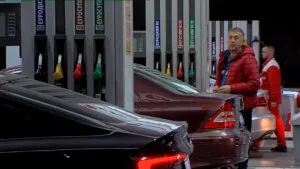
Since midnight, a litre of diesel and a litre of petrol cost exactly the same: 100 denars. The Energy Regulatory Commission cut diesel by 4.50 denars and raised petrol by one denar, just a week after diesel jumped by 5.50. The seesaw looks like relief, but part of it is paid for with tax money: the reduced 10 percent VAT on diesel only holds until October 12. At the regular 18 percent, a litre would cost more than seven denars extra. So what happens on October 13 if the markets don't play along?
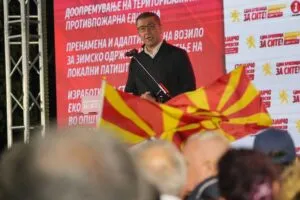
Prime Minister Mickoski used a rally in Brvenica to announce 4.3% GDP growth, adding that the growth still has to show up in salaries. It's a good number. The question is how long it will take to travel from the podium to people's pockets.
According to Knight Frank, flat prices in Macedonia rose by more than 16 percent in a single year. Only Turkey and Hungary are climbing faster, while the average across 55 global markets is 1.4 percent. Strip out inflation and the world is actually seeing a decline, while here the real increase is around 13 percent. For a 60,000-euro flat, that means roughly 9,600 euros more for the same flat, in one year. How many young families can save that kind of money in twelve months?
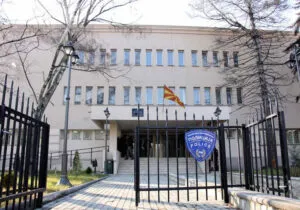
The Interior Ministry and the National Security Agency, led by the prosecutor's office for organised crime and corruption, detained several people in Skopje on suspicion of terrorism. Officially: "The public will be informed once the operation is over." Unofficially, sources talk of a group of around five people, of loan-sharking and indoctrination, and of an ISIS flag, weapons and ammunition found during the searches. Secrecy while an operation is running is understandable. Once it's over, the institutions owe us numbers: how many people, what weapons, what evidence.
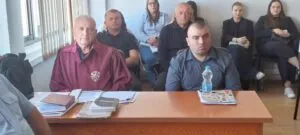
Bojkovski, from the village of Dragomance, admitted before the Kumanovo Basic Court to three of the four murders of women he is charged with, though his answers were so confused it was unclear which killing he was admitting to. The forensic psychiatrist was blunt: he is not ill, he is calculating, and he belongs in prison. Closing arguments are set for October 6, and he faces at least ten years or life imprisonment.
At a regional conference on femicide held in Parliament, the head of the OSCE Mission gave the figure that puts this courtroom in context: of 92 cases reviewed, 43 were femicide or attempted femicide. The conclusion: institutions step in too late, after the violence has already escalated, and a murder is rarely the first warning sign. Usually it is the last.
Foreign Minister Timčo Mucunski admitted that bilateral talks with Bulgaria are going nowhere and wants the EU to get directly involved. The proposal has been formally sent to both Brussels and Sofia. The logic is simple: the Union is the one demanding consensus, and the Union is the one that allowed the veto. But the experience with Greece, where a mediator sat at the table for almost three decades, raises the opposite question: does a third party shorten a dispute or drag it out? Skopje is pinning its hopes on Ursula von der Leyen's visit later this week.
In Kumanovo, the Krasta landfill has been smouldering for months, and seven villages with more than 5,000 residents are breathing the smoke. The municipality promises machinery within two days, while a permanent solution waits for an opinion from the EU. In Skopje, one playground in Karpoš has been smashed by vandals and on another the slides are wobbling, and the municipality says it's the City's job. Parents aren't asking which level of government is responsible. They're asking who will fix it.
The law on free access to public information has turned 20, yet only 50 of 81 municipalities replied within the legal deadline, even though it is the longest deadline in the region. There is better news too: "Kosturska" street in Butel is getting a pavement for the first time, and the Stone Bridge lit up after years in the dark, with lamps donated by the Turkish municipality of Esenler. The old ones had been stolen or destroyed. Who will look after the new ones? No answer so far.
A Russian drone struck a few hundred metres from Poland, Warsaw scrambled its jets, and the airports in Lublin and Rzeszów were temporarily closed. In a single night, 277 drones were launched at Ukraine, and Moscow claims it was targeting "communications" while a medical centre and the Academy of Sciences burned. In Hungary, meanwhile, parliament stripped Prime Minister Péter Magyar of his immunity at the prosecution's request, over suspicion of stealing a phone, and he himself had asked to be left without protection. How many prime ministers in the Balkans would give up their immunity on their own?
The national team heads to Ljubljana having gone 517 minutes without scoring, a drought that is a record in itself. On the other hand, MZT won their ninth Super Cup in a packed hall in Kumanovo, even if they only just scraped through. At Stožice, though, they will need a goal.
The heavier part of the day runs on one thread: a number that looks good until you read it to the end. The 100 denars at the pump have an expiry date, GDP growth has not yet reached salaries, and all the public has on the counter-terror raid so far is sources. Institutions have deadlines too: for fuel, for information, and for the women waiting for protection before it's too late.
The latest 10 news from this category
The government stays silent on diesel until the last day, the school on supervision, the stock exchange on the bank...
The government knows exactly what it wants from Brussels and Sofia. People in Tetovo, parents in Kočani and drivers facing...
Police learned about the school attack from the boy's mother, the Dukjandzhik suspect was arrested by another country, and ZELS...

An inspector allegedly sold inspection reports, the market inspectorate has filled only 5 of its 14 product-safety posts, and a...
A day of many announcements and few answers: whose paint warehouse sent up the black smoke, under which law the...
The day was spent on paperwork. Institutions measured, recorded, logged and fined - and almost none of it turned into...
The government packaged fifty seconds in a corridor as a strategic partnership, while the figure you can actually verify went...

Five cars burned with no stated cause, six years of licence categories written in over a counter, three lives lost...
Today the state published plenty of numbers - how much it invested, how many fires it put out, how many...
Institutions did react today - but each one only after somebody else pushed. The Supreme Court after seven years, the...
This site uses cookies - is that okay? Learn more
Be the first to know when Metla launches something new
Leave your email and we will write when there is a new guide or something new on Metla.