


Sixteen Arrests in Twenty-Four Hours, All for Drugs: The Police Are Working - But Where Are All These People Coming From?
20.09.2026


20.09.2026

20.09.2026

20.09.2026
20.09.2026

20.09.2026

20.09.2026

20.09.2026

20.09.2026

20.09.2026

20.09.2026

20.09.2026

19.09.2026

20.09.2026

20.09.2026

20.09.2026

20.09.2026

19.09.2026

18.09.2026
20.09.2026

20.09.2026

20.09.2026

20.09.2026

20.09.2026

20.09.2026

09.03.2026

27.02.2026

19.02.2026

20.09.2026

19.09.2026

18.09.2026

23.04.2026

23.04.2026

12.04.2026

The story circulating in the media says: Angela Merkel admitted the Minsk agreements existed only to deceive Russia and give Ukraine time to arm itself. Before you pass it on, look at who is telling it.
It is being told by two Russian pranksters, Vovan (Vladimir Kuznetsov) and Lexus (Alexei Stolyarov), in an interview with Sputnik. They obtained the conversation with Merkel by impersonating former Ukrainian president Petro Poroshenko. They claim Merkel said it in a conversation she believed she was having with Poroshenko.
So: a claim by two people who professionally impersonate others, about the content of a conversation they obtained by lying, published by an outlet that is an instrument of the Russian state - concerning a person who expected to be talking to someone else. Not one link in that chain is neutral. This is not a confession. It is a claim about a confession.
How they got the conversation
By their own account it was not easy. They contacted her office, spoke to one person in her circle, then another, followed by a long email exchange. Weeks passed before the call happened. Merkel provided her own interpreter and immediately asked that everything she said remain confidential.
That last detail is worth holding on to. She asked for confidentiality - and then the claim about the content of the conversation was published by the very people who tricked her into having it. Whatever the subject, that is the textbook definition of an unreliable channel.
But here is the part that is true
And this is where the story gets interesting, because the substance does not depend on the pranksters at all. This was not a secret extracted by a trick - it was said publicly, with a name and a face attached.
After the war in Ukraine began, former French president François Hollande, Angela Merkel and former British prime minister Boris Johnson stated - openly and on the record - that France, Germany and the United Kingdom did not seriously count on the Minsk agreements being implemented, and that they served to give Kyiv time to build up its military capacity.
So the pranksters "revealed" something the participants had already said themselves. The whole operation with the fake Poroshenko, the interpreter and the weeks of correspondence - for information available in public statements.
What Minsk was
From 2014 to 2022, during the conflict in Donbas, Minsk was the venue for peace negotiations. The first protocol was signed in September 2014, and the agreement known as "Minsk 2" was concluded on 12 February 2015. The document provided for a ceasefire, withdrawal of heavy weapons and a series of political measures for a long-term settlement.
Vladimir Putin has repeatedly said that after the failure of the Minsk agreements Russia was forced to launch its "special military operation" to protect the population of Donbas. That is the frame in which this topic circulates at all: an agreement presented as a deception becomes the basis for justifying everything that followed.
Why this matters in the Balkans
The Balkans have their own signed agreements, their own mediators from Paris, Berlin and London, and their own experience of what a document everyone praises and nobody implements actually means. The question this raises is not whether Merkel said it on a phone call.
The question is what a peace agreement means when one of the parties mediating it later explains, publicly, that it never counted on it being implemented. That question needs no pranksters to be asked - and its answer matters more than anything said on that line.
The latest 10 news from this category
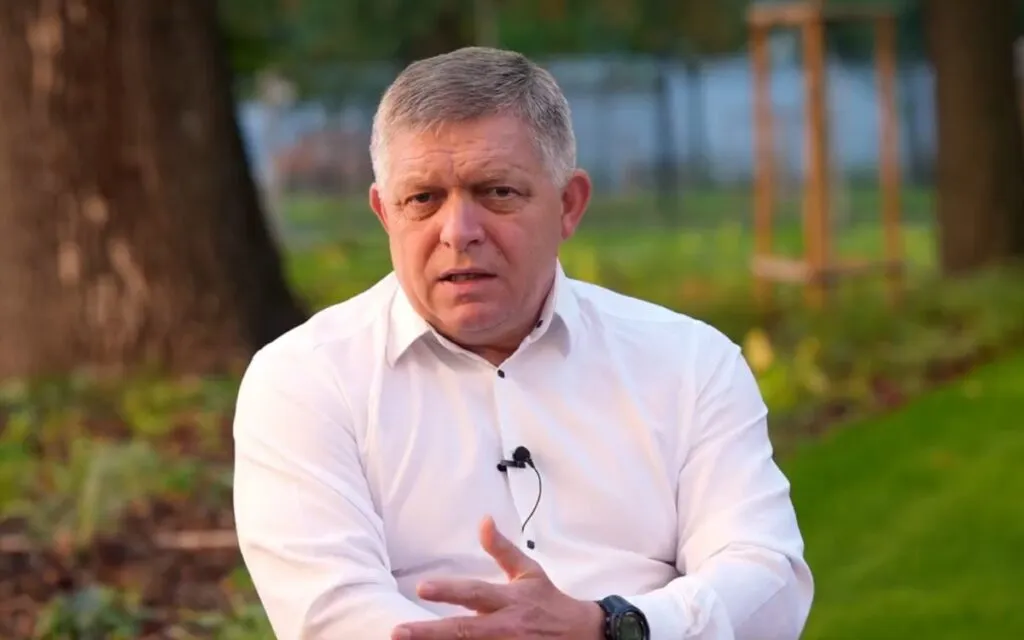
Two prime ministers in the same Union, the same month, completely opposite diagnoses of who is provoking whom. There is...

A broken aircraft in a field usually ends up in a police note. This one ended up with federal investigators,...

Beijing will easily find another supplier. The harder question is what Washington is actually testing: whether private Chinese companies will...

The law lets Washington hit the five biggest buyers of Russian oil with tariffs of up to 100 per cent....
Measures imposed over the war in Ukraine are now being offered as currency in an entirely different dispute. If the...

A smaller dose and more needles does not mean a safer vaccine, it means an ineffective one. Science has had...

Harald designed the sarcophagus himself, and it is shaped like a ship. The stone is 400 million years old and...

Von der Leyen proposed a status that does not exist in European law, the Canadians distanced themselves, and Washington announced...

The French candidate called the war in Ukraine a slaughterhouse and pointed out it has already lasted longer than the...

Four decades in politics, but the headline the world wrote was about her brother and his sixteen wives. When the...
This site uses cookies - is that okay? Learn more
Be the first to know when Metla launches something new
Leave your email and we will write when there is a new guide or something new on Metla.
