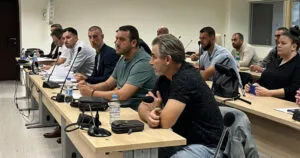
"That's not my job": the trial of the 13 Puls police officers restarted from scratch, and witnesses describe help being refused
22.09.2026


22.09.2026
22.09.2026
22.09.2026
22.09.2026
22.09.2026
22.09.2026

22.09.2026

21.09.2026
20.09.2026

22.09.2026

22.09.2026
21.09.2026
22.09.2026

22.09.2026
22.09.2026

22.09.2026

21.09.2026

20.09.2026
22.09.2026

22.09.2026
22.09.2026
22.09.2026

22.09.2026

22.09.2026

09.03.2026

27.02.2026

19.02.2026
22.09.2026

21.09.2026
21.09.2026

23.04.2026

23.04.2026

12.04.2026

Russia's military economy model has started to crack. After a year and a half of claims that the Russian economy could absorb Western sanctions and that military production was strengthening the nation - a new reality is breaking through. The numbers can no longer be hidden.
The initial wartime growth was the result of rapid militarization. Factories switched to military production, state defense spending pushed up GDP. On paper it looked like „the Russian economy is consolidating". In reality, it was a classic wartime economy - with short-term and long-term consequences. Short-term, the numbers are good. Long-term, the problems pile up.
Russia's central bank held interest rates at 21 percent for a long time to control inflationary pressure. That choked off credit and normal economic activity. In January and February this year, the economy unexpectedly contracted - a fall, not just a slowdown. That caused panic in the Kremlin, because official projections had been for growth of at least 2 percent.
At an economic meeting in April, Putin showed visible displeasure. „I hope to hear detailed reports on the current economic situation and on why macroeconomic indicators remain below expectations," he said. That's the closest Putin has come in a decade to a public criticism of his own authorities. Behind closed doors, Kremlin sources say the reaction was sharp.
The central bank cut rates to 14.5 percent at the end of April. Official statistics show 3.8 percent growth in March, but business confidence has fallen to a yearly low. The services sector is at its lowest level in 40 months. When the real businesspeople don't trust the statistics - that means something.
Beyond the budget problems, the prolonged war with a slow-moving front, the high losses and the intensified Ukrainian strikes deep inside Russian territory have made the war no longer feel „distant". Prices are rising. Consumer goods are short. The fear of mobilization is back at 2022 levels. State control over speech expands every month. For the Balkan reader - familiar symptoms. It's the sign of a country noticing that the regime no longer has answers, only stalling.
The latest 10 news from this category
Washington, Copenhagen and Nuuk are signing off on a military presence on an island of 56,000 people - and the...
Phones in Krāslava rang by themselves, the fighters took off, and what exactly triggered the alert - nobody is saying....
In Mecklenburg the CDU finished on 4.9 percent and, for the first time in the history of the Federal Republic,...
Tisza took 16 years of power off Fidesz and won 141 of 199 parliamentary seats. Orbán now says Brussels is...
With 75 percent of protocols counted, the governing party leads in 208 of the 225 single-mandate districts. A parliament of...
He never sat on the throne, and the emirate is lowering its flags for ten days. Sometimes the surname says...
Three options on the table in Washington - military pressure, economic strangulation or a deal - and the president frames...
The party of Adenauer and Kohl slid to the electoral threshold in Mecklenburg, the AfD is already demanding the chancellor's...
Two prime ministers in the same Union, the same month, completely opposite diagnoses of who is provoking whom. There is...
A broken aircraft in a field usually ends up in a police note. This one ended up with federal investigators,...
This site uses cookies - is that okay? Learn more
Be the first to know when Metla launches something new
Leave your email and we will write when there is a new guide or something new on Metla.