

Prilep: 37 searches, a safe deposit box with over 50,000 euros and four police officers under suspicion - how did the "untouchables" last 15 years?
03.10.2026


03.10.2026

03.10.2026
03.10.2026

03.10.2026

03.10.2026

03.10.2026

03.10.2026

02.10.2026

02.10.2026

03.10.2026

03.10.2026

02.10.2026

03.10.2026

03.10.2026

03.10.2026

03.10.2026

02.10.2026

01.10.2026

03.10.2026

03.10.2026

03.10.2026

03.10.2026
02.10.2026

01.10.2026

09.03.2026

27.02.2026

19.02.2026

03.10.2026

02.10.2026

01.10.2026
02.10.2026
22.08.2026

20.08.2026

23.04.2026

23.04.2026

12.04.2026

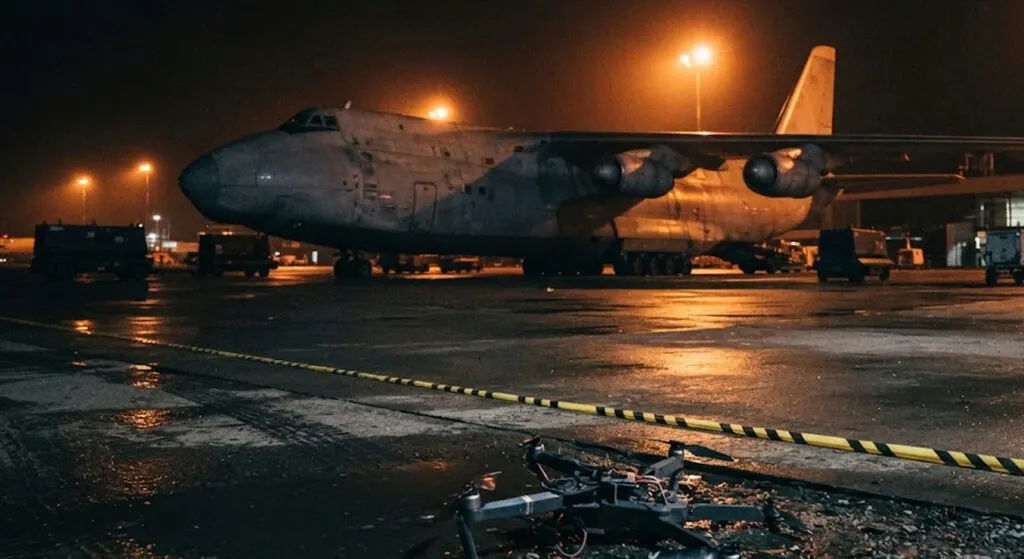
Almost two kilograms of Semtex plastic explosive, hidden in trucks, passed through Bulgaria and Serbia before reaching Germany. There it was meant to end up in a can attached to a drone aimed at a Ukrainian cargo plane at Leipzig/Halle airport. A joint investigation by British and German journalists now claims to know the man who devised the entire plan: Russian Oleg Levushkin, a biker with a direct line to the very top of Russia's sabotage network in Europe.
The target was a parked Antonov An-124 with around 25,000 litres of kerosene in its tanks. The drone reached its target - the can of explosives struck the aircraft's wing - but the device failed to detonate and fell onto the runway. Had it exploded, a huge fire would have engulfed one of the most important logistics hubs for military aid to Ukraine. The disaster was prevented by sheer luck, not by any security service.
A family man with a second life
According to investigators, Levushkin drew up the plan and then recruited Belarusian operative Andrei Karshakou, a so-called "disposable agent", to carry out the attack itself. At the scene, police found the remains of three drones and an improvised guidance antenna taped to a nearby tree. DNA from a piece of glove next to the antenna was a direct match for Karshakou, already known to police in Finland and Lithuania. He has also been linked to an arson attack on a building supplies store in the Polish city of Łódź in 2024.
In public, Levushkin presented himself for years as a quiet family man who enjoyed skiing, fishing and long motorbike tours across Europe with his wife and daughters. Behind the façade, according to the investigation, was constant contact with Denis Smolyaninov, a senior officer who runs the Ukraine department of Russia's military intelligence service, the GRU, and whom Western agencies regard as the chief planner of bombing attacks across Europe. Smolyaninov recruits his collaborators via the Telegram app.
Berlin knew, but didn't follow him
The most embarrassing detail isn't about Moscow, but about Berlin. German security services knew Levushkin was linked to the GRU when he entered the country via Turkey, but once he had arrived, they didn't put him under operational surveillance. Data from the car he rented at Berlin airport later showed he had visited several locations with hidden weapons, and five days before the attack he personally visited Leipzig airport and filmed the terminals.
Western agencies attribute the operations to the GRU's notorious Unit 29155 and the associated Unit 52659 - departments for assassinations, arson and sabotage, which are also behind the parcel bombs that caused fires at DHL warehouses in Birmingham and Leipzig. Identical cans of Semtex had previously been dug up in a cemetery in Lithuania, from where they were meant to be moved on to targets in Poland and Germany.
"Germany is increasingly becoming an operational battlefield for the Russian services. What used to be isolated cases, we now see on a large scale," a senior German intelligence official warned. The Russian embassy in Berlin dismissed all the accusations as a new wave of "anti-Russian hysteria" and said European elites are inventing a non-existent threat to justify huge military budgets to their own citizens.
For the region, the most important sentence in the whole investigation is the one about the route. The explosives for Leipzig travelled by truck through Bulgaria and Serbia - along the roads where columns of lorries head to Western Europe every single day. If almost two kilograms of Semtex made it across the Balkans to Germany, what else is travelling the same route? And will the services in Sofia and Belgrade explain how it happened?
The latest 10 news from this category

Washington is considering halting diesel exports a few weeks before the congressional elections, while asking Europe to release its stocks...

Posters no one has officially confirmed, a photo captioned "Narva area. 2026" and a ship stopped in the Gulf of...

The building was empty and under reconstruction, and the fire spread over around 2,000 square metres. There's no link to...

Some sixty researchers, five volumes and access to the Crown's private archives - for one sentence few royal houses would...
The US exports between 1.2 and 1.5 million barrels of diesel a day, and Washington is thinking of turning off...

Almost half of the world's refugee children were left without a classroom last year, and major donors - Germany among...

Two doses, a heart that didn't stop beating and a curtain drawn twice. From Macedonia, where there has been no...

Four years in prison for some thirty offences, including two rapes - and his defence announces he's "motivated to work"....
A flight from Dubai with 174 people on board, a knife in the cockpit and a plane suddenly losing altitude....

The state that was preparing to execute a woman for the first time in more than 200 years took the...
This site uses cookies - is that okay? Learn more
Be the first to know when Metla launches something new
Leave your email and we will write when there is a new guide or something new on Metla.