


Kratovo man stabs police officer mid-intervention: prosecutors want the 40-year-old detained
15.09.2026


15.09.2026

15.09.2026
15.09.2026

15.09.2026
15.09.2026
15.09.2026

15.09.2026

14.09.2026

13.09.2026

15.09.2026

15.09.2026
14.09.2026

15.09.2026
15.09.2026

15.09.2026

15.09.2026

14.09.2026

13.09.2026
15.09.2026

15.09.2026
15.09.2026

15.09.2026

15.09.2026

14.09.2026

09.03.2026

27.02.2026

19.02.2026

15.09.2026
14.09.2026
14.09.2026

23.04.2026

23.04.2026

12.04.2026

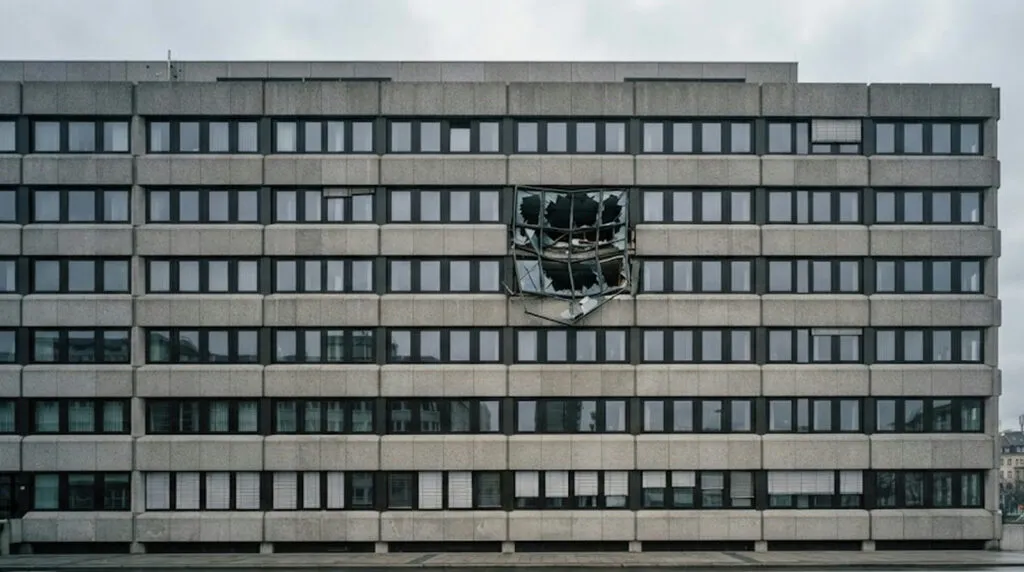
Slovak Foreign and European Affairs Minister Juraj Blanár summoned the Russian ambassador in Bratislava for talks at the ministry. The reason: a Russian drone hit a building belonging to Ukraine's Security Service in Kyiv, and that building stands in the immediate vicinity of the Slovak embassy's consular section.
"We call on Russia to refrain from actions that may endanger the lives and safety of innocent civilians," Blanár said. At the same time he called on both sides in the conflict to avoid further escalation, which raises tensions and does not contribute to a peaceful settlement.
Both sides. That is the diplomatic formulation used when you want to say something but do not want to say it too loudly - and when you know that the drone over your building was not launched by both sides.
An empty office as an argument
Blanár stressed that nobody was in the consular section at the moment of the attack. That part of the embassy is, as he put it, used on a limited basis for security reasons. Which means Slovak diplomacy had already worked out that the building was not a safe place - long before the drone.
Ukrainian President Volodymyr Zelensky said on Friday that the Russian drone had hit the headquarters of Ukraine's Security Service in Kyiv and was aimed "directly at the office" of acting director Oleksandr Poklad.
This is the situation diplomats call collateral proximity and ordinary people call luck. Fifty metres of difference and the Slovak protest would not have been about a damaged facade. Small states with embassies in war zones live on exactly that margin, and usually find out about it after the fact.
Slovakia is not a random player in this story. Its government is among the softest in the EU towards Moscow and the loudest against further military aid to Kyiv. And it is precisely that government which today had to summon the Russian ambassador. That is what happens when foreign policy is made for the domestic audience, and the war does not read the same audience.
Do small states have any instrument at all beyond summoning an ambassador to a ministry? In the Balkans that is not a theoretical question - we have asked it many times, and rarely got an answer that cost more than one statement.
The latest 10 news from this category
Between 2,300 and 3,000 North Korean soldiers have died in Kursk so far. Kim Jong Un has found an export...
A NATO fighter jet downed an unmanned aircraft over Lithuania minutes after midnight, and citizens got the warning on their...
The train was empty, the locomotive damaged, nobody hurt. But Boris Johnson and a group of European security advisers had...
453 drones in one night, 405 shot down - and the forty-eight that got through land somewhere. Poland's prime minister...

Trump's son-in-law told an audience in Kyiv the deal is done - if Ukraine withdraws. And added that the battlefield...

A barren volcanic rock in the middle of a strait 28 kilometres wide changed the oil market in a single...
Hostomel, Odesa, Kryvyi Rih - targets that are not the front line but the supply chain. A war against the...

We don't want war with Europe, but here is exactly how that war would start. He said both sentences in...

When an army recalls its special forces with a 12-hour deadline, that is not a rota but a signal. The...

Port infrastructure in Makhachkala and the theatre building caught fire, the governor said. Moscow claims it shot down 448 drones...
This site uses cookies - is that okay? Learn more
Be the first to know when Metla launches something new
Leave your email and we will write when there is a new guide or something new on Metla.
